



PIN1 Antibody (YA1635)
(Synonyms: DOD; UBL5)Based on 1 Customer Validation
PIN1 Antibody (YA1635) is a Rabbit-derived and non-conjugated IgG monoclonal antibody, targeting to PIN1.
-
Host:
Rabbit
-
Isotype:
IgG
-
Application:
WB, ICC/IF, FC
-
Reactivity :
Human, Mouse, Rat
-
Formulation:
Supplied in 50mM Tris-Glycine(pH 7.4), 0.15M NaCl, 40% Glycerol, 0.01% Sodium azide and 0.05% BSA
-
Conjugation:
Non-conjugated


To place orders, for customer services and technical support, please contact: MedChemExpress USA
Tel: 609-228-6898 E-mail: [email protected] [email protected]





Applications
| Application |
WB

WB: Western Blot
|
ICC/IF
ICC/IF: Immunocytochemistry/
Immunofluorescence |
FC
FC: Flow Cytometry
|
|---|---|---|---|
| Dilution Ratio | 1:500-1:1000 | 1:50-1:200 | 1:20 |


Product Details
PIN1 Antibody (YA1635) is a Rabbit-derived and non-conjugated IgG monoclonal antibody, targeting to PIN1.
-
Host Rabbit

-
Clonality Recombinant,Monoclonal

-
Species ReactivityHuman, Mouse, Rat
-
Observed Molecular WeightObserved band size: 18 kDa
Note: Due to possible protein modifications or aggregation, the molecular weight should be confirmed by actual measurement, and the predicted value is for reference only.

-
Calculated Molecular Weight Predicted band size: 18 kDa

Entrez Gene: 5300 Human ; 23988 Mouse ; 298696 Rat
SwissProt: Q13526 Human ; Q9QUR7 Mouse ;
OMIM: 601052 Human
A synthetic peptide of human Pin1
Endogenous
Affinity Purified
Non-conjugated
Unmodified
IgG


Product Properties
-
Appearance
Solution
-
Formulation
Supplied in 50mM Tris-Glycine(pH 7.4), 0.15M NaCl, 40% Glycerol, 0.01% Sodium azide and 0.05% BSA
-
Concentration
Batch-dependent, Please check the COA for the concentration of each lot. Check Lot Concentration
-
Storage & Stability
Stored at -20°C for 1 year. Avoid repeated freeze / thaw cycles.
-
Shipping
Shipping with blue ice.


Verification Images
-
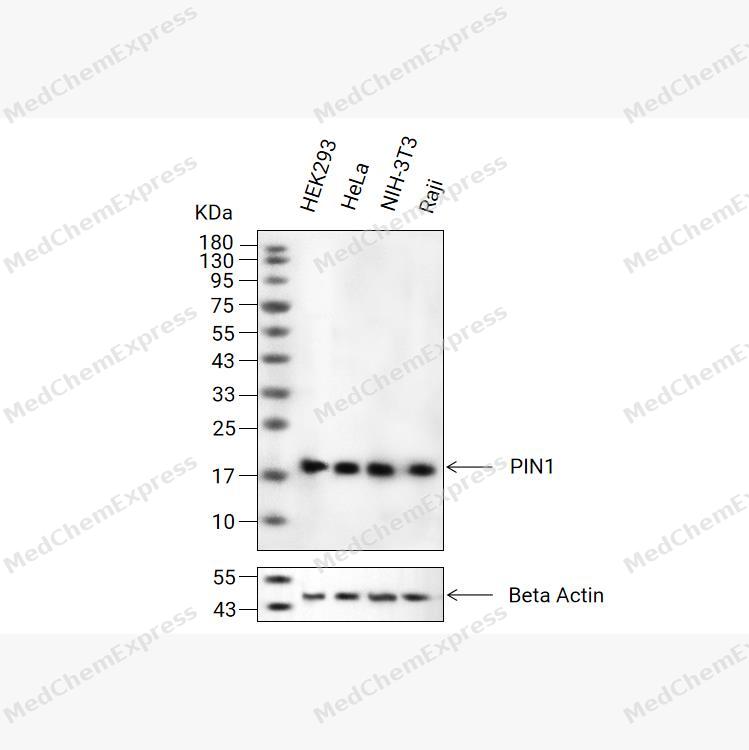 Western blot analysis of extracts from HEK-293(lane 2(20μg)), HeLa(lane 3(20μg)), NIH-3T3(lane 4(20μg)) and Raji(lane 5(20μg)) using PIN1 Antibody(HY-P81890). Proteins were transferred to a PVDF membrane and blocked with 5% non-fat milk in TBST for 2 hour at room temperature. The primary antibody ( 1/1000) and Loading control antibody (Beta Actin, HY-P80993,1/10000) was used in 5% non-fat milk in TBST at 4°C overnight. Goat Anti-Rabbit IgG-HRP Secondary Antibody (HY-P8001,1/10,000) was used for 1 hour at room temperature.
 -
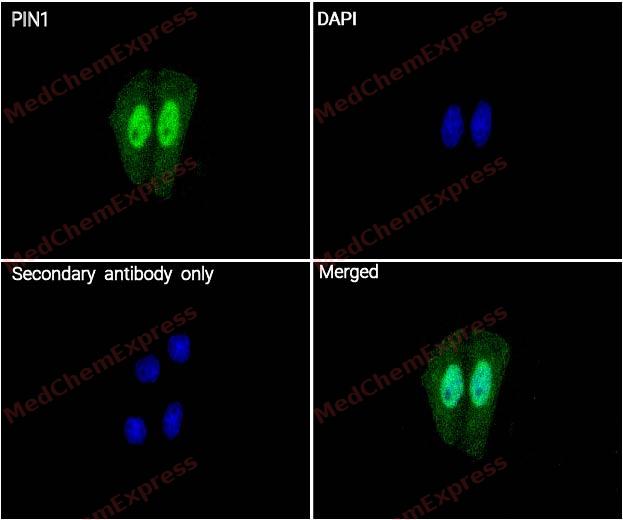 Immunocytochemistry analysis of HeLa cells labeling PIN1 with PIN1 Antibody (HY-P81890) at 1/100 dilution . Cells were fixed in 4% paraformaldehyde for 15 minutes at room temperature, permeabilized with 0.1% Triton X-100 in PBS for 15 minutes at room temperature, then blocked with quick block buffer for 10 minutes at room temperature. Cells were then incubated with PIN1 Antibody (HY-P81890) at 1/100 dilution in quick block buffer overnight at 4 ℃.AF488-conjugated Goat Anti-Rabbit IgG H&L(HY-P8002, Green) was used as the secondary antibody at 1/1,000 dilution. PBS instead of the primary antibody was used as the secondary antibody only control. The Nuclear counterstain was DAPI (Blue).
 -
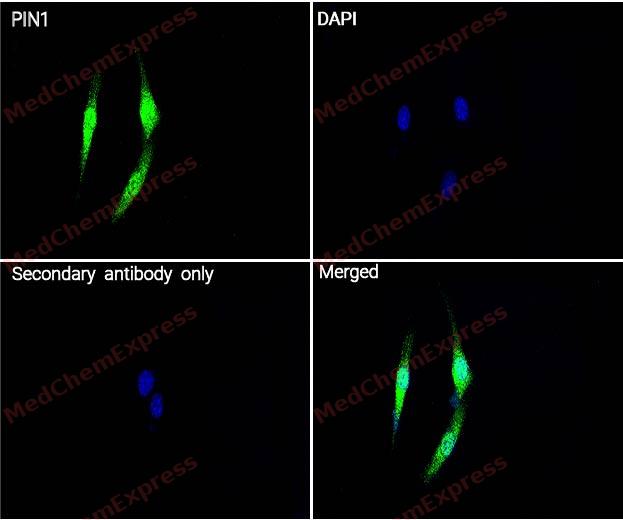 Immunocytochemistry analysis of NIH/3T3 cells labeling PIN1 with PIN1 Antibody (HY-P81890) at 1/100 dilution . Cells were fixed in 4% paraformaldehyde for 15 minutes at room temperature, permeabilized with 0.1% Triton X-100 in PBS for 15 minutes at room temperature, then blocked with quick block buffer for 10 minutes at room temperature. Cells were then incubated with PIN1 Antibody (HY-P81890) at 1/100 dilution in quick block buffer overnight at 4 ℃. AF488-conjugated Goat Anti-Rabbit IgG H&L(HY-P8002, Green) was used as the secondary antibody at 1/1,000 dilution. PBS instead of the primary antibody was used as the secondary antibody only control. The Nuclear counterstain was DAPI (Blue).


Background
-
Function
PIN1 is a peptidyl-prolyl isomerase (PPIase) that specifically recognizes the pSer/Thr-Pro motif, catalyzes the cis and trans isomerization of the proline amide bond, changes the conformation of the substrate protein, thereby affecting its function, stability or intracellular localization. PIN1 regulates cell cycle proteins such as cyclin D, cyclin E, and CDC25, thereby regulating the G1-S process and mitotic progression. PIN1 regulates the stability of proteins such as p53 and p73, responds to stress signals such as DNA damage, and thus affects cell cycle arrest or apoptosis. PIN1 regulates the phosphorylation of tau protein, mediating the neurological functions. PIN1 regulates transcription factors such as NF-κB and JUN, mediates immune responses. PIN1 dysfunction could lead to Alzheimer's disease, cancer, asthma, or microbial infection[1][2].
-
Subcellular Localization
Nucleus; Nucleus speckle; Cytoplasm
-
Expression
Tissue_specificity:Expressed in immune cells in the lung (at protein level) (PubMed:29686383) . The phosphorylated form at Ser-71 is expressed in normal breast tissue cells but not in breast cancer cells -
Subunit
Interacts with STIL (By similarity). Interacts with KIF20B (PubMed:11470801). Interacts with NEK6 (PubMed:16476580). Interacts (via WW domain) with PRKX (PubMed:19367327). Interacts with BTK (PubMed:16644721). Interacts (via PpiC domain) with DAPK1 (PubMed:21497122). Interacts with the phosphorylated form of RAF1 (PubMed:15664191). Interacts (via WW domain) with ATCAY; upon NGF stimulation (PubMed:18628984). Interacts with PML (isoform PML-4) (PubMed:22033920). Interacts with BCL6 (PubMed:17828269). Interacts with FBXW7, disrupting FBXW7 dimerization and promoting FBXW7 autoubiquitination and degradation (PubMed:22608923). Directly interacts with RBBP8/CtIP; this interaction depends upon RBBP8 phosphorylation (PubMed:23623683). Interacts (via WW domain) with IRAK3/IRAK-M (when phosphorylated at 'Ser-110') in response to IL33-mediated (but not TLR4 ligand LPS) dendritic cell stimulation (PubMed:29686383). Interacts with PGK1 (when phosphorylated at 'Ser-203'); the interaction is direct, occurs under hypoxic conditions, and targets PGK1 to the mitochondrion by promoting interactions with the TOM complex (PubMed:26942675)
-
SwissProt ID
-
Synonyms
DOD; UBL5
-
Research Field
Neuroscience


Documentation
-
Data Sheet (260 KB)
-
SDS (251 KB)
- English - EN (251 KB)
- Français - FR (251 KB)
- Deutsch - DE (251 KB)
- Norwegian - NO (251 KB)
- Español - ES (251 KB)
- Swedish - SV (251 KB)
- Italian - IT (251 KB)
- Korean - KR (251 KB)
- Portuguese - PT (251 KB)
-
User Guide for Antibodies (1077 KB)
References

 Powered by Bioz
