



PKD2 Antibody (YA1730)
(Synonyms: PRKD2; PKD2; HSPC187; Serine/threonine-protein kinase D2; nPKC-D2)
Based on 1 Customer Validation
PKD2 Antibody (YA1730) is a Rabbit-derived and non-conjugated IgG monoclonal antibody, targeting to PKD2.
-
Host:
Rabbit
-
Isotype:
IgG
-
Application:
WB, IHC-P, ICC/IF, FC
-
Reactivity :
Human, Mouse
-
Formulation:
Supplied in 50mM Tris-Glycine(pH 7.4), 0.15M NaCl, 40%Glycerol, 0.01% sodium azide and 0.05% BSA.
-
Conjugation:
Non-conjugated


To place orders, for customer services and technical support, please contact: MedChemExpress USA
Tel: 609-228-6898 E-mail: [email protected] [email protected]





Applications
| Application |
WB

WB: Western Blot
|
IHC-P
IHC-P: Immunohistochemistry-Paraffin
|
ICC/IF
ICC/IF: Immunocytochemistry/
Immunofluorescence |
FC
FC: Flow Cytometry
|
|---|---|---|---|---|
| Dilution Ratio | 1:500-1:1000 | 1:50-1:100 | 1:50-1:200 | 1:50-1:100 |


Product Details
PKD2 Antibody (YA1730) is a Rabbit-derived and non-conjugated IgG monoclonal antibody, targeting to PKD2.
-
Host Rabbit

-
Clonality Recombinant,Monoclonal

-
Species ReactivityHuman, Mouse
-
Observed Molecular WeightObserved band size: 105 kDa
Note: Due to possible protein modifications or aggregation, the molecular weight should be confirmed by actual measurement, and the predicted value is for reference only.

-
Calculated Molecular Weight Predicted band size: 97 kDa

Entrez Gene: 25865 Human ; 101540 Mouse ; 292658 Rat
SwissProt: Q9BZL6 Human ; Q8BZ03 Mouse ; Q5XIS9 Rat
OMIM: 607074 Human
A synthesized peptide derived from human Protein Kinase D2 aa201-286.
Endogenous
Affinity Chromatography
Non-conjugated
Unmodified
IgG


Product Properties
-
Appearance
Solution
-
Formulation
Supplied in 50mM Tris-Glycine(pH 7.4), 0.15M NaCl, 40%Glycerol, 0.01% sodium azide and 0.05% BSA.
-
Concentration
Batch-dependent, Please check the COA for the concentration of each lot. Check Lot Concentration
-
Storage & Stability
Stored at -20°C for 1 year. Avoid repeated freeze / thaw cycles.
-
Shipping
Shipping with blue ice.


Verification Images
-
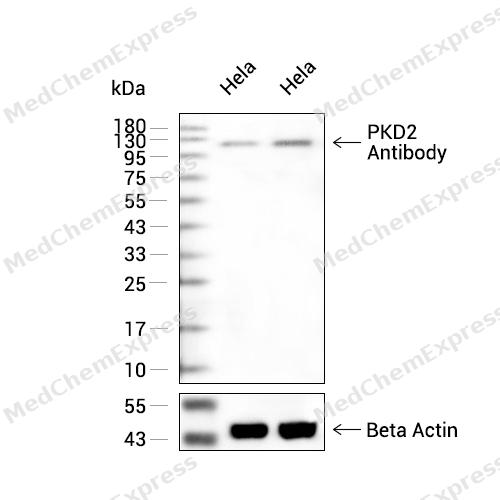 Western blot analysis of extracts from Hela(lane 2(20ug) and Hela(lane 3(40ug) using PKD2 Antibody (HY-P81985) Rabbit mAb. Proteins were transferred to a PVDF membrane and blocked with 5% non-fat milk in TBST for 2 hour at room temperature. The primary antibody (1/1000) and Loading control antibody (Beta Actin, HY-P80438, 1/10000) was used in 5% non-fat milk in TBST at 4°C overnight. Goat Anti-Mouse/Rabbit IgG-HRP Secondary Antibody (1/10000) was used for 1 hour at room temperature.
 -
 Immunohistochemical analysis of paraffin-embedded human endometrium tissue using PKD2 Antibody (HY-P81985, 1/100). The section was pretreated using heat mediated antigen retrieval with sodium citrate buffer (pH 6.0) for 8 minutes. The tissues were blocked with quick block buffer for 0.5 hours at room temperature, washed with PBS and PBST, and then incubated with the primary antibody overnight at 4℃. The detection was performed using an HRP conjugated compact polymer system. DAB was used as the chromogen. Tissues were counterstained with hematoxylin and mounted with DPX.
 -
 Immunohistochemical analysis of paraffin-embedded human tonsil tissue using PKD2 Antibody (HY-P81985, 1/100). The section was pretreated using heat mediated antigen retrieval with sodium citrate buffer (pH 6.0) for 8 minutes. The tissues were blocked with quick block buffer for 0.5 hours at room temperature, washed with PBS and PBST, and then incubated with the primary antibody overnight at 4℃. The detection was performed using an HRP conjugated compact polymer system. DAB was used as the chromogen. Tissues were counterstained with hematoxylin and mounted with DPX.
 -
 Immunohistochemical analysis of paraffin-embedded human small intestine tissue using PKD2 Antibody (HY-P81985, 1/100). The section was pretreated using heat mediated antigen retrieval with sodium citrate buffer (pH 6.0) for 8 minutes. The tissues were blocked with quick block buffer for 0.5 hours at room temperature, washed with PBS and PBST, and then incubated with the primary antibody overnight at 4℃. The detection was performed using an HRP conjugated compact polymer system. DAB was used as the chromogen. Tissues were counterstained with hematoxylin and mounted with DPX.
 -
 Immunohistochemical analysis of paraffin-embedded human heart tissue using PKD2 Antibody (HY-P81985, 1/100). The section was pretreated using heat mediated antigen retrieval with sodium citrate buffer (pH 6.0) for 8 minutes. The tissues were blocked with quick block buffer for 0.5 hours at room temperature, washed with PBS and PBST, and then incubated with the primary antibody overnight at 4℃. The detection was performed using an HRP conjugated compact polymer system. DAB was used as the chromogen. Tissues were counterstained with hematoxylin and mounted with DPX.
 -
 Immunohistochemical analysis of paraffin-embedded human pancreas tissue using PKD2 Antibody (HY-P81985, 1/100). The section was pretreated using heat mediated antigen retrieval with sodium citrate buffer (pH 6.0) for 8 minutes. The tissues were blocked with quick block buffer for 0.5 hours at room temperature, washed with PBS and PBST, and then incubated with the primary antibody overnight at 4℃. The detection was performed using an HRP conjugated compact polymer system. DAB was used as the chromogen. Tissues were counterstained with hematoxylin and mounted with DPX.
 -
 Immunohistochemical analysis of paraffin-embedded human liver tissue using PKD2 Antibody (HY-P81985, 1/100). The section was pretreated using heat mediated antigen retrieval with sodium citrate buffer (pH 6.0) for 8 minutes. The tissues were blocked with quick block buffer for 0.5 hours at room temperature, washed with PBS and PBST, and then incubated with the primary antibody overnight at 4℃. The detection was performed using an HRP conjugated compact polymer system. DAB was used as the chromogen. Tissues were counterstained with hematoxylin and mounted with DPX.
 -
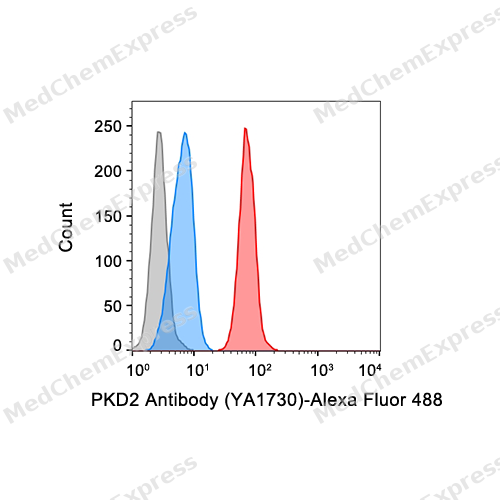 Flow cytometric analysis of 1X10^6 SH-SY5Y cells labeling PKD2 Antibody (YA1730) (HY-P81985, red). Cells were fixed with 4% paraformaldehyde and permeabilised with 90% methanol. Then stained with the primary antibody at 1/50 dilution for an hour at 4℃. Alexa Fluor® 488-conjugated AffiniPure Goat Anti-Rabbit IgG H&L (HY-P8002) was used as the secondary antibody at 1/1,000 dilution for 30 minutes at 4℃. Rabbit IgG Isotype Control (HY-P80879, blue) was used as the isotype control, cells without incubation with primary antibody were used as the unlabeled control (black).
 -
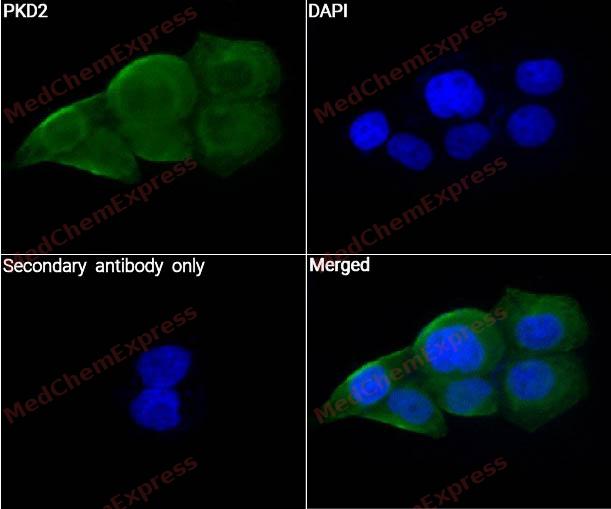 Immunocytochemistry analysis of HELA cells labeling alpha PKD2 with PKD2 Antibody (HY-P81985) at 1/50 dilution. Cells were fixed in 4% paraformaldehyde for 15 minutes at room temperature, permeabilized with 0.1% Triton X-100 for 10 minutes at room temperature, then blocked with QuickBlock™ Blocking Buffer for Immunol Staining for 10 min at room temperature. Cells were then incubated with PKD2Antibody (HY-P81985) at 1/50dilution in QuickBlock™ Blocking Buffer for Immunol Staining at 4 ℃. Alexa Fluor® 488-conjugated AffiniPure Goat Anti-Rabbit IgG H&L(HY-P8002, Green) was used as the secondary antibody at 1/1,000 dilution. PBS instead of the primary antibody was used as the secondary antibody only control. The Nuclear counterstain was DAPI (Blue).
 -
 Immunocytochemistry analysis of HELA cells labelingalpha PKD2 with alpha PKD2 Antibody (HY-P81985) at 1/100 dilution. Cells were fixed in 4% paraformaldehyde for 15 minutes at room temperature, permeabilized with 0.1% Triton X-100 for 10 minutes at room temperature, then blocked with QuickBlock™ Blocking Buffer for Immunol Staining for 10 min at room temperature. Cells were then incubated with PKD2 Antibody (HY-P81985) at 1/100 dilution in QuickBlock™ Blocking Buffer for Immunol Staining at 4 ℃. Alexa Fluor® 488-conjugated AffiniPure Goat Anti-Rabbit IgG H&L(HY-P8002, Green) was used as the secondary antibody at 1/1,000 dilution. PBS instead of the primary antibody was used as the secondary antibody only control. The Nuclear counterstain was DAPI (Blue).


Background
-
Function
PKD2 encodes polycystin-2/TRPP2, a six-transmembrane, non-selective cation channel that localizes to the primary cilium, plasma membrane, and endoplasmic reticulum[1][2]. Mechanistically, PKD2 supports ciliary ion-channel activity in renal collecting duct epithelium, where the native channel conducts K+ and Na+ and is sensitized by high intraciliary Ca2+[1]. Through interaction with PKD1, PKD2 contributes to a receptor-ion-channel complex that links extracellular cues to Ca2+-dependent signaling, including WNT/Ca2+ responses[3]. In disease models, loss of PKD2 or exclusion of channel-functional polycystin-2 from cilia promotes renal cystogenesis, supporting a cilia-centered mechanism in autosomal dominant polycystic kidney disease[1][4]. Compared with PKD1, PKD2 provides the required ciliary channel subunit, while PKD1 can confer distinct channel properties within the PKD1-PKD2 complex[1][5]. Compared with PKD2L1, PKD2 shows different ciliary ion selectivity, because PKD2L1-containing channels preferentially conduct Ca2+[1][6]. For experimental applications, direct ciliary electrophysiology and heterologous ciliary expression provide practical systems for evaluating PKD2 variants and channel behavior[1]. Pharmacological work should distinguish PKD2 from associated subunits, because pregnenolone sulfate and isosakuranetin modulate a TRPM3-dependent TRPP2 ciliary channel rather than proving PKD2-specific agonism or inhibition[7].
-
Subcellular Localization
Cytoplasm; Cell membrane; Nucleus; Golgi apparatus, trans-Golgi network
-
Expression
Tissue_specificity:Broad expression -
Isoforms & Post-Translational Modification
Q9BZL6 has 3 isomers: Q9BZL6-1: 96722 Da (predicted); Q9BZL6-2: 80115 Da (predicted); Q9BZL6-3: 97743 Da (predicted).
Phosphorylation of Ser-876 correlates with the activation status of the kinase (PubMed:11062248). Ser-706 or/and Ser-710 are probably phosphorylated by PKC (PubMed:12058027, PubMed:28428613). Phosphorylation at Ser-244 by CSNK1D and CSNK1E promotes nuclear localization and substrate targeting (PubMed:17962809). Phosphorylation at Ser-244, Ser-706 and Ser-710 is required for nuclear localization (PubMed:17962809). Phosphorylated at Tyr-438 by ABL1 in response to oxidative stress (PubMed:15604256). Phosphorylated at Tyr-717 by ABL1 specifically in response to oxidative stress; requires prior phosphorylation at Ser-706 or/and Ser-710 (PubMed:28428613) -
Subunit
Interacts (via C-terminus) with LCK (PubMed:19192391). Interacts (via N-terminal AP-rich region) with CIB1 isoform 2 (PubMed:23503467). Interacts (via N-terminus and zing-finger domain 1 and 2) with PRKCD in response to oxidative stress; the interaction is independent of PRKD2 tyrosine phosphorylation (PubMed:28428613)
-
SwissProt ID
-
Synonyms
PRKD2; PKD2; HSPC187; Serine/threonine-protein kinase D2; nPKC-D2
-
Research Field
Signal Transduction


Documentation
-
Data Sheet (262 KB)
-
SDS (251 KB)
- English - EN (251 KB)
- Français - FR (251 KB)
- Deutsch - DE (251 KB)
- Norwegian - NO (251 KB)
- Español - ES (251 KB)
- Swedish - SV (251 KB)
- Italian - IT (251 KB)
- Korean - KR (251 KB)
- Portuguese - PT (251 KB)
-
User Guide for Antibodies (1077 KB)
References
[1]. Liu X, et al. Polycystin-2 is an essential ion channel subunit in the primary cilium of the renal collecting duct epithelium. Elife. 2018 Feb 14;7:e33183. [Content Brief]
[2]. Hardy E, et al. Polycystins as components of large multiprotein complexes of polycystin interactors. Cell Signal. 2020 Aug;72:109640. [Content Brief]
[3]. Kim S, et al. The polycystin complex mediates Wnt/Ca(2+) signalling. Nat Cell Biol. 2016 Jul;18(7):752-764. [Content Brief]
[4]. Walker RV, et al. Ciliary exclusion of Polycystin-2 promotes kidney cystogenesis in an autosomal dominant polycystic kidney disease model. Nat Commun. 2019 Sep 6;10(1):4072. [Content Brief]
[5]. Wang Z, et al. The ion channel function of polycystin-1 in the polycystin-1/polycystin-2 complex. EMBO Rep. 2019 Nov 5;20(11):e48336. [Content Brief]
[6]. DeCaen PG, et al. Direct recording and molecular identification of the calcium channel of primary cilia. Nature. 2013 Dec 12;504(7479):315-8. [Content Brief]
[7]. Kleene SJ, et al. The TRPP2-dependent channel of renal primary cilia also requires TRPM3. PLoS One. 2019 Mar 18;14(3):e0214053. [Content Brief]

 Powered by Bioz
