



PP2A alpha + beta Antibody (YA123)
(Synonyms: Serine/threonine-protein phosphatase 2A catalytic subunit beta isoform, PP2A-beta, PPP2CB)Based on 1 publication(s) in Google Scholar
PP2A alpha + beta Antibody (YA123) is a Rabbit-derived and non-conjugated IgG monoclonal antibody, targeting to PP2A alpha + beta.
-
Host:
Rabbit
-
Isotype:
IgG
-
Application:
WB, ICC/IF, IHC-P, IP
-
Reactivity :
Human, Mouse, Rat
-
Formulation:
Supplied in 1*TBS (pH7.4), 0.05% BSA and 40% Glycerol. Preservative: 0.05% Sodium Azide.
-
Conjugation:
Non-conjugated


To place orders, for customer services and technical support, please contact: MedChemExpress USA
Tel: 609-228-6898 E-mail: [email protected] [email protected]



Publications Citing Use of MedChemExpress (MCE) PP2A alpha + beta Antibody (YA123)
More

Applications
| Application |
WB

WB: Western Blot
|
ICC/IF
ICC/IF: Immunocytochemistry/
Immunofluorescence |
IHC-P
IHC-P: Immunohistochemistry-Paraffin
|
IP
IP: Immunoprecipitation
|
|---|---|---|---|---|
| Dilution Ratio | 1:1000-1:2000 | 1:50-1:200 | 1:100-1:200 | Use at an assay dependent concentration. |


Product Details
PP2A alpha + beta Antibody (YA123) is a Rabbit-derived and non-conjugated IgG monoclonal antibody, targeting to PP2A alpha + beta.
-
Host Rabbit

-
Clonality Recombinant,Monoclonal

-
Species ReactivityHuman, Mouse, Rat
-
Observed Molecular WeightObserved band size: 36 kDa
Note: Due to possible protein modifications or aggregation, the molecular weight should be confirmed by actual measurement, and the predicted value is for reference only.

-
Calculated Molecular Weight Predicted band size: 36 kDa

Entrez Gene: 5515 Human ; 5516 Human ; 19052 Mouse ; 19053 Mouse ; 24672 Rat 24673
SwissProt: P62714 Human ; P67775 Human ; P62715 Mouse ; P63330 Mouse ; P62716 Rat P63331
OMIM: 176916 Human
Synthetic peptide corresponding to Human PP2A alpha.AA range:260-309.
Endogenous
Protein A affinity purified.
Non-conjugated
Unmodified
IgG


Product Properties
-
Appearance
Solution
-
Formulation
Supplied in 1*TBS (pH7.4), 0.05% BSA and 40% Glycerol. Preservative: 0.05% Sodium Azide.
-
Concentration
Batch-dependent, Please check the COA for the concentration of each lot. Check Lot Concentration
-
Storage & Stability
Stored at -20°C for 1 year. Avoid repeated freeze / thaw cycles.
-
Shipping
Shipping with blue ice.


Publications (1)
-
Journal Impact Factor
-
Most Recent


Verification Images
-
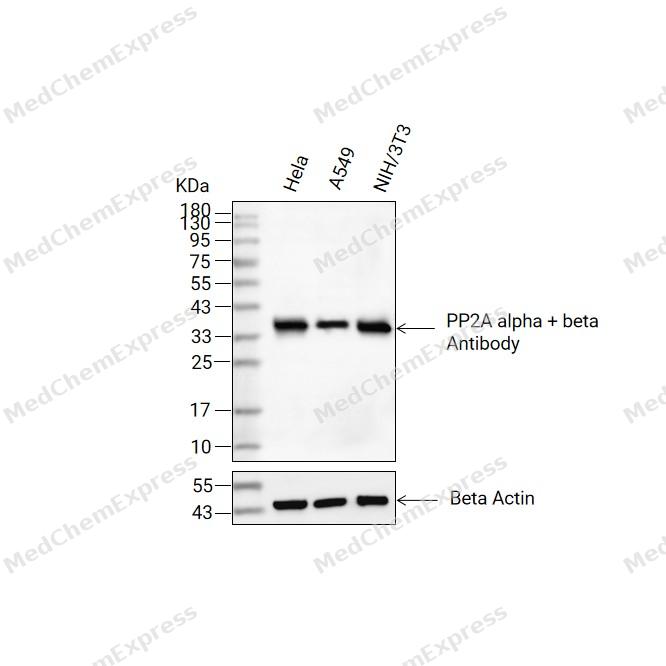 Western blot analysis of extracts from Hela(lane 2(20ug) , A549(lane 3(20ug) and NIH/3T3(lane 4(20ug) using PP2A alpha + beta Antibody (HY-P80284) Rabbit mAb. Proteins were transferred to a PVDF membrane and blocked with 5% non-fat milk in TBST for 2 hour at room temperature. The primary antibody (1/1000) and Loading control antibody (Beta Actin, HY-P83730, 1/10000) was used in 5% non-fat milk in TBST at 4°C overnight. Goat Anti-Mouse/Rabbit IgG-HRP Secondary Antibody (1/10000) was used for 1 hour at room temperature.
 -
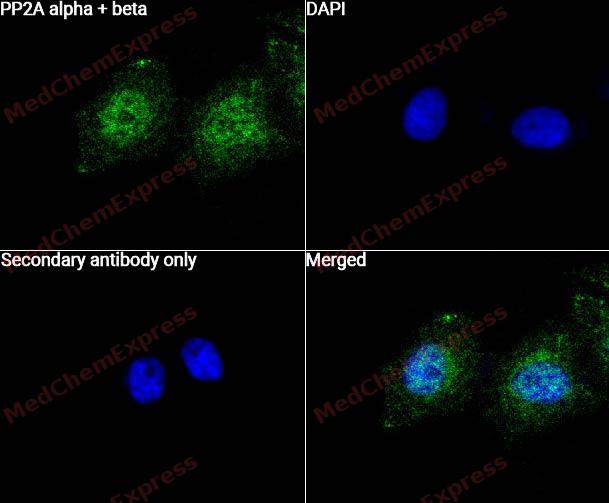 Immunocytochemistry analysis of Hela cells labeling PP2A alpha + beta with PP2A alpha + beta Antibody (HY-P80284) at 1/50 dilution. Cells were fixed in 4% paraformaldehyde for 15 minutes at room temperature, permeabilized with 0.1% Triton X-100 for 10 minutes at room temperature, then blocked with QuickBlock™ Blocking Buffer for Immunol Staining for 10 min at room temperature. Cells were then incubated with PP2A alpha + beta Antibody (HY-P80284) at 1/50 dilution in QuickBlock™ Blocking Buffer for Immunol Staining at 4 ℃. Alexa Fluor® 488-conjugated AffiniPure Goat Anti-Rabbit IgG H&L(HY-P8002, Green) was used as the secondary antibody at 1/1,000 dilution. PBS instead of the primary antibody was used as the secondary antibody only control. The Nuclear counterstain was DAPI (Blue).
 -
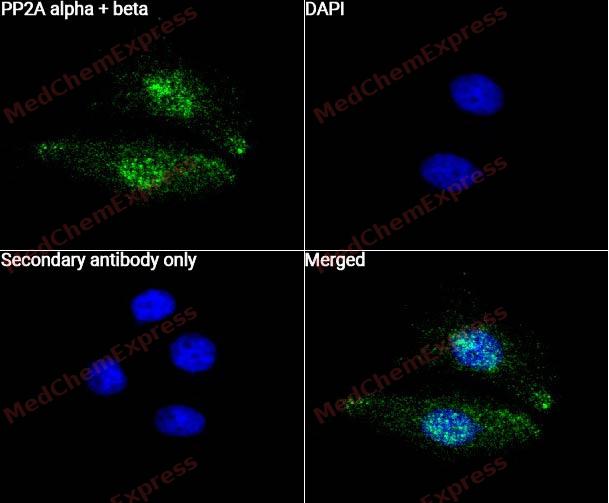 Immunocytochemistry analysis of A431 cells labeling PP2A alpha + beta with PP2A alpha + beta Antibody (HY-P80284) at 1/50 dilution. Cells were fixed in 4% paraformaldehyde for 15 minutes at room temperature, permeabilized with 0.1% Triton X-100 for 10 minutes at room temperature, then blocked with QuickBlock™ Blocking Buffer for Immunol Staining for 10 min at room temperature. Cells were then incubated with PP2A alpha + beta Antibody (HY-P80284) at 1/50 dilution in QuickBlock™ Blocking Buffer for Immunol Staining at 4 ℃. Alexa Fluor® 488-conjugated AffiniPure Goat Anti-Rabbit IgG H&L(HY-P8002, Green) was used as the secondary antibody at 1/1,000 dilution. PBS instead of the primary antibody was used as the secondary antibody only control. The Nuclear counterstain was DAPI (Blue).
 -
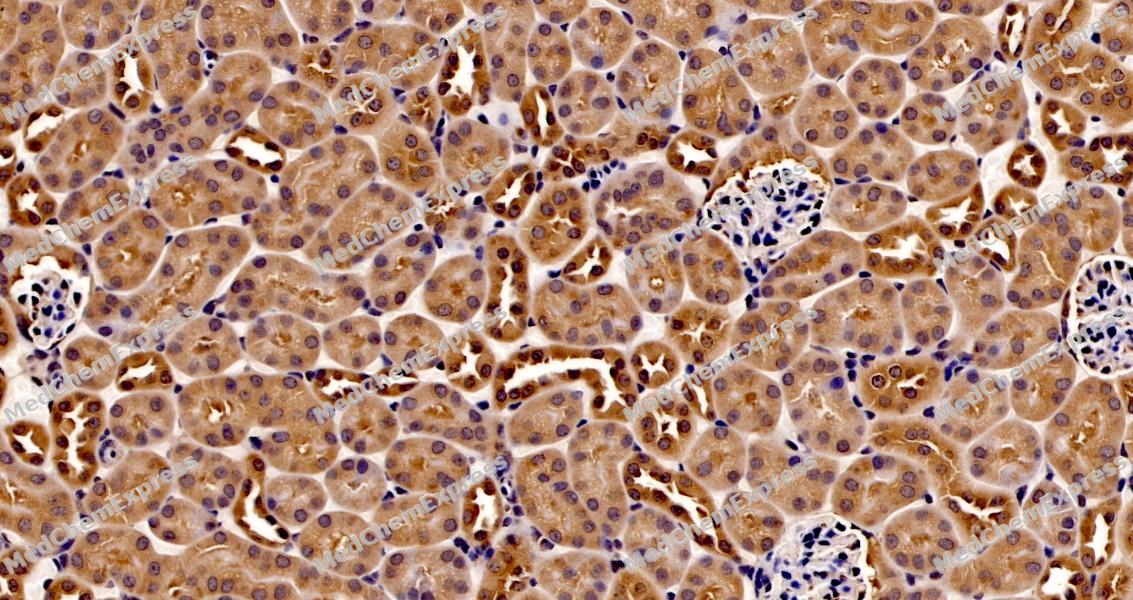 Immunohistochemical analysis of paraffin-embedded mouse kidney tissue using PP2A alpha + beta Antibody. The section was pre-treated using heat mediated antigen retrieval with sodium citrate buffer (pH 6.0) for 8 minutes. The tissues were blocked in QuickBlock for 20 minutes at room temperature, washed with ddH2O and PBS, and then probed with the primary antibody at 1/100 dilution in 4℃ overnight. The detection was performed using an HRP conjugated compact polymer system. DAB was used as the chromogen. Tissues were counterstained with hematoxylin and mounted with DPX.
 -
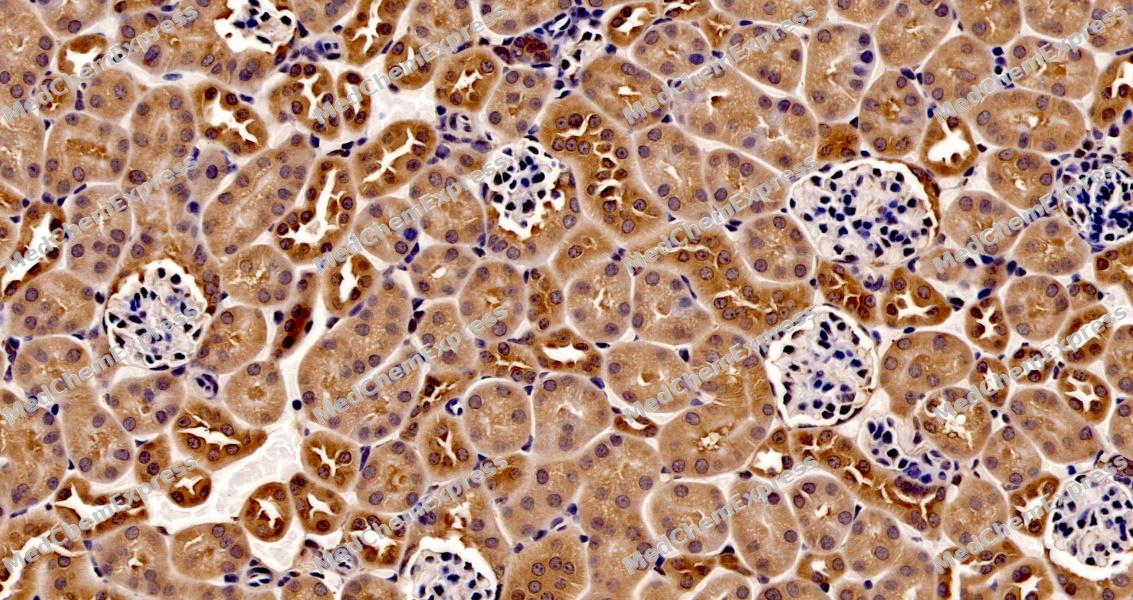 Immunohistochemical analysis of paraffin-embedded mouse kidney tissue using PP2A alpha + beta Antibody. The section was pre-treated using heat mediated antigen retrieval with sodium citrate buffer (pH 6.0) for 8 minutes. The tissues were blocked in QuickBlock for 20 minutes at room temperature, washed with ddH2O and PBS, and then probed with the primary antibody at 1/100 dilution in 4℃ overnight. The detection was performed using an HRP conjugated compact polymer system. DAB was used as the chromogen. Tissues were counterstained with hematoxylin and mounted with DPX.


Background
-
Function
PP2A alpha + beta is a Catalytic subunit of protein phosphatase 2A (PP2A), a serine/threonine phosphatase involved in the regulation of a wide variety of enzymes, signal transduction pathways, and cellular events (Probable). PP2A can modulate the activity of phosphorylase B kinase, casein kinase 2, mitogen-stimulated S6 kinase, and MAP-2 kinase. Part of the striatin-interacting phosphatase and kinase (STRIPAK) complexes. STRIPAK complexes have critical roles in protein (de)phosphorylation and are regulators of multiple signaling pathways including Hippo, MAPK, nuclear receptor and cytoskeleton remodeling. Different types of STRIPAK complexes are involved in a variety of biological processes such as cell growth, differentiation, apoptosis, metabolism and immune regulation[1].
-
Subcellular Localization
Cytoplasm; Nucleus; Chromosome, centromere; Cytoplasm, cytoskeleton, spindle pole
-
Subunit
PP2A consists of a common heterodimeric core enzyme (composed of a 36 kDa catalytic subunit (subunit C) and a 65 kDa constant regulatory subunit (PR65) (subunit A)) that associates with a variety of regulatory subunits. Proteins that associate with the core dimer include three families of regulatory subunits B (the R2/B/PR55/B55, R3/B''/PR72/PR130/PR59 and R5/B'/B56 families), the 48 kDa variable regulatory subunit, viral proteins, and cell signaling molecules. Binds PPME1. May indirectly interact with SGO1, most probably through regulatory B56 subunits. Interacts with CTTNBP2NL. Interacts with PTPA (PubMed:12952889). Found in a complex with at least ARL2, PPP2CB, PPP2R1A, PPP2R2A, PPP2R5E and TBCD. Interacts with TBCD (By similarity). Part of the core of STRIPAK complexes composed of PP2A catalytic and scaffolding subunits, the striatins (PP2A regulatory subunits), the striatin-associated proteins MOB4, STRIP1 and STRIP2, PDCD10 and members of the STE20 kinases, such as STK24 and STK26 (PubMed:18782753)
-
SwissProt ID
-
Synonyms
Serine/threonine-protein phosphatase 2A catalytic subunit beta isoform, PP2A-beta, PPP2CB
-
Research Field
Cell Biology
Documentation
-
Data Sheet (260 KB)
-
SDS (252 KB)
- English - EN (252 KB)
- Français - FR (252 KB)
- Deutsch - DE (252 KB)
- Norwegian - NO (252 KB)
- Español - ES (252 KB)
- Swedish - SV (252 KB)
- Italian - IT (252 KB)
- Korean - KR (252 KB)
- Portuguese - PT (252 KB)
-
User Guide for Antibodies (1077 KB)
References

 Powered by Bioz
