



Rad21 Antibody (YA3546)
(Synonyms: HR21; MCD1; NXP1; SCC1; CDLS4; hHR21; HRAD21)
Based on 1 Customer Validation
Rad21 Antibody (YA3546) is a Mouse-derived and non-conjugated IgG1 monoclonal antibody, targeting to Rad21.
-
Host:
Mouse
-
Isotype:
IgG1
-
Application:
WB, IHC-P, ICC/IF, FC, ELISA
-
Reactivity :
Human, Rat, Monkey
-
Formulation:
Supplied in PBS with 0.05% sodium azide
-
Conjugation:
Non-conjugated


To place orders, for customer services and technical support, please contact: MedChemExpress USA
Tel: 609-228-6898 E-mail: [email protected] [email protected]





Applications
| Application |
WB

WB: Western Blot
|
IHC-P
IHC-P: Immunohistochemistry-Paraffin
|
ICC/IF
ICC/IF: Immunocytochemistry/
Immunofluorescence |
FC
FC: Flow Cytometry
|
ELISA
ELISA: Enzyme Linked Immunosorbent Assay
|
|---|---|---|---|---|---|
| Dilution Ratio | 1:500-1:2000 | 1:200-1:1000 | 1:200-1:1000 | 1:200-1:400 | 1:10000 |


Product Details
Rad21 Antibody (YA3546) is a Mouse-derived and non-conjugated IgG1 monoclonal antibody, targeting to Rad21.
-
Host Mouse

-
Clonality Monoclonal

-
Species ReactivityHuman, Rat, Monkey
-
Observed Molecular WeightObserved band size: 72/128 kDa
Note: Due to possible protein modifications or aggregation, the molecular weight should be confirmed by actual measurement, and the predicted value is for reference only.

-
Calculated Molecular Weight Predicted band size: 72 kDa

Purified recombinant fragment of human RAD21 (AA: 287-403) expressed in E. Coli.
affinity purified.
Non-conjugated
Unmodified
IgG1


Product Properties
-
Appearance
Solution
-
Formulation
Supplied in PBS with 0.05% sodium azide
-
Concentration
Batch-dependent, Please check the COA for the concentration of each lot. Check Lot Concentration
-
Storage & Stability
Stored at -20°C for 1 year. Avoid repeated freeze / thaw cycles.
-
Shipping
Shipping with blue ice.


Verification Images
-
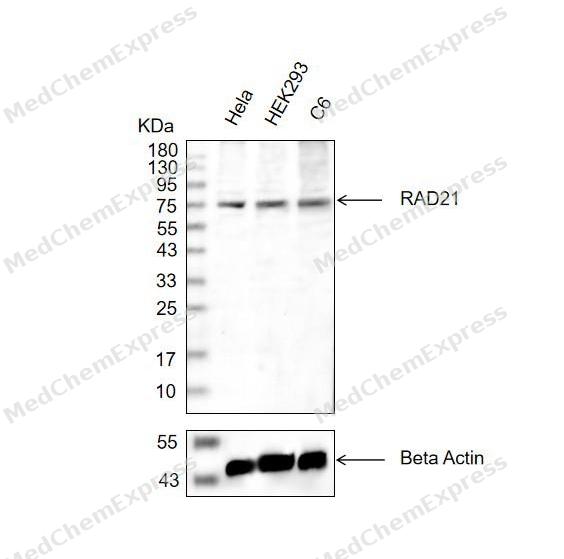 Western blot analysis of extracts from Hela(lane2(20μg) ,HEK293(lane 3(20μg) and C6(lane 4(20ug) using RAD21(HY-P83849) Mouse mAb. Proteins were transferred to a PVDF membrane and blocked with 5% non-fat milk in TBST for 2 hour at room temperature. The primary antibody (1/1000) and Loading control antibody (Beta Actin, HY-P80438, 1/10000) was used in 5% non-fat milk in TBST at 4°C overnight. Goat Anti-Mouse IgG-HRP Secondary Antibody (1/10000) was used for 1 hour at room temperature.
 -
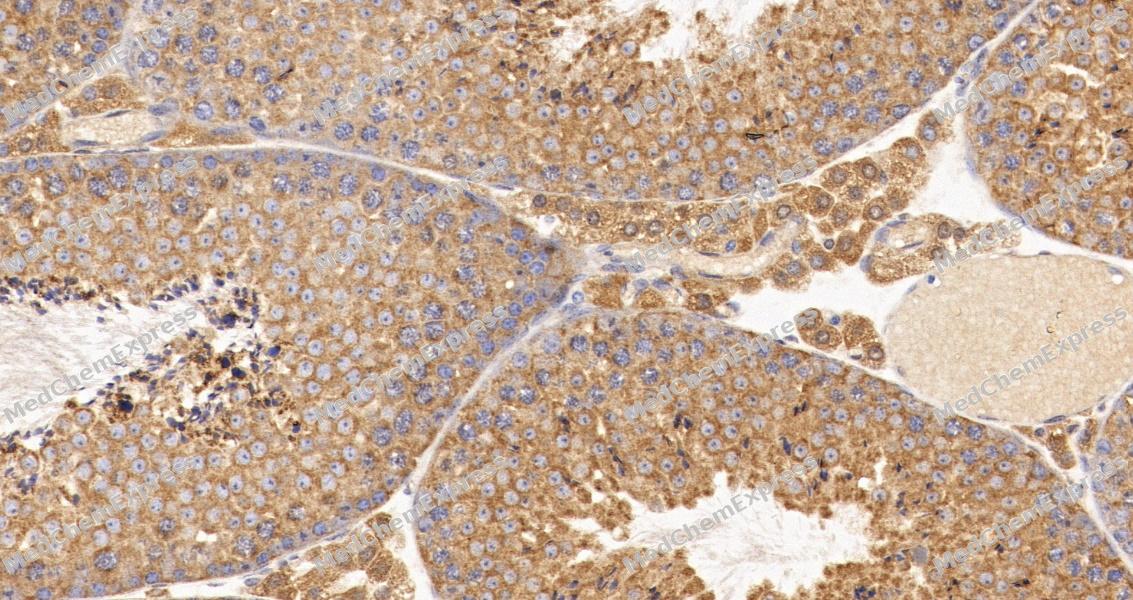 Immunohistochemical analysis of paraffin-embedded mouse testis tissue using RAD21 Antibody. The section was pre-treated using heat mediated antigen retrieval with sodium citrate buffer (pH 6.0) for 2 minutes. The tissues were blocked in QuickBlock for 20 minutes at room temperature, washed with ddH2O and PBS, and then probed with the primary antibody at 1/100 dilution in 4℃ overnight. The detection was performed using an HRP conjugated compact polymer system. DAB was used as the chromogen. Tissues were counterstained with hematoxylin and mounted with DPX.
 -
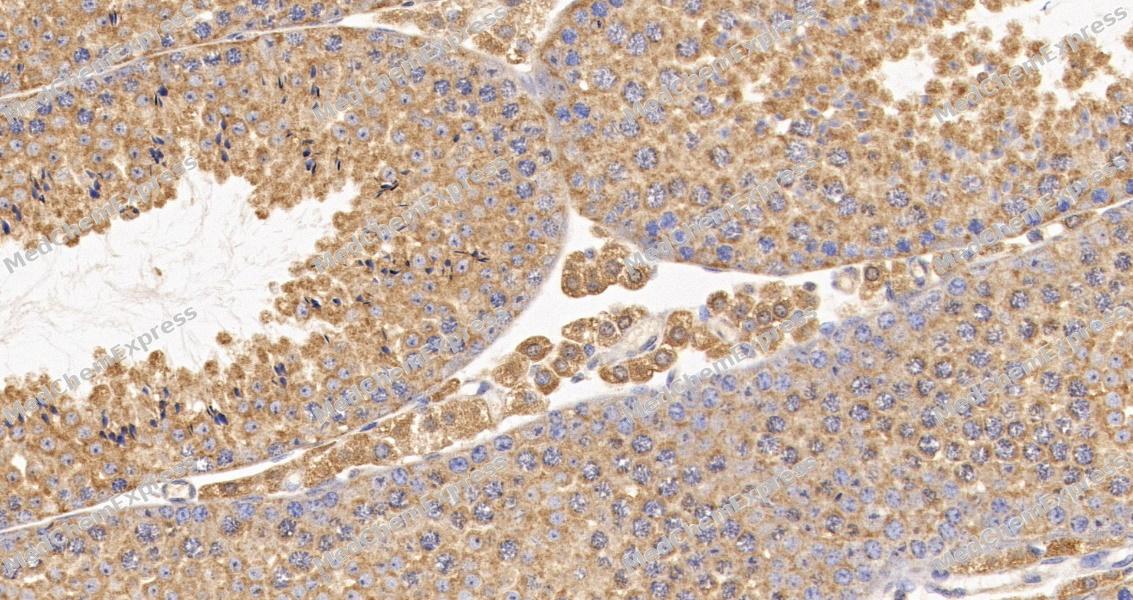 Immunohistochemical analysis of paraffin-embedded mouse testis tissue using RAD21 Antibody. The section was pre-treated using heat mediated antigen retrieval with sodium citrate buffer (pH 6.0) for 2 minutes. The tissues were blocked in QuickBlock for 20 minutes at room temperature, washed with ddH2O and PBS, and then probed with the primary antibody at 1/100 dilution in 4℃ overnight. The detection was performed using an HRP conjugated compact polymer system. DAB was used as the chromogen. Tissues were counterstained with hematoxylin and mounted with DPX.
 -
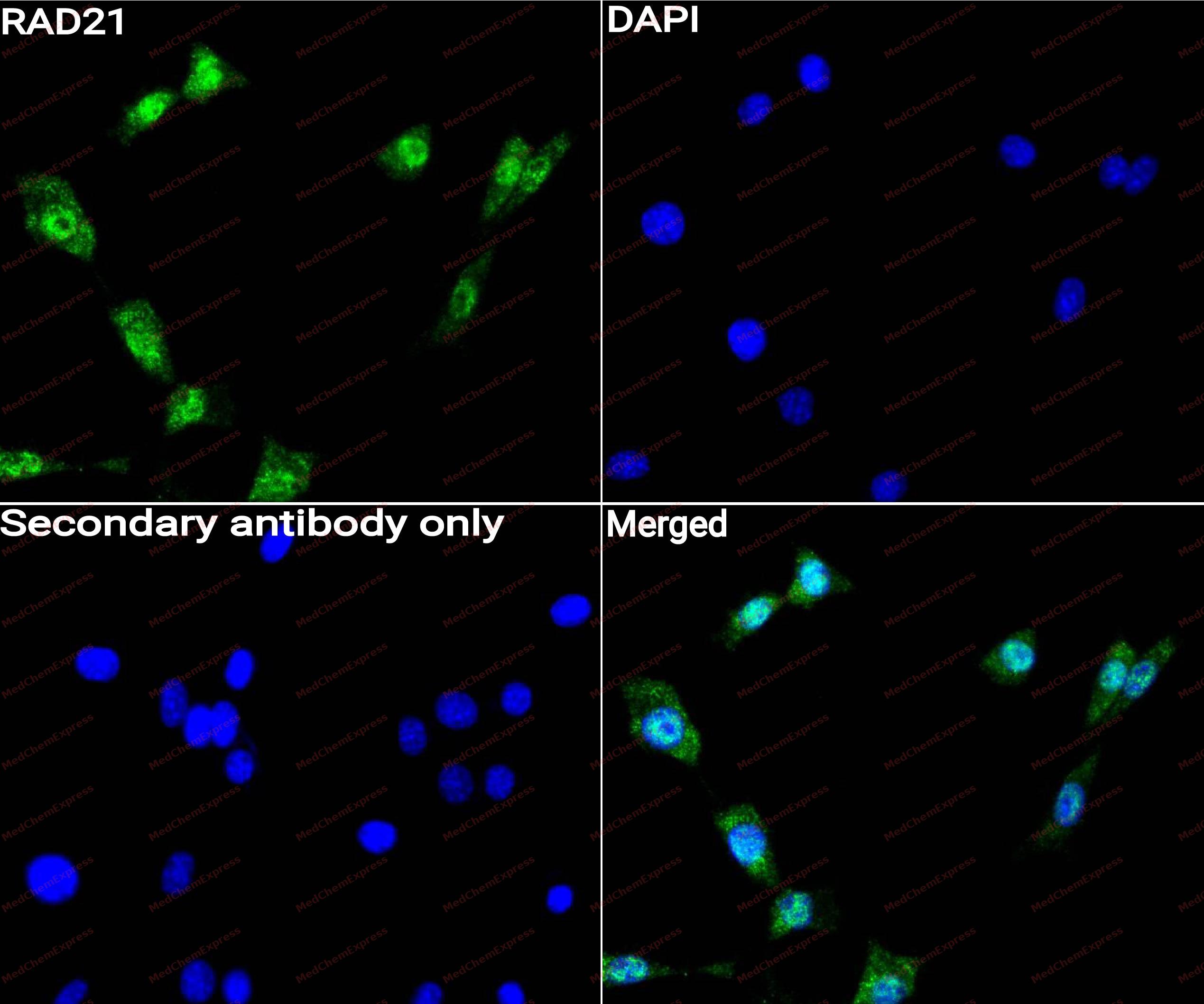 Immunocytochemistry analysis of Hela cells labeling RAD21 with RAD21 Antibody (HY-P83849) at 1/50 dilution. Cells were fixed in 4% paraformaldehyde for 15 minutes at room temperature, permeabilized with 0.1% Triton X-100 for 10 minutes at room temperature, then blocked with QuickBlock™ Blocking Buffer for Immunol Staining for 10 min at room temperature. Cells were then incubated with RAD21 Antibody (HY-P83849) at 1/50 dilution in QuickBlock™ Blocking Buffer for Immunol Staining at 4 ℃. Alexa Fluor® 488-conjugated AffiniPure Goat Anti-Mouse IgG H&L(HY-P8005, Green) was used as the secondary antibody at 1/1,000 dilution. PBS instead of the primary antibody was used as the secondary antibody only control. The Nuclear counterstain was DAPI (Blue).
 -
 Immunocytochemistry analysis of Hela cells labeling RAD21 with RAD21 Antibody (HY-P83849) at 1/100 dilution. Cells were fixed in 4% paraformaldehyde for 15 minutes at room temperature, permeabilized with 0.1% Triton X-100 for 10 minutes at room temperature, then blocked with QuickBlock™ Blocking Buffer for Immunol Staining for 10 min at room temperature. Cells were then incubated with RAD21 Antibody (HY-P83849)at 1/100 dilution in QuickBlock™ Blocking Buffer for Immunol Staining at 4 ℃. Alexa Fluor® 488-conjugated AffiniPure Goat Anti-Mouse IgG H&L(HY-P8005,Green) was used as the secondary antibody at 1/1,000 dilution. PBS instead of the primary antibody was used as the secondary antibody only control. The Nuclear counterstain was DAPI (Blue).


Background
-
Function
Rad21 is an As a member of the cohesin complex, involved in sister chromatid cohesion from the time of DNA replication in S phase to their segregation in mitosis, a function that is essential for proper chromosome segregation, post-replicative DNA repair, and the prevention of inappropriate recombination between repetitive regions. The cohesin complex may also play a role in spindle pole assembly during mitosis. In interphase, cohesins may function in the control of gene expression by binding to numerous sites within the genome. May control RUNX1 gene expression (Probable). Binds to and represses APOB gene promoter. May play a role in embryonic gut development, possibly through the regulation of enteric neuron development; May promote apoptosis[1][2][3].
-
Subcellular Localization
Nucleus; Nucleus matrix; Chromosome; Chromosome, centromere; Cytoplasm, cytoskeleton, spindle pole; Cytoplasm, cytosol; Nucleus
-
Expression
Tissue_specificity:Expression in the gut (protein level) -
Subunit
Component of the cohesin complex, which consists of an SMC1A/B and SMC3 heterodimer core and 2 non-Smc subunits RAD21 and STAG1/SA1, STAG2/SA2 or STAG3/SA3 (PubMed:10931856, PubMed:11590136, PubMed:22628566, PubMed:25575569, PubMed:32409525). Interacts (via C-terminus) with SMC1A and (via N-terminus) with SMC3; these interactions are direct (PubMed:12198550, PubMed:32409525). The cohesin complex interacts with NUMA1 (PubMed:11590136). The cohesin complex also interacts with CDCA5, PDS5A and PDS5B; this interaction might regulate the ability of the cohesin complex to mediate sister chromatid cohesion (PubMed:15837422). The interaction with PDS5B is direct and is stimulated by STAG1/SA1 (PubMed:19696148). The cohesin complex interacts with the cohesin loading complex subunits NIPBL/Scc2 (via HEAT repeats) and MAU2/Scc4 (PubMed:22628566). NIPBL directly contacts all members of the complex, RAD21, SMC1A/B, SMC3 and STAG1 (PubMed:32409525). The cohesin complex interacts with DDX11/ChIR1 (PubMed:17105772). Directly interacts with WAPL; this interaction is stimulated by STAG1/SA1 (PubMed:19696148). Interacts with the ISWI chromatin remodeling complex component SMARCA5/SNF2h; the interaction is direct (PubMed:12198550). Interacts with the NuRD complex component CHD4; the interaction is direct (PubMed:12198550)
-
SwissProt ID
-
Synonyms
HR21; MCD1; NXP1; SCC1; CDLS4; hHR21; HRAD21


Documentation

 Powered by Bioz
