



RUNX1 Antibody (YA5893)
(Synonyms: RUNX1; AML1; CBFA2; Runt-related transcription factor 1; Acute myeloid leukemia 1 protein; Core-binding factor subunit alpha-2; CBF-alpha-2; Oncogene AML-1; Polyomavirus enhancer-binding protein 2 alpha B subunit; PEA2-alpha B; PEBP2-alpha)Based on 1 Customer Validation
RUNX1 Antibody (YA5893) is a Rabbit-derived and non-conjugated IgG monoclonal antibody, targeting to RUNX1.
-
Host:
Rabbit
-
Isotype:
IgG
-
Application:
WB, IHC-P, ICC/IF, IP, ELISA
-
Reactivity :
Human, Mouse, Rat
-
Formulation:
Supplied in PBS, 50% glycerol, 0.05% Proclin 300, 0.05%BSA
-
Conjugation:
Non-conjugated


To place orders, for customer services and technical support, please contact: MedChemExpress USA
Tel: 609-228-6898 E-mail: [email protected] [email protected]





Applications
| Application |
IHC-P

IHC-P: Immunohistochemistry-Paraffin
|
WB
WB: Western Blot
|
ICC/IF
ICC/IF: Immunocytochemistry/
Immunofluorescence |
ELISA
ELISA: Enzyme Linked Immunosorbent Assay
|
IP
IP: Immunoprecipitation
|
|---|---|---|---|---|---|
| Dilution Ratio | 1:200-1:1000 | 1:2000-1:10000 | 1:200-1:1000 | 1:5000-1:20000 | 1:50-1:200 |


Product Details
RUNX1 Antibody (YA5893) is a Rabbit-derived and non-conjugated IgG monoclonal antibody, targeting to RUNX1.
-
Host Rabbit

-
Clonality Monoclonal

-
Species ReactivityHuman, Mouse, Rat
-
Observed Molecular WeightObserved band size: 43-55 kDa
Note: Due to possible protein modifications or aggregation, the molecular weight should be confirmed by actual measurement, and the predicted value is for reference only.

-
Calculated Molecular Weight Predicted band size: 49 kDa

Protein A
Non-conjugated
Unmodified
IgG


Product Properties
-
Appearance
Solution
-
Formulation
Supplied in PBS, 50% glycerol, 0.05% Proclin 300, 0.05%BSA
-
Concentration
Batch-dependent, Please check the COA for the concentration of each lot. Check Lot Concentration
-
Storage & Stability
Stored at -20°C for 1 year. Avoid repeated freeze / thaw cycles.
-
Shipping
Shipping with blue ice.


Verification Images
-
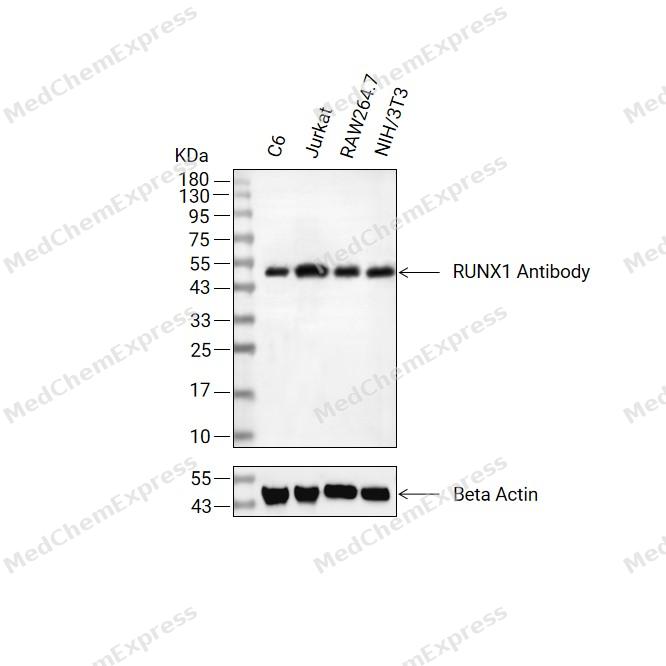 Western blot analysis of extracts from C6(lane 2(20ug) , Jurkat(lane 3(20ug) and RAW264.7(lane 4(20ug),NIH/3T3(lane 5(20ug) using RUNX1 Antibody (HY-P86201) Rabbit mAb. Proteins were transferred to a PVDF membrane and blocked with 5% non-fat milk in TBST for 2 hour at room temperature. The primary antibody (1/1000) and Loading control antibody (Beta Actin, HY-P83730, 1/10000) was used in 5% non-fat milk in TBST at 4°C overnight. Goat Anti-Mouse/Rabbit IgG-HRP Secondary Antibody (1/10000) was used for 1 hour at room temperature.
 -
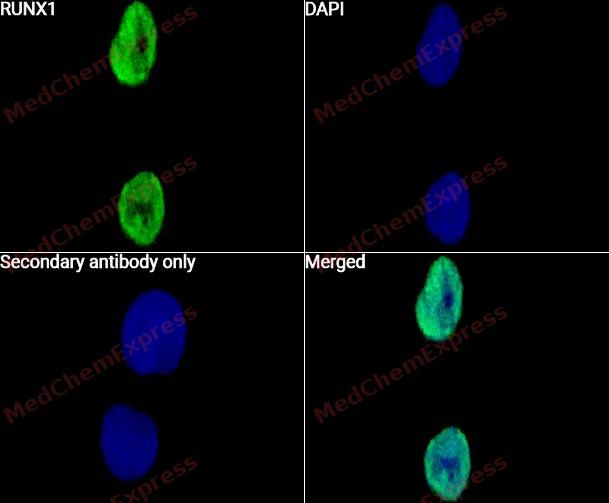 Immunocytochemistry analysis of A549 cells labeling RUNX1 with RUNX1 Antibody (HY-P86201)at 1/50 dilution. Cells were fixed in 4% paraformaldehyde for 15 minutes at room temperature, permeabilized with 0.1% Triton X-100 for 10 minutes at room temperature, then blocked with QuickBlock™ Blocking Buffer for Immunol Staining for 10 min at room temperature. Cells were then incubated with RUNX1 Antibody (HY-P86201) at 1/50 dilution in QuickBlock™ Blocking Buffer for Immunol Staining at 4 ℃. Alexa Fluor® 488-conjugated AffiniPure Goat Anti-Rabbit IgG H&L(HY-P8002, Green) was used as the secondary antibody at 1/1,000 dilution. PBS instead of the primary antibody was used as the secondary antibody only control. The Nuclear counterstain was DAPI (Blue).
 -
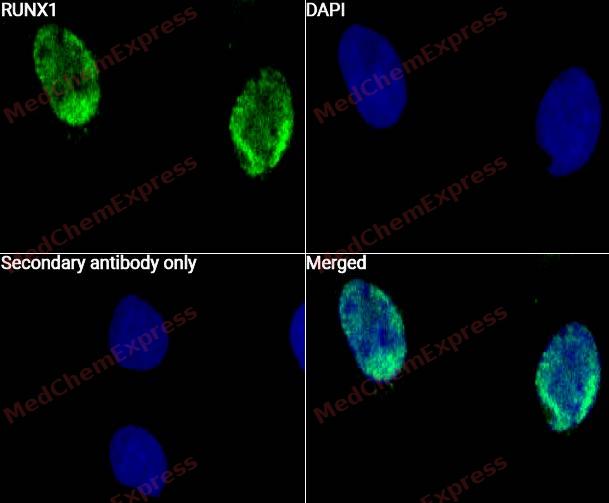 Immunocytochemistry analysis of A549 cells labeling RUNX1 with RUNX1 Antibody (HY-P86201) at 1/100 dilution. Cells were fixed in 4% paraformaldehyde for 15 minutes at room temperature, permeabilized with 0.1% Triton X-100 for 10 minutes at room temperature, then blocked with QuickBlock™ Blocking Buffer for Immunol Staining for 10 min at room temperature. Cells were then incubated with RUNX1 Antibody (HY-P86201) at 1/100 dilution in QuickBlock™ Blocking Buffer for Immunol Staining at 4 ℃. Alexa Fluor® 488-conjugated AffiniPure Goat Anti-Rabbit IgG H&L(HY-P8002, Green) was used as the secondary antibody at 1/1,000 dilution. PBS instead of the primary antibody was used as the secondary antibody only control. The Nuclear counterstain was DAPI (Blue).


Background
-
Function
RUNX1 (Runt-related transcription factor 1) is a pivotal hematopoietic transcription factor that orchestrates lineage specification, stem cell maintenance, and differentiation[1][2]. Mechanistically, RUNX1 regulates multiple signaling pathways, including NF-κB, PI3K/AKT, and TGF-β, modulating immune responses, inflammation, and hematopoietic proliferation[2][3][4]. In early hematopoiesis, isoforms such as RUNX1b and RUNX1-205 exhibit distinct temporal functions, with RUNX1-205 blocking hemogenic endothelial emergence while promoting late-stage hematopoietic differentiation[5][6]. RUNX1 mutations or haploinsufficiency contribute to leukemia, myelodysplastic syndromes, familial platelet disorders, and influence sensitivity to chemotherapeutic agents, demonstrating its disease relevance[1][3][7][8]. Compared with RUNX2 and RUNX3, RUNX1 exhibits unique tissue-specific expression and isoform-dependent regulation, particularly in hematopoietic and renal epithelial cells, underscoring functional distinctions within the RUNX family[1][9][4]. Pharmacologically, small molecule inhibitors targeting RUNX1-CBFβ interaction or TGF-β pathways have been shown to modulate RUNX1 activity, restore hematopoietic defects, and reduce inflammation and fibrosis in experimental models, suggesting translational potential[10][7][4]. RUNX1 also regulates platelet function and aspirin-responsive gene expression, highlighting its relevance in cardiovascular disease and cancer prevention[11]. Collectively, RUNX1 serves as a central transcriptional hub connecting developmental, inflammatory, and pathological processes, making it a critical focus for both mechanistic studies and therapeutic exploration.
-
Subcellular Localization
Nucleus
-
Expression
Tissue_specificity:It was expressed in all tested tissues except the brain and heart. The highest levels were found in the thymus, bone marrow, and peripheral blood.
Induction:Up-regulated by phorbol myristate acetate (PMA) -
Isoforms & Post-Translational Modification
Q01196 has 11 isomers: Q01196-1: 48737 Da (predicted); Q01196-2: 50701 Da (predicted); Q01196-3: 27427 Da (predicted); Q01196-4: 28226 Da (predicted); Q01196-5: 24049 Da (predicted); Q01196-6: 20395 Da (predicted); Q01196-7: 26509 Da (predicted); Q01196-8: 51818 Da (predicted); Q01196-9: 49077 Da (predicted); Q01196-10: 50173 Da (predicted); Q01196-11: 37733 Da (predicted).
Phosphorylated in its C-terminus upon IL-6 treatment. Phosphorylation enhances interaction with KAT6A;Methylated;Phosphorylated in Ser-249 Thr-273 and Ser-276 by HIPK2 when associated with CBFB and DNA. This phosphorylation promotes subsequent EP300 phosphorylation -
Subunit
Heterodimer with CBFB. RUNX1 binds DNA as a monomer and through the Runt domain. DNA-binding is increased by heterodimerization. Isoform AML-1L can neither bind DNA nor heterodimerize. Interacts with TLE1 and ALYREF/THOC4 (PubMed:9119228, PubMed:9751710). Interacts with ELF1, ELF2 and SPI1 (PubMed:10207087). Interacts via its Runt domain with the ELF4 N-terminal region (PubMed:10207087). Interaction with ELF2 isoform 2 (NERF-1a) may act to repress RUNX1-mediated transactivation (PubMed:14970218). Interacts with KAT6A and KAT6B (PubMed:11742995, PubMed:11965546). Interacts with SUV39H1, leading to abrogation of transactivating and DNA-binding properties of RUNX1 (PubMed:12917624, PubMed:16652147). Interacts with YAP1 (PubMed:18280240). Interacts with HIPK2 (By similarity). Interaction with CDK6 prevents myeloid differentiation, reducing its transcription transactivation activity. Found in a complex with PRMT5, RUNX1 and CBFB. Interacts with FOXP3 (PubMed:17377532). Interacts with TBX21 (By similarity). Interacts with DPF2 (PubMed:28533407)
-
SwissProt ID
-
Synonyms
RUNX1; AML1; CBFA2; Runt-related transcription factor 1; Acute myeloid leukemia 1 protein; Core-binding factor subunit alpha-2; CBF-alpha-2; Oncogene AML-1; Polyomavirus enhancer-binding protein 2 alpha B subunit; PEA2-alpha B; PEBP2-alpha


Documentation
-
Data Sheet (264 KB)
-
SDS (252 KB)
- English - EN (252 KB)
- Français - FR (252 KB)
- Deutsch - DE (252 KB)
- Norwegian - NO (252 KB)
- Español - ES (252 KB)
- Swedish - SV (252 KB)
- Italian - IT (252 KB)
- Korean - KR (252 KB)
- Portuguese - PT (252 KB)
-
User Guide for Antibodies (1077 KB)
References
[1]. Cohen MM Jr. Perspectives on RUNX genes: an update. Am J Med Genet A. 2009 Dec;149A(12):2629-46. doi: 10.1002/ajmg.a.33021. PMID: 19830829. et al. Perspectives on RUNX genes: an update. Am J Med Genet A. 2009 Dec;149A(12):2629-46. [Content Brief]
[2]. Tang X, et al. RUNX1: A Regulator of NF-kB Signaling in Pulmonary Diseases. Curr Protein Pept Sci. 2018;19(2):172-178. [Content Brief]
[3]. Edwards H, et al. RUNX1 regulates phosphoinositide 3-kinase/AKT pathway: role in chemotherapy sensitivity in acute megakaryocytic leukemia. Blood. 2009 Sep 24;114(13):2744-52. [Content Brief]
[4]. Sun W, et al. RUNX1-205, a novel splice variant of the human RUNX1 gene, has blockage effect on mesoderm-hemogenesis transition and promotion effect during the late stage of hematopoiesis. J Mol Cell Biol. 2020 Jun 11;12(5):386-396. [Content Brief]
[5]. Voora D, et al. Systems Pharmacogenomics Finds RUNX1 Is an Aspirin-Responsive Transcription Factor Linked to Cardiovascular Disease and Colon Cancer. EBioMedicine. 2016 Sep;11:157-164. [Content Brief]
[6]. Chen B, et al. Inducible overexpression of RUNX1b/c in human embryonic stem cells blocks early hematopoiesis from mesoderm. J Mol Cell Biol. 2017 Aug 1;9(4):262-273. [Content Brief]
[7]. Illendula A, et al. Small Molecule Inhibitor of CBFβ-RUNX Binding for RUNX Transcription Factor Driven Cancers. EBioMedicine. 2016 Jun;8:117-131. [Content Brief]
[8]. Al-Harbi S, et al. An update on the molecular pathogenesis and potential therapeutic targeting of AML with t(8;21)(q22;q22.1);RUNX1-RUNX1T1. Blood Adv. 2020 Jan 14;4(1):229-238. [Content Brief]
[9]. Hermans A, et al. A 3D-Printed and Freely Available Device to Measure the Zebrafish Optokinetic Response Before and After Injury. Zebrafish. 2024 Apr;21(2):144-148. [Content Brief]
[10]. Galichon P. Epithelial Signaling through the RUNX1/AKT Pathway: A New Therapeutic Target in Kidney Fibrosis. EBioMedicine. 2018 Jun;32:5. doi: 10.1016/j.ebiom.2018.05.020. Epub 2018 Jun 7. PMID: 29885863; PMCID: PMC6020706. et al. Epithelial Signaling through the RUNX1/AKT Pathway: A New Therapeutic Target in Kidney Fibrosis. EBioMedicine. 2018 Jun;32:5. [Content Brief]
[11]. Lam K, et al. Loss of RUNX1 function results in enhanced granulocyte-colony-stimulating factor-mediated mobilization. Blood Cancer J. 2016 Mar 25;6(3):e407. [Content Brief]

 Powered by Bioz
