



SESN2 Antibody (YA1934)
(Synonyms: HI95; SES2; SEST2)
Based on 1 Customer Validation
SESN2 Antibody (YA1934) is a Rabbit-derived and non-conjugated IgG monoclonal antibody, targeting to SESN2.
-
Host:
Rabbit
-
Isotype:
IgG
-
Application:
WB, ICC/IF, IP
-
Reactivity :
Human, Mouse, Rat
-
Formulation:
Supplied in 50mM Tris-Glycine(pH 7.4), 0.15M NaCl, 40% Glycerol, 0.01% Sodium azide and 0.05% BSA
-
Conjugation:
Non-conjugated


To place orders, for customer services and technical support, please contact: MedChemExpress USA
Tel: 609-228-6898 E-mail: [email protected] [email protected]





Applications
| Application |
WB

WB: Western Blot
|
ICC/IF
ICC/IF: Immunocytochemistry/
Immunofluorescence |
IP
IP: Immunoprecipitation
|
|---|---|---|---|
| Dilution Ratio | 1:500-1:1000 | 1:50-1:200 | 1:20 |


Product Details
SESN2 Antibody (YA1934) is a Rabbit-derived and non-conjugated IgG monoclonal antibody, targeting to SESN2.
-
Host Rabbit

-
Clonality Recombinant,Monoclonal

-
Species ReactivityHuman, Mouse, Rat
-
Observed Molecular WeightObserved band size: 54 kDa
Note: Due to possible protein modifications or aggregation, the molecular weight should be confirmed by actual measurement, and the predicted value is for reference only.

-
Calculated Molecular Weight Predicted band size: 54 kDa

Entrez Gene: 83667 Human ; 230784 Mouse ; 502988 Rat
SwissProt: P58004 Human ; P58043 Mouse ;
OMIM: 607767 Human
Recombinant protein of human SESN2
Endogenous
Affinity Purified
Non-conjugated
Unmodified
IgG


Product Properties
-
Appearance
Liquid
-
Formulation
Supplied in 50mM Tris-Glycine(pH 7.4), 0.15M NaCl, 40% Glycerol, 0.01% Sodium azide and 0.05% BSA
-
Concentration
Batch-dependent, Please check the COA for the concentration of each lot. Check Lot Concentration
-
Storage & Stability
Stored at -20°C for 1 year. Avoid repeated freeze / thaw cycles.
-
Shipping
Shipping with blue ice.


Verification Images
-
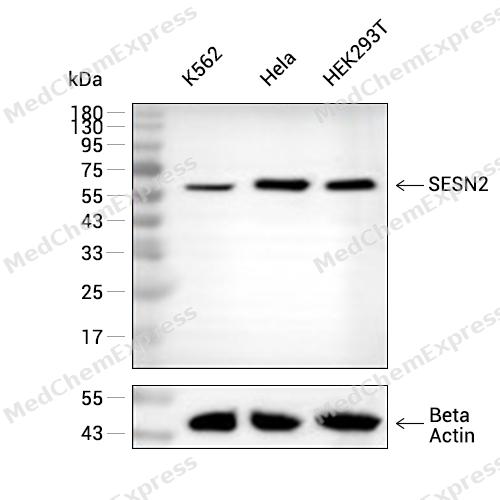 Western blot analysis of extracts from K562 (lane 2(20μg), Hela (lane 3(20μg) and HEK293T (lane 4(20μg) using SESN2 (HY-P82189) Rabbit mAb. Proteins were transferred to a PVDF membrane and blocked with 5% non-fat milk in TBST for 2 hour at room temperature. The primary antibody (1/1000) and Loading control antibody (Beta Actin, HY-P80438, 1/10000) was used in 5% non-fat milk in TBST at 4°C over-night. Goat Anti-Mouse/Rabbit IgG-HRP Secondary Antibody (1/10000) was used for 1 hour at room temperature.
 -
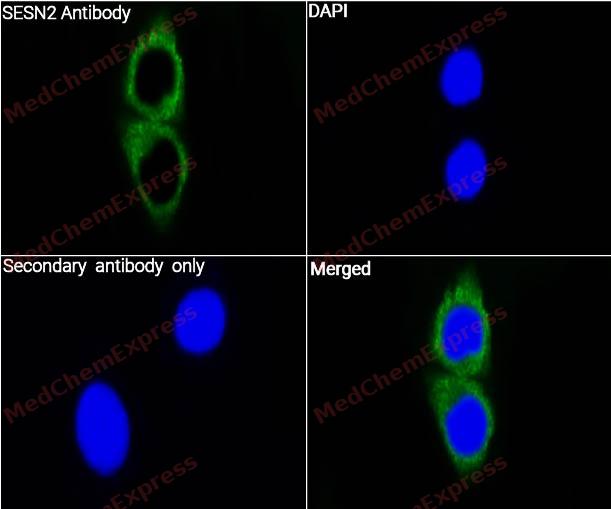 Immunocytochemistry analysis of HCT 116 cells labeling SESN2 with SESN2 Antibody (HY-P82189) at 1/50 dilution. Cells were fixed in 4% paraformaldehyde for 15 minutes at room temperature, permeabilized with 0.1% Triton X-100 for 10 minutes at room temperature, then blocked with BSA for Immunol Staining for 10 min at room temperature. Cells were then incubated with SESN2 Antibody (HY-P82189) at 1/50 dilution in BSA for Immunol Staining at 4 ℃,stay overnight. AF488-conjugated AffiniPure Goat Anti-Rabbit IgG H&L(HY-P8002, Green) was used as the secondary antibody at 1/1,000 dilution. PBS instead of the primary antibody was used as the secondary antibody only control. The Nuclear counterstain was DAPI (Blue).
 -
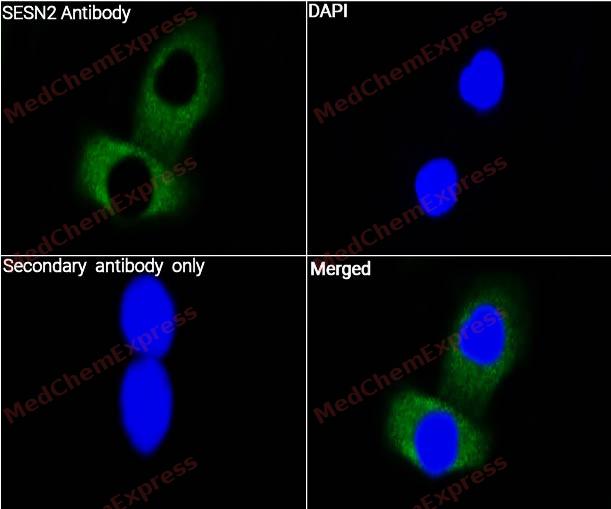 Immunocytochemistry analysis of HCT 116 cells labeling SESN2 with SESN2 Antibody (HY-P82189) at 1/100 dilution. Cells were fixed in 4% paraformaldehyde for 15 minutes at room temperature, permeabilized with 0.1% Triton X-100 for 10 minutes at room temperature, then blocked with BSA for Immunol Staining for 10 min at room temperature. Cells were then incubated with SESN2 Antibody (HY-P82189) at 1/100 dilution in BSA for Immunol Staining at 4 ℃,stay overnight. AF488-conjugated AffiniPure Goat Anti-Rabbit IgG H&L(HY-P8002, Green) was used as the secondary antibody at 1/1,000 dilution. PBS instead of the primary antibody was used as the secondary antibody only control. The Nuclear counterstain was DAPI (Blue).


Background
-
Function
SESN2 functions as an intracellular leucine sensor that negatively regulates the mTORC1 signaling pathway through the GATOR complex. In absence of leucine, binds the GATOR subcomplex GATOR2 and prevents mTORC1 signaling. Binding of leucine to SESN2 disrupts its interaction with GATOR2 thereby activating the TORC1 signaling pathway. This stress-inducible metabolic regulator also plays a role in protection against oxidative and genotoxic stresses. May negatively regulate protein translation in response to endoplasmic reticulum stress, via mTORC1. May positively regulate the transcription by NFE2L2 of genes involved in the response to oxidative stress by facilitating the SQSTM1-mediated autophagic degradation of KEAP1. May also mediate TP53 inhibition of TORC1 signaling upon genotoxic stress. Moreover, may prevent the accumulation of reactive oxygen species (ROS) through the alkylhydroperoxide reductase activity born by the N-terminal domain of the protein. Was originally reported to contribute to oxidative stress resistance by reducing PRDX1. However, this could not be confirmed[1][2][3][4][5][6][7][8][9][10][11][12][13][14].
-
Subcellular Localization
Cytoplasm
-
Expression
Tissue_specificity:Broad expression
Induction:Up-regulated by hypoxia and DNA damage (PubMed:12203114) . Up-regulated by treatments inducing endoplasmic reticulum stress (PubMed:24947615) -
Subunit
Interacts with the GATOR2 complex which is composed of MIOS, SEC13, SEH1L, WDR24 and WDR59; the interaction is negatively regulated by leucine (PubMed:25263562, PubMed:25457612, PubMed:26449471, PubMed:35114100, PubMed:35831510, PubMed:36528027). Conveys leucine availability via direct interaction with SEH1L and WDR24 components of the GATOR2 complex (PubMed:35831510, PubMed:36528027). Interacts with RRAGA, RRAGB, RRAGC and RRAGD; may function as a guanine nucleotide dissociation inhibitor for RRAGs and regulate them (PubMed:25259925). May interact with the TORC2 complex (By similarity). Interacts with KEAP1, RBX1, SQSTM and ULK1; to regulate the degradation of KEAP1 (PubMed:23274085, PubMed:25040165). May also associate with the complex composed of TSC1, TSC2 and the AMP-responsive protein kinase/AMPK to regulate TORC1 signaling (PubMed:18692468). May interact with PRDX1 (PubMed:15105503)
-
SwissProt ID
-
Synonyms
HI95; SES2; SEST2
-
Research Field
Cardiovascular


Documentation
-
Data Sheet (231 KB)
-
SDS (251 KB)
- English - EN (251 KB)
- Français - FR (251 KB)
- Deutsch - DE (251 KB)
- Norwegian - NO (251 KB)
- Español - ES (251 KB)
- Swedish - SV (251 KB)
- Italian - IT (251 KB)
- Korean - KR (251 KB)
- Portuguese - PT (251 KB)
-
User Guide for Antibodies (1077 KB)

 Powered by Bioz
