



SIRT7 Antibody (YA6765)
(Synonyms: NAD dependent deacetylase sirtuin 7 antibody; NAD dependent protein deacetylase sirtuin 7 antibody; NAD-dependent protein deacetylase sirtuin-7 antibody; Regulatory protein SIR2 homolog 7 antibody; Silent mating type information regulation 2 homolog antibody; Silent mating type information regulation 2 S.cerevisiae homolog 7 antibody; SIR2 L7 antibody; SIR2 like protein 7 antibody; Sir2 related protein type 7 antibody; SIR2, S.CEREVISIAE, HOMOLOG-LIKE 7 antibody)Based on 1 Customer Validation
SIRT7 Antibody (YA6765) is a Rabbit-derived and non-conjugated IgG monoclonal antibody, targeting to SIRT7.
-
Host:
Rabbit
-
Isotype:
IgG
-
Application:
WB, ICC/IF, IHC-P, IP, ChIP
-
Reactivity :
Human, Mouse, Rat
-
Formulation:
Supplied in PBS (pH7.4), 0.1% BSA, 40% Glycerol. Preservative: 0.05% Sodium Azide.
-
Conjugation:
Non-conjugated


To place orders, for customer services and technical support, please contact: MedChemExpress USA
Tel: 609-228-6898 E-mail: [email protected] [email protected]





Applications
| Application |
WB

WB: Western Blot
|
ICC/IF
ICC/IF: Immunocytochemistry/
Immunofluorescence |
IHC-P
IHC-P: Immunohistochemistry-Paraffin
|
IP
IP: Immunoprecipitation
|
ChIP
ChIP: Chromatin Immunoprecipitation
|
|---|---|---|---|---|---|
| Dilution Ratio | 1:2000 | 1:100 | 1:500 | 1-2μg/sample | Use 0.5~2 μg for 25 μg of chromatin. |


Product Details
SIRT7 Antibody (YA6765) is a Rabbit-derived and non-conjugated IgG monoclonal antibody, targeting to SIRT7.
-
Host Rabbit

-
Clonality Recombinant,Monoclonal

-
Species ReactivityHuman, Mouse, Rat
-
Observed Molecular WeightObserved band size: 45 kDa
Note: Due to possible protein modifications or aggregation, the molecular weight should be confirmed by actual measurement, and the predicted value is for reference only.

-
Calculated Molecular Weight Predicted band size: 45 kDa

Recombinant protein within human SIRT7 aa 1-400.
affinity purified.
Non-conjugated
Unmodified
IgG


Product Properties
-
Appearance
Solution
-
Formulation
Supplied in PBS (pH7.4), 0.1% BSA, 40% Glycerol. Preservative: 0.05% Sodium Azide.
-
Concentration
Batch-dependent, Please check the COA for the concentration of each lot. Check Lot Concentration
-
Storage & Stability
Stored at -20°C for 1 year. Avoid repeated freeze / thaw cycles.
-
Shipping
Shipping with blue ice.


Verification Images
-
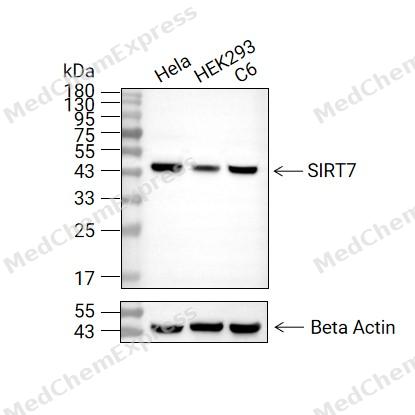 Western blot analysis of extracts from Hela (lane 2(20μg), HEK293 (lane 3(20μg) and C6 (lane 4(20μg) using SIRT7 (HY-P87072) Rabbit mAb. Proteins were transferred to a PVDF membrane and blocked with 5% non-fat milk in TBST for 2 hour at room temperature. The primary antibody (1/1000) and Loading control antibody (Beta Actin, HY-P80438, 1/10000) was used in 5% non-fat milk in TBST at 4°C overnight. Goat Anti-Mouse/Rabbit IgG-HRP Secondary Antibody (1/10000) was used for 1 hour at room temperature.
 -
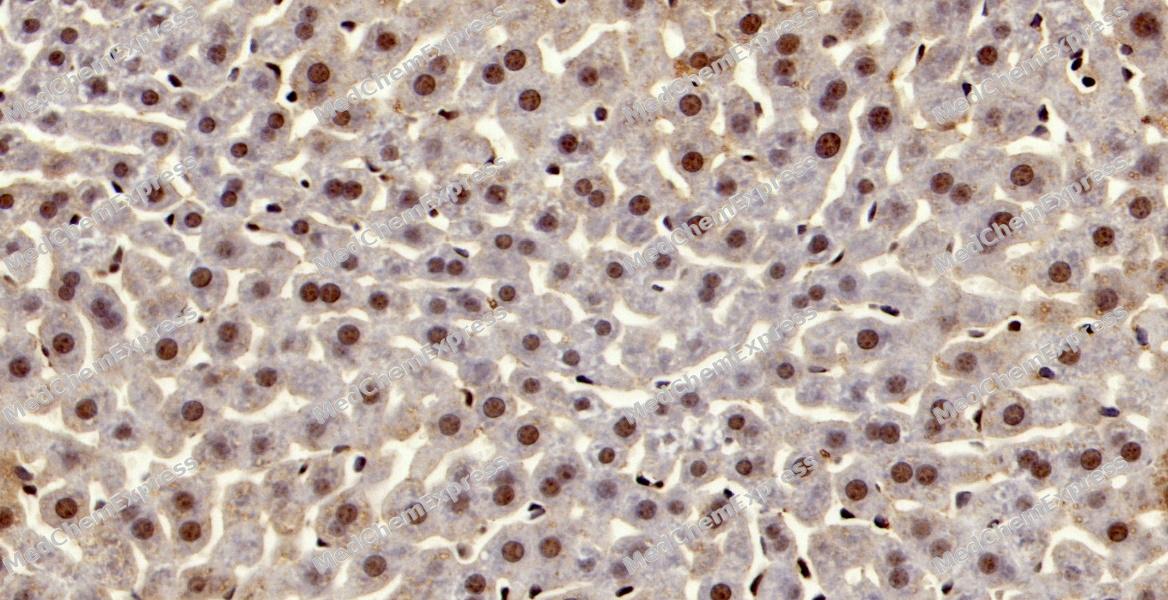 Immunohistochemical analysis of paraffin-embedded mouse liver tissue using SIRT7 Antibody. The section was pre-treated using heat mediated antigen retrieval with sodium citrate buffer (pH 6.0) for 8 minutes. The tissues were blocked in QuickBlock for 20 minutes at room temperature, washed with ddH2O and PBS, and then probed with the primary antibody at 1/100 dilution in 4℃ overnight. The detection was performed using an HRP conjugated compact polymer system. DAB was used as the chromogen. Tissues were counterstained with hematoxylin and mounted with DPX.
 -
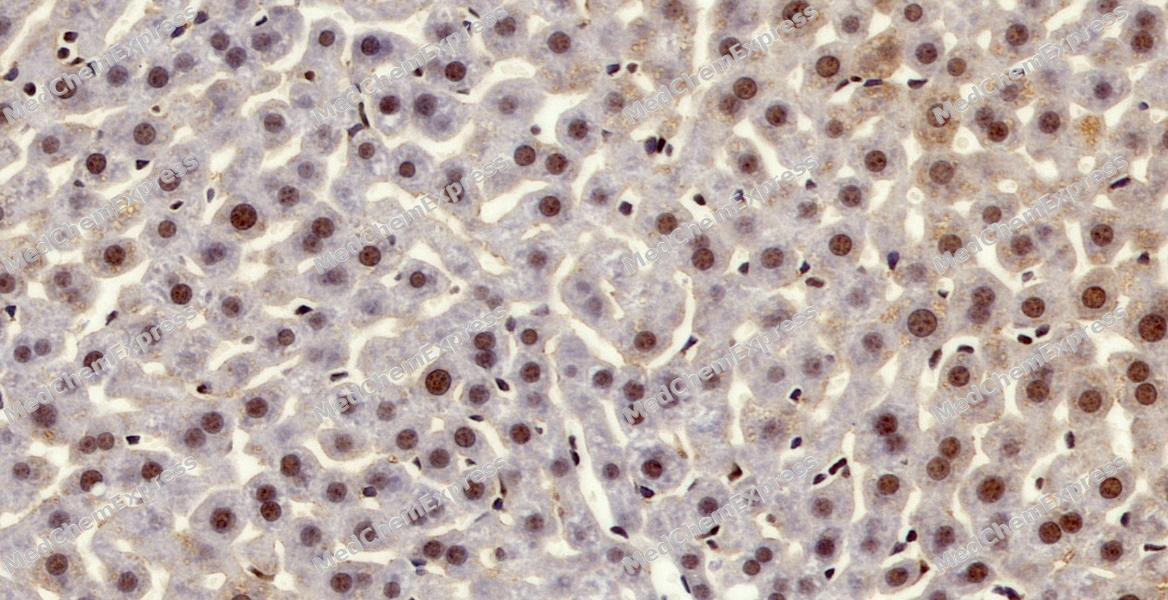 Immunohistochemical analysis of paraffin-embedded mouse liver tissue using SIRT7 Antibody. The section was pre-treated using heat mediated antigen retrieval with sodium citrate buffer (pH 6.0) for 8 minutes. The tissues were blocked in QuickBlock for 20 minutes at room temperature, washed with ddH2O and PBS, and then probed with the primary antibody at 1/100 dilution in 4℃ overnight. The detection was performed using an HRP conjugated compact polymer system. DAB was used as the chromogen. Tissues were counterstained with hematoxylin and mounted with DPX.
 -
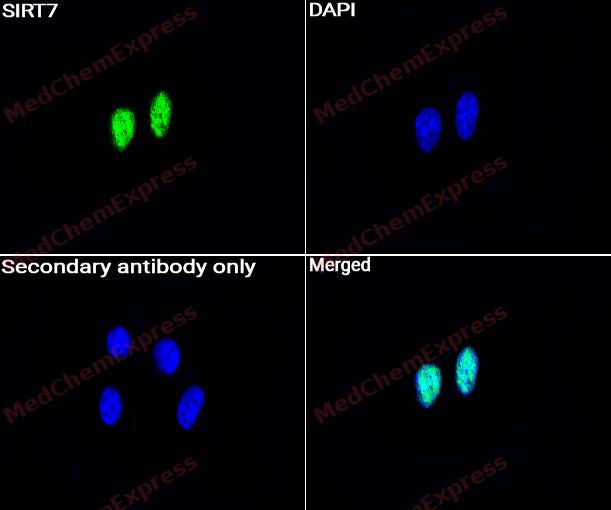 Immunocytochemistry analysis of RAW264.7 cells labeling SIRT7 with SIRT7 Antibody (HY-P87072) at 1/50 dilution. Cells were fixed in 4% paraformaldehyde for 15 minutes at room temperature, permeabilized with 0.1% Triton X-100 for 10 minutes at room temperature, then blocked with BSA for Immunol Staining for 10 min at room temperature. Cells were then incubated with SIRT7 Antibody (HY-P87072) at 1/50 dilution in BSA for Immunol Staining at 4 ℃ overnight. AF488-conjugated AffiniPure Goat Anti-Rabbit IgG H&L(HY-P8002, Green) was used as the secondary antibody at 1/1,000 dilution. PBS instead of the primary antibody was used as the secondary antibody only control. The Nuclear counterstain was DAPI (Blue).
 -
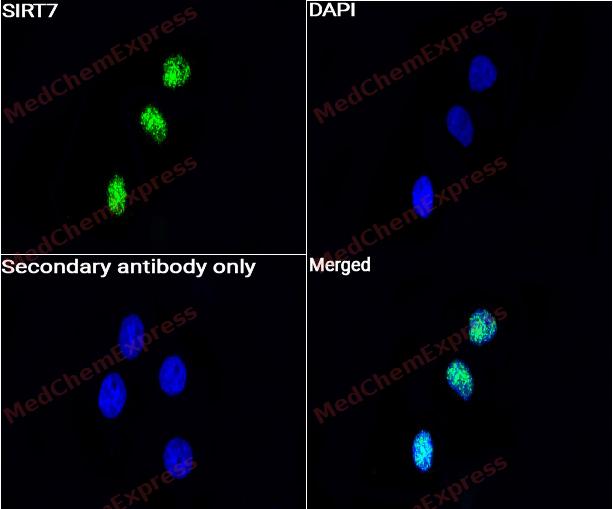 Immunocytochemistry analysis of RAW264.7 cells labeling SIRT7 with SIRT7 Antibody (HY-P87072) at 1/100 dilution. Cells were fixed in 4% paraformaldehyde for 15 minutes at room temperature, permeabilized with 0.1% Triton X-100 for 10 minutes at room temperature, then blocked with BSA for Immunol Staining for 10 min at room temperature. Cells were then incubated with SIRT7 Antibody (HY-P87072) at 1/100 dilution in BSA for Immunol Staining at 4 ℃ overnight. AF488-conjugated AffiniPure Goat Anti-Rabbit IgG H&L(HY-P8002, Green) was used as the secondary antibody at 1/1,000 dilution. PBS instead of the primary antibody was used as the secondary antibody only control. The Nuclear counterstain was DAPI (Blue).


Background
-
Function
SIRT7 is a mammalian sirtuin and NAD+-dependent histone/protein deacetylase involved in genome stability, metabolism, stress responses, tumorigenesis, ribosome biogenesis, and transcriptional regulation[1]. Mechanistically, DNA activates SIRT7 to deacetylate histone H3 in chromatin, and RNA increases SIRT7 catalytic efficiency while ribosomal RNA acts as a predominant binding partner[1][2]. Therefore, SIRT7 connects nucleolar biology with chromatin regulation through deacetylation of fibrillarin, maintenance of H2AQ104 methylation, and support of cell-cycle-dependent rDNA transcription[3]. SIRT7 also deacetylates ribosomal RNA ac4C, indicating an epitranscriptional role in rRNA modification and aging-related regulation[4]. In DNA damage models, SIRT7 promotes genome integrity by PARP1-dependent recruitment to DNA damage sites, H3K18Ac modulation, 53BP1 recruitment, and non-homologous end joining repair[5]. In cellular senescence models, SIRT7 supports SNF2H association with rDNA sequences and protects against rDNA instability, rDNA copy loss, and acute senescence[6]. Compared with SIRT6, SIRT7 shows a distinct activation mechanism because DNA activates SIRT7 peptide deacetylation, whereas SIRT6 peptide deacetylation is not DNA-activated[1]. For experimental applications, improved DNA- or RNA-activated enzymatic assays and SIRT7 lysine deacylase profiling support development of SIRT7 modulators[1][2][7].
-
Subcellular Localization
Nucleus, nucleolus,Nucleus, nucleoplasm,Chromosome,Cytoplasm
-
Expression
Induction: Overexpressed in thyroid carcinoma cell lines and tissues, but not in adenomas
-
Isoforms & Post-Translational Modification
Q9NRC8 has three isomers: Q9NRC8-1: 44898 Da (predicted); Q9NRC8-2: 20404 Da (predicted); Q9NRC8-3: 35851 Da (predicted).
Phosphorylated during mitosis丨Methylation at Arg-388 by PRMT6 inhibits the H3K18Ac histone deacetylase activity, promoting mitochondria biogenesis and maintaining mitochondria respiration丨Ubiquitinated via 'Lys-63'-linked ubiquitin chains (PubMed:28655758) -
Subunit
Interacts with UBTF and the RNA polymerase I complex (PubMed:16618798, PubMed:19174463)
-
SwissProt ID
-
Synonyms
NAD dependent deacetylase sirtuin 7 antibody; NAD dependent protein deacetylase sirtuin 7 antibody; NAD-dependent protein deacetylase sirtuin-7 antibody; Regulatory protein SIR2 homolog 7 antibody; Silent mating type information regulation 2 homolog antibody; Silent mating type information regulation 2 S.cerevisiae homolog 7 antibody; SIR2 L7 antibody; SIR2 like protein 7 antibody; Sir2 related protein type 7 antibody; SIR2, S.CEREVISIAE, HOMOLOG-LIKE 7 antibody


Documentation
-
Data Sheet (261 KB)
-
SDS (254 KB)
- English - EN (254 KB)
- Français - FR (254 KB)
- Deutsch - DE (254 KB)
- Norwegian - NO (254 KB)
- Español - ES (254 KB)
- Swedish - SV (254 KB)
- Italian - IT (254 KB)
- Korean - KR (254 KB)
- Portuguese - PT (254 KB)
-
User Guide for Antibodies (1077 KB)
References
[1]. Tong Z, et al. SIRT7 Is Activated by DNA and Deacetylates Histone H3 in the Chromatin Context. ACS Chem Biol. 2016 Mar 18;11(3):742-7. [Content Brief]
[2]. Tong Z, et al. SIRT7 Is an RNA-Activated Protein Lysine Deacylase. ACS Chem Biol. 2017 Jan 20;12(1):300-310. [Content Brief]
[3]. Iyer-Bierhoff A, et al. SIRT7-Dependent Deacetylation of Fibrillarin Controls Histone H2A Methylation and rRNA Synthesis during the Cell Cycle. Cell Rep. 2018 Dec 11;25(11):2946-2954.e5. [Content Brief]
[4]. Khalili M, et al. Underserved Does Not Mean Undeserved: Unfurling the HCV Care in the Safety Net. Dig Dis Sci. 2018 Dec;63(12):3250-3252. [Content Brief]
[5]. Vazquez BN, et al. SIRT7 promotes genome integrity and modulates non-homologous end joining DNA repair. EMBO J. 2016 Jul 15;35(14):1488-503. [Content Brief]
[6]. Paredes S, et al. The epigenetic regulator SIRT7 guards against mammalian cellular senescence induced by ribosomal DNA instability. J Biol Chem. 2018 Jul 13;293(28):11242-11250. [Content Brief]
[7]. Kibria MG, et al. SIRT7 Is a Lysine Deacylase with a Preference for Depropionylation and Demyristoylation. Int J Mol Sci. 2025 Mar 28;26(7):3153. [Content Brief]

 Powered by Bioz
