



SLC22A3 Antibody (YA2830)
(Synonyms: SLC22A3; EMTH; OCT3; Solute carrier family 22 member 3; Extraneuronal monoamine transporter; EMT; Organic cation transporter 3)
Based on 1 Customer Validation
SLC22A3 Antibody (YA2830) is a Rabbit-derived and non-conjugated IgG monoclonal antibody, targeting to SLC22A3.
-
Host:
Rabbit
-
Isotype:
IgG
-
Application:
WB, IHC-P, FC
-
Reactivity :
Human
-
Formulation:
Supplied in rabbit IgG in 50mM Tris-Glycine(pH 7.4), 0.15M NaCl, 40%Glycerol, 0.01% sodium azide and 0.05% BSA.
-
Conjugation:
Non-conjugated


To place orders, for customer services and technical support, please contact: MedChemExpress USA
Tel: 609-228-6898 E-mail: [email protected] [email protected]





Applications
| Application |
WB

WB: Western Blot
|
IHC-P
IHC-P: Immunohistochemistry-Paraffin
|
FC
FC: Flow Cytometry
|
|---|---|---|---|
| Dilution Ratio | 1:1000-1:2000 | 1:100-1:200 | 1:50-1:100 |


Product Details
SLC22A3 Antibody (YA2830) is a Rabbit-derived and non-conjugated IgG monoclonal antibody, targeting to SLC22A3.
-
Host Rabbit

-
Clonality Recombinant,Monoclonal

-
Species ReactivityHuman
-
Observed Molecular WeightObserved band size: 75 kDa
Note: Due to possible protein modifications or aggregation, the molecular weight should be confirmed by actual measurement, and the predicted value is for reference only.

-
Calculated Molecular Weight Predicted band size: 61 kDa

A synthesized peptide derived from human SLC22A3 aa300-370/556.
Endogenous
Affinity Purified
Non-conjugated
Unmodified
IgG


Product Properties
-
Appearance
Solution
-
Formulation
Supplied in rabbit IgG in 50mM Tris-Glycine(pH 7.4), 0.15M NaCl, 40%Glycerol, 0.01% sodium azide and 0.05% BSA.
-
Concentration
Batch-dependent, Please check the COA for the concentration of each lot. Check Lot Concentration
-
Storage & Stability
Stored at -20°C for 1 year. Avoid repeated freeze / thaw cycles.
-
Shipping
Shipping with blue ice.


Verification Images
-
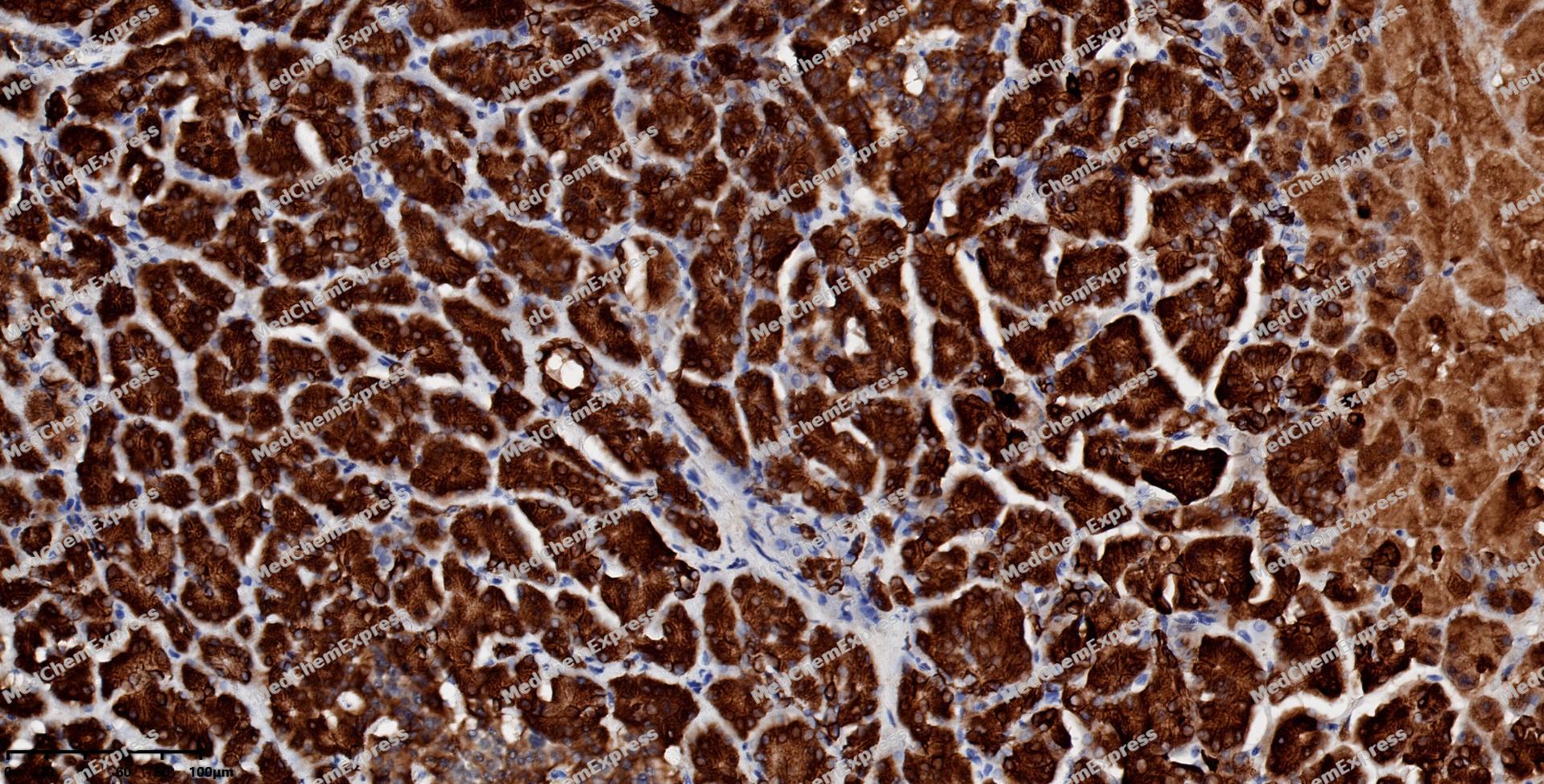 Immunohistochemical analysis of paraffin-embedded human pancreas using SLC22A3 antibody. The section was pre-treated using heat mediated antigen retrieval with EDTA (pH 9.0) for 14 minutes. The tissues were blocked in 5% BSA for 30 minutes at room temperature, washed with TBST, and then probed with the primary antibody (HY-P83085, 1/200) for 1 hour at room temperature. The detection was performed using Polymer HRP-conjugated Goat Anti-Mouse/Rabbit lgG(H&L) secondary antibody (HY-P83652). DAB was used as the chromogen. Tissues were counterstained with hematoxylin and mounted with DPX.
 -
 Immunohistochemical analysis of paraffin-embedded human lung cancer using SLC22A3 antibody. The section was pre-treated using heat mediated antigen retrieval with EDTA (pH 9.0) for 14 minutes. The tissues were blocked in 5% BSA for 30 minutes at room temperature, washed with TBST, and then probed with the primary antibody (HY-P83085, 1/200) for 1 hour at room temperature. The detection was performed using Polymer HRP-conjugated Goat Anti-Mouse/Rabbit lgG(H&L) secondary antibody (HY-P83652). DAB was used as the chromogen. Tissues were counterstained with hematoxylin and mounted with DPX.
 -
 Immunohistochemical analysis of paraffin-embedded human ovarian cancer using SLC22A3 antibody. The section was pre-treated using heat mediated antigen retrieval with EDTA (pH 9.0) for 14 minutes. The tissues were blocked in 5% BSA for 30 minutes at room temperature, washed with TBST, and then probed with the primary antibody (HY-P83085, 1/200) for 1 hour at room temperature. The detection was performed using Polymer HRP-conjugated Goat Anti-Mouse/Rabbit lgG(H&L) secondary antibody (HY-P83652). DAB was used as the chromogen. Tissues were counterstained with hematoxylin and mounted with DPX.
 -
 Immunohistochemical analysis of paraffin-embedded human liver cancer using SLC22A3 antibody. The section was pre-treated using heat mediated antigen retrieval with EDTA (pH 9.0) for 14 minutes. The tissues were blocked in 5% BSA for 30 minutes at room temperature, washed with TBST, and then probed with the primary antibody (HY-P83085, 1/200) for 1 hour at room temperature. The detection was performed using Polymer HRP-conjugated Goat Anti-Mouse/Rabbit lgG(H&L) secondary antibody (HY-P83652). DAB was used as the chromogen. Tissues were counterstained with hematoxylin and mounted with DPX.
 -
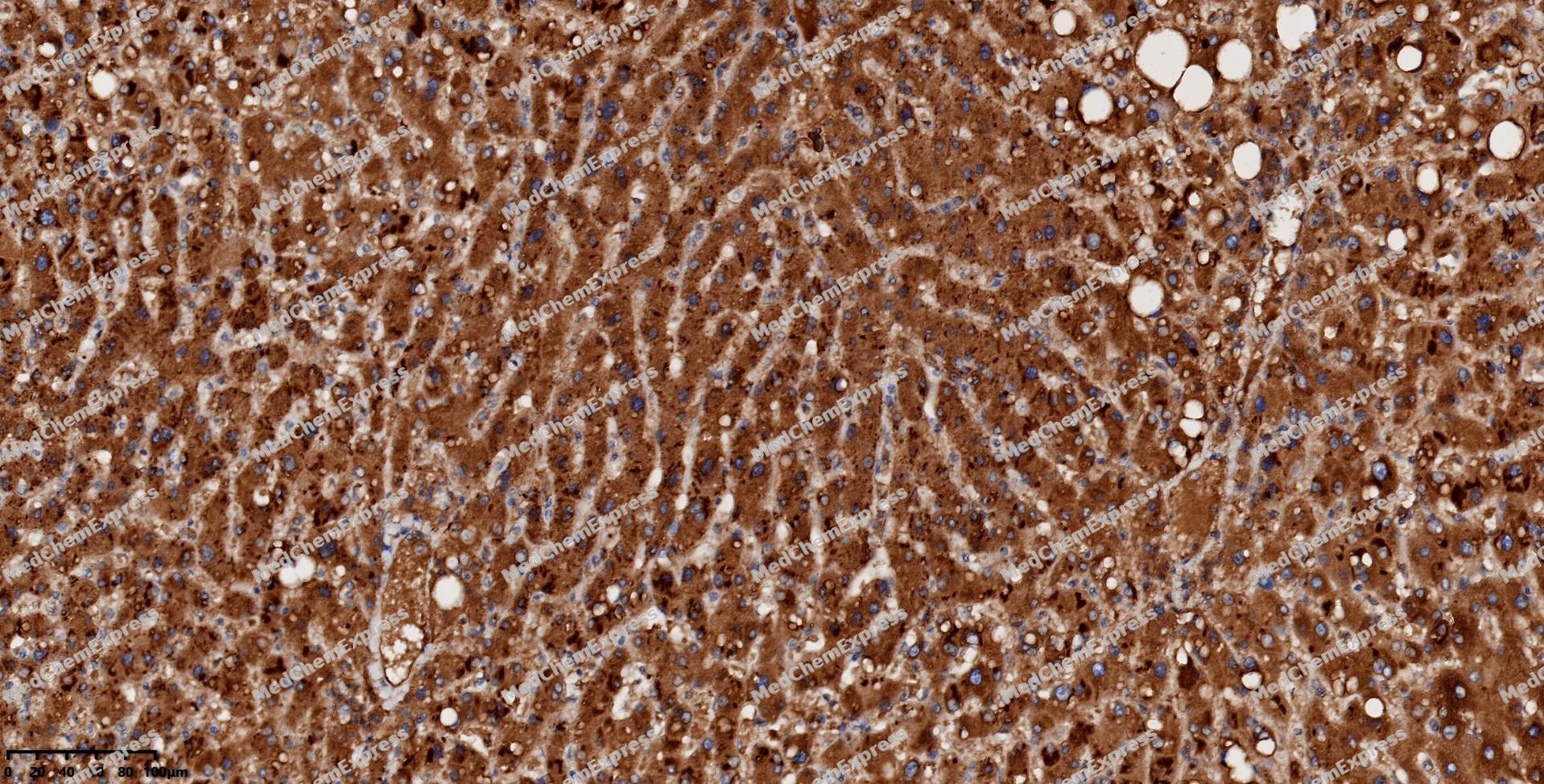 Immunohistochemical analysis of paraffin-embedded human liver using SLC22A3 antibody. The section was pre-treated using heat mediated antigen retrieval with EDTA (pH 9.0) for 14 minutes. The tissues were blocked in 5% BSA for 30 minutes at room temperature, washed with TBST, and then probed with the primary antibody (HY-P83085, 1/200) for 1 hour at room temperature. The detection was performed using Polymer HRP-conjugated Goat Anti-Mouse/Rabbit lgG(H&L) secondary antibody (HY-P83652). DAB was used as the chromogen. Tissues were counterstained with hematoxylin and mounted with DPX.
 -
 Immunohistochemical analysis of paraffin-embedded human bladder cancer using SLC22A3 antibody. The section was pre-treated using heat mediated antigen retrieval with EDTA (pH 9.0) for 14 minutes. The tissues were blocked in 5% BSA for 30 minutes at room temperature, washed with TBST, and then probed with the primary antibody (HY-P83085, 1/200) for 1 hour at room temperature. The detection was performed using Polymer HRP-conjugated Goat Anti-Mouse/Rabbit lgG(H&L) secondary antibody (HY-P83652). DAB was used as the chromogen. Tissues were counterstained with hematoxylin and mounted with DPX.
 -
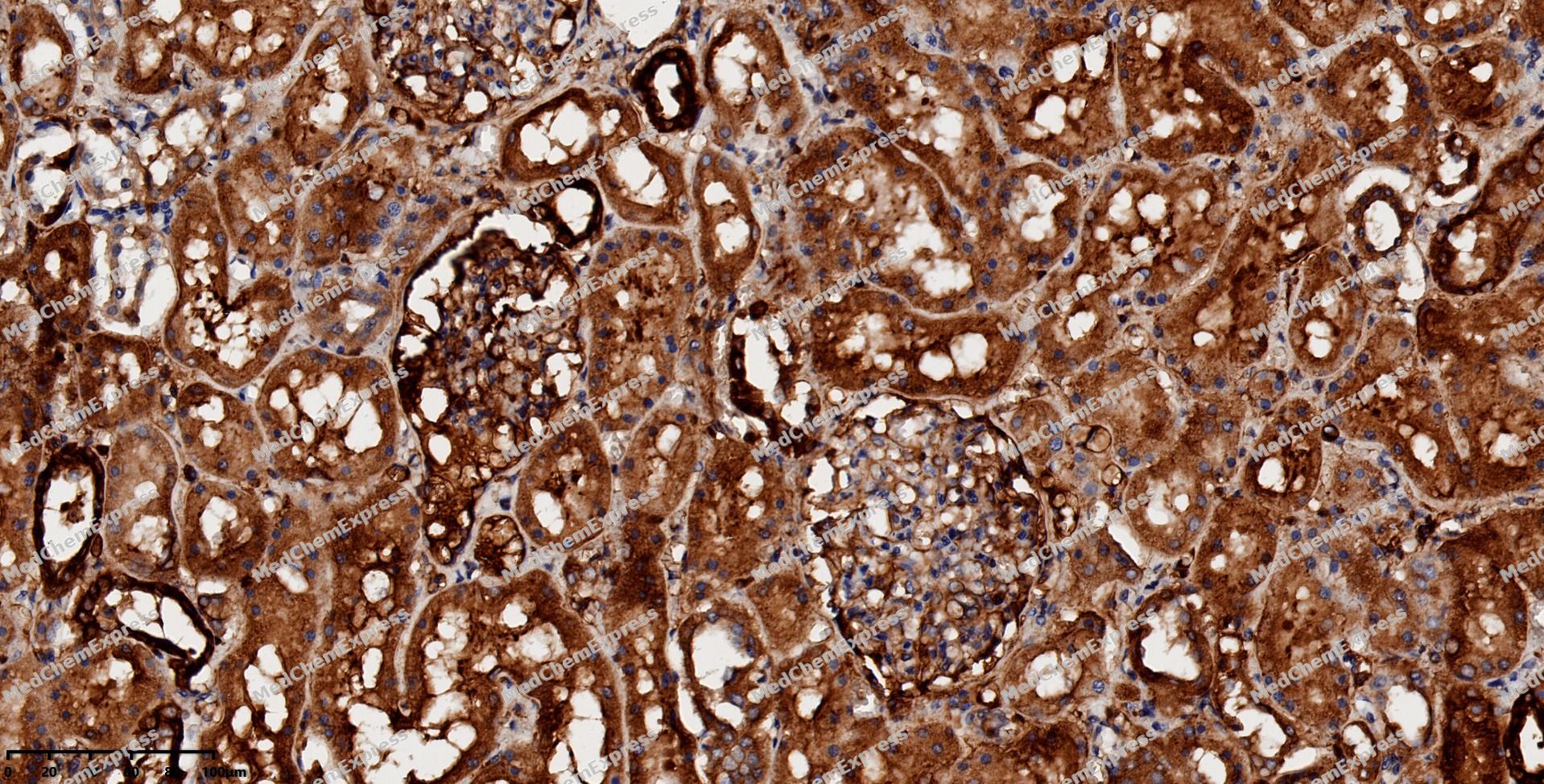 Immunohistochemical analysis of paraffin-embedded human kidney using SLC22A3 antibody. The section was pre-treated using heat mediated antigen retrieval with EDTA (pH 9.0) for 14 minutes. The tissues were blocked in 5% BSA for 30 minutes at room temperature, washed with TBST, and then probed with the primary antibody (HY-P83085, 1/200) for 1 hour at room temperature. The detection was performed using Polymer HRP-conjugated Goat Anti-Mouse/Rabbit lgG(H&L) secondary antibody (HY-P83652). DAB was used as the chromogen. Tissues were counterstained with hematoxylin and mounted with DPX.


Background
-
Function
SLC22A3 is an Electrogenic voltage-dependent transporter that mediates the transport of a variety of organic cations such as endogenous bioactive amines, cationic drugs and xenobiotics. Cation cellular uptake or release is driven by the electrochemical potential, i.e. membrane potential and concentration gradient. Functions as a Na(+)- and Cl(-)-independent, bidirectional uniporter. Implicated in monoamine neurotransmitters uptake such as dopamine, adrenaline/epinephrine, noradrenaline/norepinephrine, histamine, serotonin and tyramine, thereby supporting a role in homeostatic regulation of aminergic neurotransmission in the brain. Transports dopaminergic neuromodulators cyclo(his-pro) and salsolinol with low efficiency. May be involved in the uptake and disposition of cationic compounds by renal clearance from the blood flow. May contribute to regulate the transport of cationic compounds in testis across the blood-testis-barrier (Probable). Mediates the transport of polyamine spermidine and putrescine. Mediates the bidirectional transport of polyamine agmatine. Also transports guanidine. May also mediate intracellular transport of organic cations, thereby playing a role in amine metabolism and intracellular signaling[1][2][3][4][5][6].
-
Subcellular Localization
Cell membrane; Multi-pass membrane protein; Apical cell membrane; Multi-pass membrane protein; Basolateral cell membrane; Multi-pass membrane protein; Mitochondrion membrane; Endomembrane system; Nucleus membrane; Nucleus outer membrane
-
Expression
Tissue_specificity:Expressed in liver (PubMed:10196521, PubMed:9933568) . Expressed in intestine (PubMed:16263091, PubMed:20858707) . Expressed in kidney in proximal tubular cells (PubMed:10966924) . Expressed in placenta (PubMed:10966924, PubMed:9933568) . Expressed throughout the brain, including cerebral cortex, cerebrellum, substancia nigra, medulla oblongata, hippocampus, caudate nucleus, nucleus accumbens and pons with low levels of expression detected in nearly all brain regions (PubMed:10196521, PubMed:20858707) . In testis, mostly localized to peritubular myoid cells and Leydig cells, and weakly expressed in developing germ cells (PubMed:35307651) . Expressed in tracheal and bronchial epithelium of the respiratory tract, where it localizes to the apical membrane of ciliated cells, the entire membrane of basal cells and the basolateral membrane of intermediate cells (PubMed:15817714) . Expressed in skeletal muscle, adrenal gland, heart, prostate, aorta, salivary gland, adrenal gland, uterus, lymph node, lung, trachea and spinal cord (PubMed:10196521, PubMed:20858707, PubMed:9933568) . Expressed in fetal lung and liver (PubMed:9933568) -
SwissProt ID
-
Synonyms
SLC22A3; EMTH; OCT3; Solute carrier family 22 member 3; Extraneuronal monoamine transporter; EMT; Organic cation transporter 3
-
Research Field
Signal Transduction


Documentation
-
Data Sheet (261 KB)
-
SDS (251 KB)
- English - EN (251 KB)
- Français - FR (251 KB)
- Deutsch - DE (251 KB)
- Norwegian - NO (251 KB)
- Español - ES (251 KB)
- Swedish - SV (251 KB)
- Italian - IT (251 KB)
- Korean - KR (251 KB)
- Portuguese - PT (251 KB)
-
User Guide for Antibodies (1077 KB)
References
[1]. Gründemann D, et al. Molecular identification of the corticosterone-sensitive extraneuronal catecholamine transporter. Nat Neurosci. 1998 Sep;1(5):349-51. [Content Brief]
[2]. Wu X, et al. Structure, function, and regional distribution of the organic cation transporter OCT3 in the kidney. Am J Physiol Renal Physiol. 2000 Sep;279(3):F449-58. [Content Brief]
[3]. Gründemann D, et al. Agmatine is efficiently transported by non-neuronal monoamine transporters extraneuronal monoamine transporter (EMT) and organic cation transporter 2 (OCT2). J Pharmacol Exp Ther. 2003 Feb;304(2):810-7. [Content Brief]
[4]. Taubert D, et al. Identification of the endogenous key substrates of the human organic cation transporter OCT2 and their implication in function of dopaminergic neurons. PLoS One. 2007 Apr 25;2(4):e385. [Content Brief]
[5]. Duan H, et al. Selective transport of monoamine neurotransmitters by human plasma membrane monoamine transporter and organic cation transporter 3. J Pharmacol Exp Ther. 2010 Dec;335(3):743-53. [Content Brief]
[6]. Amphoux A, et al. Differential pharmacological in vitro properties of organic cation transporters and regional distribution in rat brain. Neuropharmacology. 2006 Jun;50(8):941-52. [Content Brief]

 Powered by Bioz
