



SRSF3 Antibody (YA2169)
(Synonyms: SRSF3; SFRS3; SRP20; Serine/arginine-rich splicing factor 3; Pre-mRNA-splicing factor SRP20; Splicing factor; arginine/serine-rich 3)
Based on 1 Customer Validation
SRSF3 Antibody (YA2169) is a Rabbit-derived and non-conjugated IgG monoclonal antibody, targeting to SRSF3.
-
Host:
Rabbit
-
Isotype:
IgG
-
Application:
WB, IHC-P, ICC/IF, FC
-
Reactivity :
Mouse, Rat, Human
-
Formulation:
Supplied in 50mM Tris-Glycine(pH 7.4), 0.15M NaCl, 40%Glycerol, 0.01% sodium azide and 0.05% BSA.
-
Conjugation:
Non-conjugated


To place orders, for customer services and technical support, please contact: MedChemExpress USA
Tel: 609-228-6898 E-mail: [email protected] [email protected]





Applications
| Application |
WB

WB: Western Blot
|
IHC-P
IHC-P: Immunohistochemistry-Paraffin
|
ICC/IF
ICC/IF: Immunocytochemistry/
Immunofluorescence |
FC
FC: Flow Cytometry
|
|---|---|---|---|---|
| Dilution Ratio | 1:500-1:1000 | 1:50-1:100 | 1:50-1:200 | 1:50-1:100 |


Product Details
SRSF3 Antibody (YA2169) is a Rabbit-derived and non-conjugated IgG monoclonal antibody, targeting to SRSF3.
-
Host Rabbit

-
Clonality Recombinant,Monoclonal

-
Species ReactivityMouse, Rat, Human
-
Observed Molecular WeightObserved band size: 19 kDa
Note: Due to possible protein modifications or aggregation, the molecular weight should be confirmed by actual measurement, and the predicted value is for reference only.

-
Calculated Molecular Weight Predicted band size: 19 kDa

Entrez Gene: 6428 Human ; 20383 Mouse ; 361814 Rat
SwissProt: P84103 Human ; P84104 Mouse ;
OMIM: 603364 Human
A synthesized peptide derived from human SRSF3 aa50-100.
Endogenous
Affinity Chromatography
Non-conjugated
Unmodified
IgG


Product Properties
-
Appearance
Solution
-
Formulation
Supplied in 50mM Tris-Glycine(pH 7.4), 0.15M NaCl, 40%Glycerol, 0.01% sodium azide and 0.05% BSA.
-
Concentration
Batch-dependent, Please check the COA for the concentration of each lot. Check Lot Concentration
-
Storage & Stability
Stored at -20°C for 1 year. Avoid repeated freeze / thaw cycles.
-
Shipping
Shipping with blue ice.


Verification Images
-
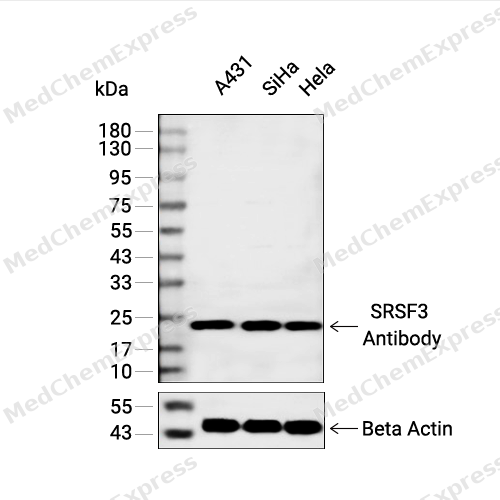 Western blot analysis of extracts from A431(lane 2(20ug) ,SiHa(lane 3(20ug) and Hela(lane 4(20ug) using SRSF3 Antibody (HY-P82424) Rabbit mAb. Proteins were transferred to a PVDF membrane and blocked with 5% non-fat milk in TBST for 2 hour at room temperature. The primary antibody (1/1000) and Loading control antibody (Beta Actin, HY-P80438, 1/10000) was used in 5% non-fat milk in TBST at 4°C overnight. Goat Anti-Mouse/Rabbit IgG-HRP Secondary Antibody (1/10000) was used for 1 hour at room temperature.
 -
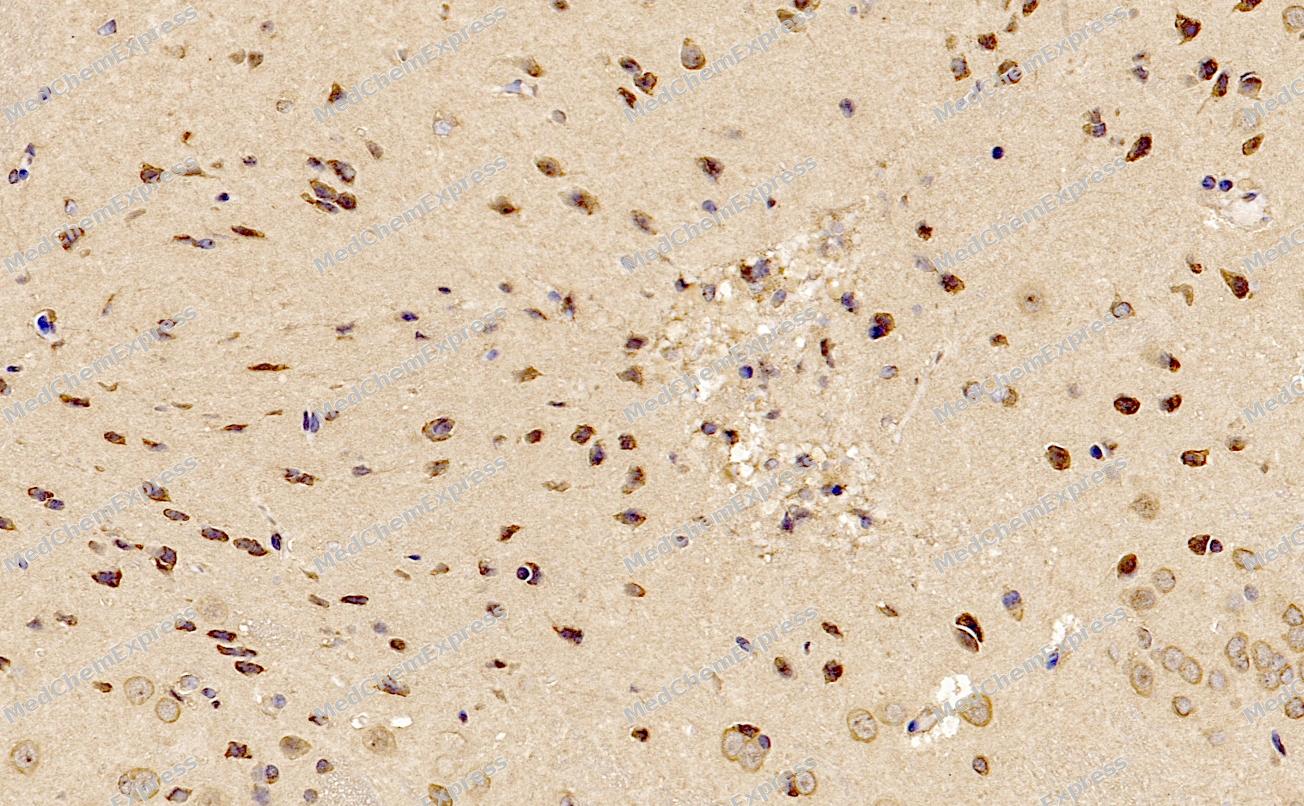 Immunohistochemical analysis of paraffin-embedded Rat brain tissue using SRSF3 Antibody (YA2169). The section was pre-treated using heat mediated antigen retrieval with Tris-EDTA buffer (pH 8.0) for 8 minutes. The tissues were blocked in QuickBlock for 20 minutes at room temperature, washed with ddH2O and PBS, and then probed with the primary antibody (HY-P82424, 1/100) in 4℃ overnight. The detection was performed using an HRP conjugated compact polymer system. DAB was used as the chromogen. Tissues were counterstained with hematoxylin and mounted with DPX.
 -
Immunohistochemical analysis of paraffin-embedded Rat brain tissue using SRSF3 Antibody (YA2169). The section was pre-treated using heat mediated antigen retrieval with Tris-EDTA buffer (pH 8.0) for 8 minutes. The tissues were blocked in QuickBlock for 20 minutes at room temperature, washed with ddH2O and PBS, and then probed with the primary antibody (HY-P82424, 1/100) in 4℃ overnight. The detection was performed using an HRP conjugated compact polymer system. DAB was used as the chromogen. Tissues were counterstained with hematoxylin and mounted with DPX.
-
 Immunocytochemistry analysis of A431 cells labeling SRSF3 with SRSF3 Antibody (HY-P82424) at 1/100 dilution. Cells were fixed in 4% paraformaldehyde for 15 minutes at room temperature, permeabilized with 0.1% Triton X-100 in PBS for 15 minutes at room temperature, then blocked with quick block buffer for 10 minutes at room temperature. Cells were then incubated with SRSF3 Antibody (HY-P82424) at 1/100 dilution in quick block buffer overnight at 4 ℃. AF488-conjugated Goat Anti-Rabbit IgG H&L (HY-P8002, Green) was used as the secondary antibody at 1/1,000 dilution. PBS instead of the primary antibody was used as the secondary antibody only control. The Nuclear counterstain was DAPI (Blue).
 -
 Immunocytochemistry analysis of Hela cells labeling SRSF3 with SRSF3 Antibody (HY-P82424) at 1/100 dilution. Cells were fixed in 4% paraformaldehyde for 15 minutes at room temperature, permeabilized with 0.1% Triton X-100 in PBS for 15 minutes at room temperature, then blocked with quick block buffer for 10 minutes at room temperature. Cells were then incubated with SRSF3 Antibody (HY-P82424) at 1/100 dilution in quick block buffer overnight at 4 ℃. AF488-conjugated Goat Anti-Rabbit IgG H&L (HY-P8002, Green) was used as the secondary antibody at 1/1,000 dilution. PBS instead of the primary antibody was used as the secondary antibody only control. The Nuclear counterstain was DAPI (Blue).
 -
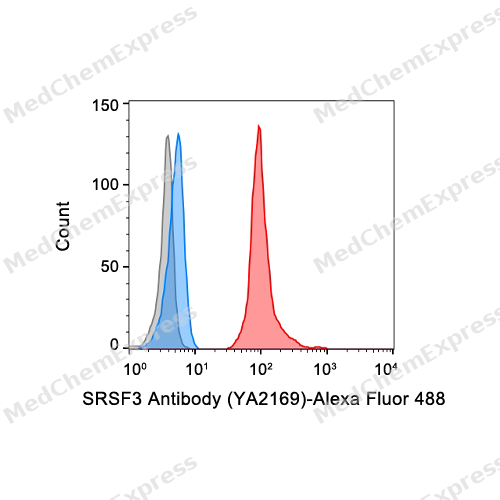 Flow cytometric analysis of 1X10^6 Jurkat cells labeling SRSF3 Antibody (YA2169) (HY-P82424, red). Cells were fixed with 4% paraformaldehyde and permeabilised with intranuclear rupture fluid. Then stained with the primary antibody at 1/50 dilution for an hour at 4℃. Alexa Fluor® 488-conjugated AffiniPure Goat Anti-Rabbit IgG H&L (HY-P8002) was used as the secondary antibody at 1/1,000 dilution for 30 minutes at 4℃. Rabbit IgG Isotype Control (HY-P80879, blue) was used as the isotype control, cells without incubation with primary antibody were used as the unlabeled control (black).


Background
-
Function
SRSF3 is a Splicing factor, which binds the consensus motif 5'-C[ACU][AU]C[ACU][AC]C-3' within pre-mRNA and promotes specific exons inclusion during alternative splicing. Interaction with YTHDC1, a RNA-binding protein that recognizes and binds N6-methyladenosine (m6A)-containing RNAs, promotes recruitment of SRSF3 to its mRNA-binding elements adjacent to m6A sites within exons. Also functions as an adapter involved in mRNA nuclear export. Binds mRNA which is thought to be transferred to the NXF1-NXT1 heterodimer for export (TAP/NXF1 pathway); enhances NXF1-NXT1 RNA-binding activity. Involved in nuclear export of m6A-containing mRNAs via interaction with YTHDC1: interaction with YTHDC1 facilitates m6A-containing mRNA-binding to both SRSF3 and NXF1, promoting mRNA nuclear export[1][2][3][4][5][6].
-
Subcellular Localization
Nucleus; Nucleus speckle; Cytoplasm
-
Isoforms & Post-Translational Modification
P84103 has 2 isomers: P84103-1: 19330 Da (predicted); P84103-2: 14203 Da (predicted).
Phosphorylated by CLK1, CLK2, CLK3 and CLK4. Extensively phosphorylated on serine residues in the RS domain -
Subunit
Interacts with CPSF6 (PubMed:15169763). Interacts with RBMY1A1 (PubMed:15595951). Interacts with SREK1/SFRS12 (PubMed:10757789). Interacts with NXF1 (PubMed:12667464, PubMed:17036044). Interacts with YTHDC1, leading to recruitment to RNA elements adjacent to m6A sites (PubMed:26876937, PubMed:28984244). Interacts with SRSP; increases SRSF3 binding to specific exons (PubMed:32440474)
-
SwissProt ID
-
Synonyms
SRSF3; SFRS3; SRP20; Serine/arginine-rich splicing factor 3; Pre-mRNA-splicing factor SRP20; Splicing factor; arginine/serine-rich 3
-
Research Field
Epigenetics and Nuclear Signaling


Documentation
-
Data Sheet (261 KB)
-
SDS (252 KB)
- English - EN (252 KB)
- Français - FR (252 KB)
- Deutsch - DE (252 KB)
- Norwegian - NO (252 KB)
- Español - ES (252 KB)
- Swedish - SV (252 KB)
- Italian - IT (252 KB)
- Korean - KR (252 KB)
- Portuguese - PT (252 KB)
-
User Guide for Antibodies (1077 KB)
References
[1]. Hargous Y, et al. Molecular basis of RNA recognition and TAP binding by the SR proteins SRp20 and 9G8. EMBO J. 2006 Nov 1;25(21):5126-37. [Content Brief]
[2]. Xiao W, et al. Nuclear m(6)A Reader YTHDC1 Regulates mRNA Splicing. Mol Cell. 2016 Feb 18;61(4):507-519. [Content Brief]
[3]. Meng N, et al. Small Protein Hidden in lncRNA LOC90024 Promotes "Cancerous" RNA Splicing and Tumorigenesis. Adv Sci (Weinh). 2020 May;7(10):1903233. [Content Brief]
[4]. Huang Y, et al. Splicing factors SRp20 and 9G8 promote the nucleocytoplasmic export of mRNA. Mol Cell. 2001 Apr;7(4):899-905. [Content Brief]
[5]. Hautbergue GM, et al. Mutually exclusive interactions drive handover of mRNA from export adaptors to TAP. Proc Natl Acad Sci U S A. 2008 Apr 1;105(13):5154-9. [Content Brief]
[6]. Roundtree IA, et al. YTHDC1 mediates nuclear export of N(6)-methyladenosine methylated mRNAs. Elife. 2017 Oct 6;6:. [Content Brief]

 Powered by Bioz
