



SULT1A1 Antibody (YA7977)
(Synonyms: HAST1/HAST2; P-PST; P-PST 1; PST; ST1A1; ST1A3; STP; STP1; ts-PST; TSPST1)
Based on 1 Customer Validation
SULT1A1 Antibody (YA7977) is a Mouse-derived and non-conjugated IgG1 monoclonal antibody, targeting to SULT1A1.
-
Host:
Mouse
-
Isotype:
IgG1
-
Application:
WB, IHC-P, ICC/IF, FC
-
Reactivity :
Human
-
Formulation:
Spplied in PBS (pH 7.3) containing 1% BSA, 50% glycerol and 0.02% sodium azide.
-
Conjugation:
Non-conjugated


To place orders, for customer services and technical support, please contact: MedChemExpress USA
Tel: 609-228-6898 E-mail: [email protected] [email protected]





Applications
| Application |
WB

WB: Western Blot
|
IHC-P
IHC-P: Immunohistochemistry-Paraffin
|
ICC/IF
ICC/IF: Immunocytochemistry/
Immunofluorescence |
FC
FC: Flow Cytometry
|
|---|---|---|---|---|
| Dilution Ratio | 1:500-2000 | 1:150-500 | 1:100-250 | 1:100 |


Product Details
SULT1A1 Antibody (YA7977) is a Mouse-derived and non-conjugated IgG1 monoclonal antibody, targeting to SULT1A1.
-
Host Mouse

-
Clonality Monoclonal

-
Species ReactivityHuman
-
Calculated Molecular Weight Predicted band size: 34.0 kDa

Full length human recombinant protein of human SULT1A1 produced in HEK293T cell.
Endogenous
Affinity purified
Non-conjugated
Unmodified
IgG1


Product Properties
-
Appearance
Solution
-
Formulation
Spplied in PBS (pH 7.3) containing 1% BSA, 50% glycerol and 0.02% sodium azide.
-
Concentration
Batch-dependent, Please check the COA for the concentration of each lot. Check Lot Concentration
-
Storage & Stability
Stored at -20°C for 1 year. Avoid repeated freeze / thaw cycles.
-
Shipping
Shipping with blue ice.


Verification Images
-
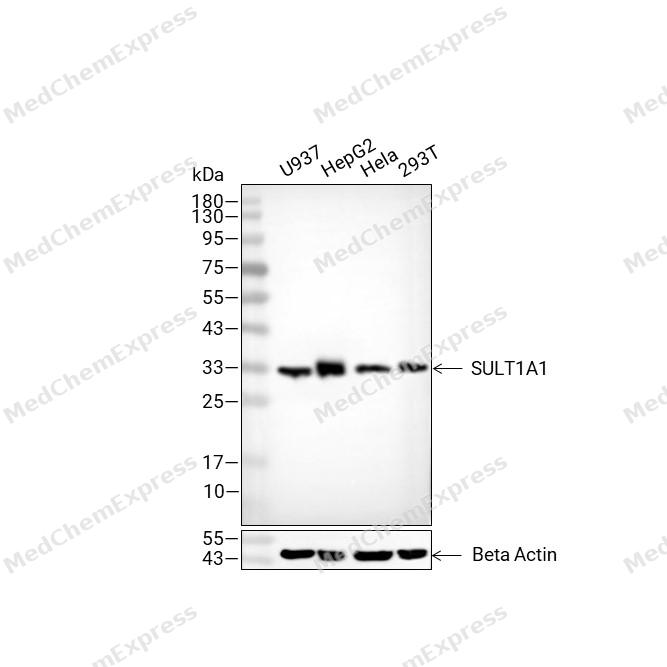 Western blot analysis of extracts from U937 (lane2(20μg), HepG2 (lane3(20μg), Hela (lane4(20μg) and 293T (lane5(20μg) using SULT1A1 Antibody (HY-P88293). Proteins were transferred to a PVDF membrane and blocked with 5% non-fat milk in TBST for 2 hour at room temperature. The primary antibody (1/2000) and Loading control antibody (Beta Actin, HY-P80993, 1/10,000) was used in 5% non-fat milk in TBST at 4°C overnight. Goat Anti-Mouse IgG-HRP Secondary Antibody (HY-P8004 ,1/10,000) was used for 1 hour at room temperature.
 -
 Immunocytochemistry analysis of HepG2 cells labeling SULT1A1 with SULT1A1 Antibody (HY-P88293) at 1/100 dilution. Cells were fixed in 4% paraformaldehyde for 15 minutes at room temperature, permeabilized with 0.1% Triton X-100 in PBS for 15 minutes at room temperature, then blocked with quick block buffer for 10 minutes at room temperature. Cells were then incubated with SULT1A1 Antibody (HY-P88293) at 1/100 dilution in quick block buffer overnight at 4 ℃.AF488-conjugated Goat Anti-Mouse IgG H&L(HY-P8005, Green) was used as the secondary antibody at 1/1,000 dilution. PBS instead of the primary antibody was used as the secondary antibody only control. The Nuclear counterstain was DAPI (Blue).
 -
 Immunocytochemistry analysis of HepG2 cells labeling SULT1A1 with SULT1A1 Antibody (HY-P88293) at 1/200 dilution. Cells were fixed in 4% paraformaldehyde for 15 minutes at room temperature, permeabilized with 0.1% Triton X-100 in PBS for 15 minutes at room temperature, then blocked with quick block buffer for 10 minutes at room temperature. Cells were then incubated with SULT1A1 Antibody (HY-P88293) at 1/200 dilution in quick block buffer overnight at 4 ℃.AF488-conjugated Goat Anti-Mouse IgG H&L(HY-P8005, Green) was used as the secondary antibody at 1/1,000 dilution. PBS instead of the primary antibody was used as the secondary antibody only control. The Nuclear counterstain was DAPI (Blue).


Background
-
Function
SULT1A1 is a Sulfotransferase that utilizes 3'-phospho-5'-adenylyl sulfate (PAPS) as sulfonate donor to catalyze the sulfate conjugation of a wide variety of acceptor molecules bearing a hydroxyl or an amine group. Sulfonation increases the water solubility of most compounds, and therefore their renal excretion, but it can also result in bioactivation to form active metabolites. Displays broad substrate specificity for small phenolic compounds. Plays an important role in the sulfonation of endogenous molecules such as steroid hormones. Mediates the sulfate conjugation of a variety of xenobiotics, including the drugs acetaminophen and minoxidil. Mediates also the metabolic activation of carcinogenic N-hydroxyarylamines leading to highly reactive intermediates capable of forming DNA adducts, potentially resulting in mutagenesis. May play a role in gut microbiota-host metabolic interaction. O-sulfonates 4-ethylphenol (4-EP), a dietary tyrosine-derived metabolite produced by gut bacteria. The product 4-EPS crosses the blood-brain barrier and may negatively regulate oligodendrocyte maturation and myelination, affecting the functional connectivity of different brain regions associated with the limbic system. Catalyzes the sulfate conjugation of dopamine. Catalyzes the sulfation of T4 (L-thyroxine/3,5,3',5'-tetraiodothyronine), T3 (3,5,3'-triiodothyronine), rT3 (3,3',5'-triiodothyronine) and 3,3'-T2 (3,3'-diiodothyronine), with a substrate preference of 3,3'-T2 > rT3 > T3 > T4[1][2][3][4][5][6][7][8].
-
Subcellular Localization
Cytoplasm
-
Expression
Tissue_Specificity: Liver, lung, adrenal, brain, platelets and skin -
Isoforms & Post-Translational Modification
P50225 has two isomers: P50225-1: 34165 Da (predicted); P50225-2: 25388 Da (predicted).
-
Subunit
Homodimer
-
SwissProt ID
-
Synonyms
HAST1/HAST2; P-PST; P-PST 1; PST; ST1A1; ST1A3; STP; STP1; ts-PST; TSPST1


Documentation

 Powered by Bioz
