



Toll-Like Receptor 3 Antibody
(Synonyms: CD283; CD283 antigen; IIAE2; TLR 3; Tlr3; TLR3_HUMAN; Toll Like Receptor 3; Toll-like receptor 3.)Based on 1 Customer Validation
Toll-Like Receptor 3 Antibody is a Rabbit-derived and non-conjugated IgG polyclonal antibody, targeting to Toll-Like Receptor 3.
-
Host:
Rabbit
-
Isotype:
IgG
-
Application:
WB, IHC-P, IHC-F, ICC/IF, ELISA
-
Reactivity :
Human, Mouse, Rat
-
Formulation:
Supplied in 0.01M TBS (pH7.4) with 1% BSA, 0.02% Proclin300 and 50% Glycerol.
-
Conjugation:
Non-conjugated


To place orders, for customer services and technical support, please contact: MedChemExpress USA
Tel: 609-228-6898 E-mail: [email protected] [email protected]





Applications
| Application |
WB

WB: Western Blot
|
IHC-P
IHC-P: Immunohistochemistry-Paraffin
|
IHC-F
IHC-F: Immunohistochemistry-Frozen
|
ICC/IF
ICC/IF: Immunocytochemistry/
Immunofluorescence |
ELISA
ELISA: Enzyme Linked Immunosorbent Assay
|
|---|---|---|---|---|---|
| Dilution Ratio | 1:500-2000 | 1:100-500 | 1:100-500 | 1:100-500 | 1:5000-10000 |


Product Details
Toll-Like Receptor 3 Antibody is a Rabbit-derived and non-conjugated IgG polyclonal antibody, targeting to Toll-Like Receptor 3.
-
Host Rabbit

-
Clonality Polyclonal

-
Species ReactivityHuman, Mouse, Rat
-
Observed Molecular WeightObserved band size: 130 kDa
Note: Due to possible protein modifications or aggregation, the molecular weight should be confirmed by actual measurement, and the predicted value is for reference only.

-
Calculated Molecular Weight Predicted band size: 105 kDa

Entrez Gene: 7098 Human ; 142980 Mouse ;
SwissProt: O15455 Human ; Q99MB1 Mouse ;
OMIM: 613002 Human
KLH conjugated synthetic peptide derived from human TLR3: 801-905/905.
Endogenous
affinity purified
Non-conjugated
Unmodified
IgG


Product Properties
-
Appearance
Solution
-
Formulation
Supplied in 0.01M TBS (pH7.4) with 1% BSA, 0.02% Proclin300 and 50% Glycerol.
-
Concentration
Batch-dependent, Please check the COA for the concentration of each lot. Check Lot Concentration
-
Storage & Stability
Stored at -20°C for 1 year. Avoid repeated freeze / thaw cycles.
-
Shipping
Shipping with blue ice.


Verification Images
-
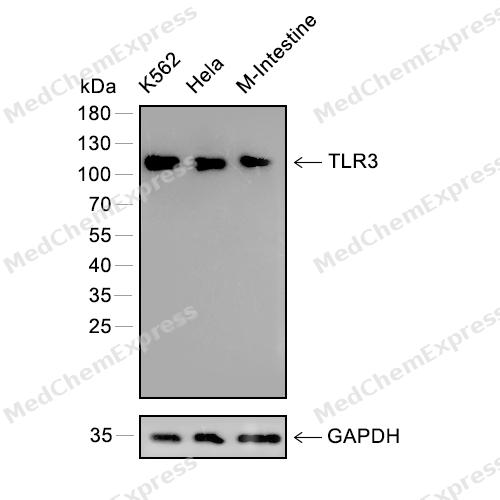 Western blot analysis of extracts from K562 (lane 1) and Hela (lane 2) and M-Intestine (lane 3) using TLR3 antibody. Proteins were transferred to a PVDF membrane and blocked with 5% nonfat powdered milk in PBST for 2 hour at room temperature. The primary antibody (1/2000) and Loading control antibody (GAPDH, 1/3000) was diluted with 5% nonfat powdered milk in PBST at 4°C overnight. Goat Anti-Rabbit IgG-HRP Secondary Antibody (1/8,000) was incubated for 45min at room temperature.
 -
 Western blot analysis was performed on protein extracts (25 μg) from Rat brain (lane 2) using Toll-Like Receptor 3 antibody. Proteins were transferred onto a 0.45 μm PVDF membrane using the Trans-Blot® Turbo™ system for 13 min. The membrane was then blocked with 5% nonfat milk in TBST (HY-K1025) for 1 h at room temperature. The primary antibody (1:1000) and loading control antibody GAPDH Antibody (HRP) (HY-P80954A) (1:5000) were diluted in 5% nonfat milk in TBST and incubated with the membrane overnight at 4°C. After washing, the membrane of primary antibody was incubated with HRP-conjugated goat anti-rabbit/mouse IgG secondary antibody (HY-P8001/HY-P8004) (1:5000) diluted in 5% nonfat milk in TBST for 1 h at room temperature. Protein bands were visualized using an Ultra High Sensitivity ECL detection kit (HY-K1005).


Background
-
Function
Toll-Like Receptor 3 is key component of innate and adaptive immunity. TLRs (Toll-like receptors) control host immune response against pathogens through recognition of molecular patterns specific to microorganisms. TLR3 is a nucleotide-sensing TLR which is activated by double-stranded RNA, a sign of viral infection. Acts via the adapter TRIF/TICAM1, leading to NF-kappa-B activation, IRF3 nuclear translocation, cytokine secretion and the inflammatory response
-
Subcellular Localization
Endoplasmic reticulum membrane; Single-pass type I membrane protein; Endosome membrane; Early endosome
-
Expression
Tissue_specificity:It is highly expressed in the placenta and pancreas. It can also be detected in CD11c+ immature dendritic cells. It is expressed only in dendritic cells and not in other leukocytes (including monocyte precursors) . TLR3 is the most strongly expressed TLR in the brain, especially in astrocytes, glial cells, and neurons. -
Isoforms & Post-Translational Modification
O15455 has 2 isomers: O15455-1: 103829 Da (predicted); O15455-2: 72937 Da (predicted).
Heavily N-glycosylated, except on that part of the surface of the ectodomain that is involved in ligand binding;TLR3 signaling requires a proteolytic cleavage mediated by cathepsins CTSB and CTSH, the cleavage occurs between amino acids 252 and 346. The cleaved form of TLR3 is the predominant form found in endosomes;Ubiquitinated by TRIM3; leading to recognition and sorting of polyubiquitinated TLR3 by the ESCRT complexes (PubMed:32878999). Ubiquitinated by ZNRF1 via 'Lys-63'-linked ubiquitin chains; leading to TLR3 lysosomal trafficking and degradation (PubMed:37158982). Ubiquitinated by RNF170 at Lys-765 via 'Lys-48'-linked ubiquitin chains; leading to TLR3 proteasomal degradation (PubMed:31076723) -
Subunit
Monomer and homodimer; dimerization is triggered by ligand-binding, the signaling unit is composed of one ds-RNA of around 40 bp and two TLR3 molecules, and lateral clustering of signaling units along the length of the ds-RNA ligand is required for TLR3 signal transduction. Interacts (via transmembrane domain) with UNC93B1; the interaction is required for transport from the ER to the endosomes (PubMed:33432245). Interacts with SRC; upon binding of double-stranded RNA. Interacts with TICAM1 (via the TIR domain) in response to poly(I:C) and this interaction is enhanced in the presence of WDFY1 (PubMed:25736436). The tyrosine-phosphorylated form (via TIR domain) interacts with WDFY1 (via WD repeat 2) in response to poly(I:C) (PubMed:25736436)
-
SwissProt ID
-
Synonyms
CD283; CD283 antigen; IIAE2; TLR 3; Tlr3; TLR3_HUMAN; Toll Like Receptor 3; Toll-like receptor 3.
-
Research Field
Immunology


Documentation
-
Data Sheet (234 KB)
-
SDS (252 KB)
- English - EN (252 KB)
- Français - FR (252 KB)
- Deutsch - DE (252 KB)
- Norwegian - NO (252 KB)
- Español - ES (252 KB)
- Swedish - SV (252 KB)
- Italian - IT (252 KB)
- Korean - KR (252 KB)
- Portuguese - PT (252 KB)
-
User Guide for Antibodies (1077 KB)

 Powered by Bioz
