



TRIM56 Antibody (YA1384)
(Synonyms: RING finger protein 109; RNF109)
Based on 1 Customer Validation
TRIM56 Antibody (YA1384) is a Rabbit-derived and non-conjugated IgG monoclonal antibody, targeting to TRIM56.
-
Host:
Rabbit
-
Isotype:
IgG
-
Application:
WB, ICC/IF
-
Reactivity :
Human
-
Formulation:
Supplied in 50mM Tris-Glycine(pH 7.4), 0.15M NaCl, 40% Glycerol, 0.01% Sodium azide and 0.05% BSA
-
Conjugation:
Non-conjugated


To place orders, for customer services and technical support, please contact: MedChemExpress USA
Tel: 609-228-6898 E-mail: [email protected] [email protected]





Applications
| Application |
WB

WB: Western Blot
|
ICC/IF
ICC/IF: Immunocytochemistry/
Immunofluorescence |
|---|---|---|
| Dilution Ratio | 1:500-1:1000 | 1:50-1:200 |


Product Details
TRIM56 Antibody (YA1384) is a Rabbit-derived and non-conjugated IgG monoclonal antibody, targeting to TRIM56.
-
Host Rabbit

-
Clonality Recombinant, Monoclonal

-
Species ReactivityHuman
-
Observed Molecular WeightObserved band size: 81 kDa
Note: Due to possible protein modifications or aggregation, the molecular weight should be confirmed by actual measurement, and the predicted value is for reference only.

-
Calculated Molecular Weight Predicted band size: 81 kDa

A synthetic peptide of human TRIM56 aa397-410.
Endogenous
Affinity Purified
Non-conjugated
Unmodified
IgG


Product Properties
-
Appearance
Liquid
-
Formulation
Supplied in 50mM Tris-Glycine(pH 7.4), 0.15M NaCl, 40% Glycerol, 0.01% Sodium azide and 0.05% BSA
-
Concentration
Batch-dependent, Please check the COA for the concentration of each lot. Check Lot Concentration
-
Storage & Stability
Stored at -20°C for 1 year. Avoid repeated freeze / thaw cycles.
-
Shipping
Shipping with blue ice.


Verification Images
-
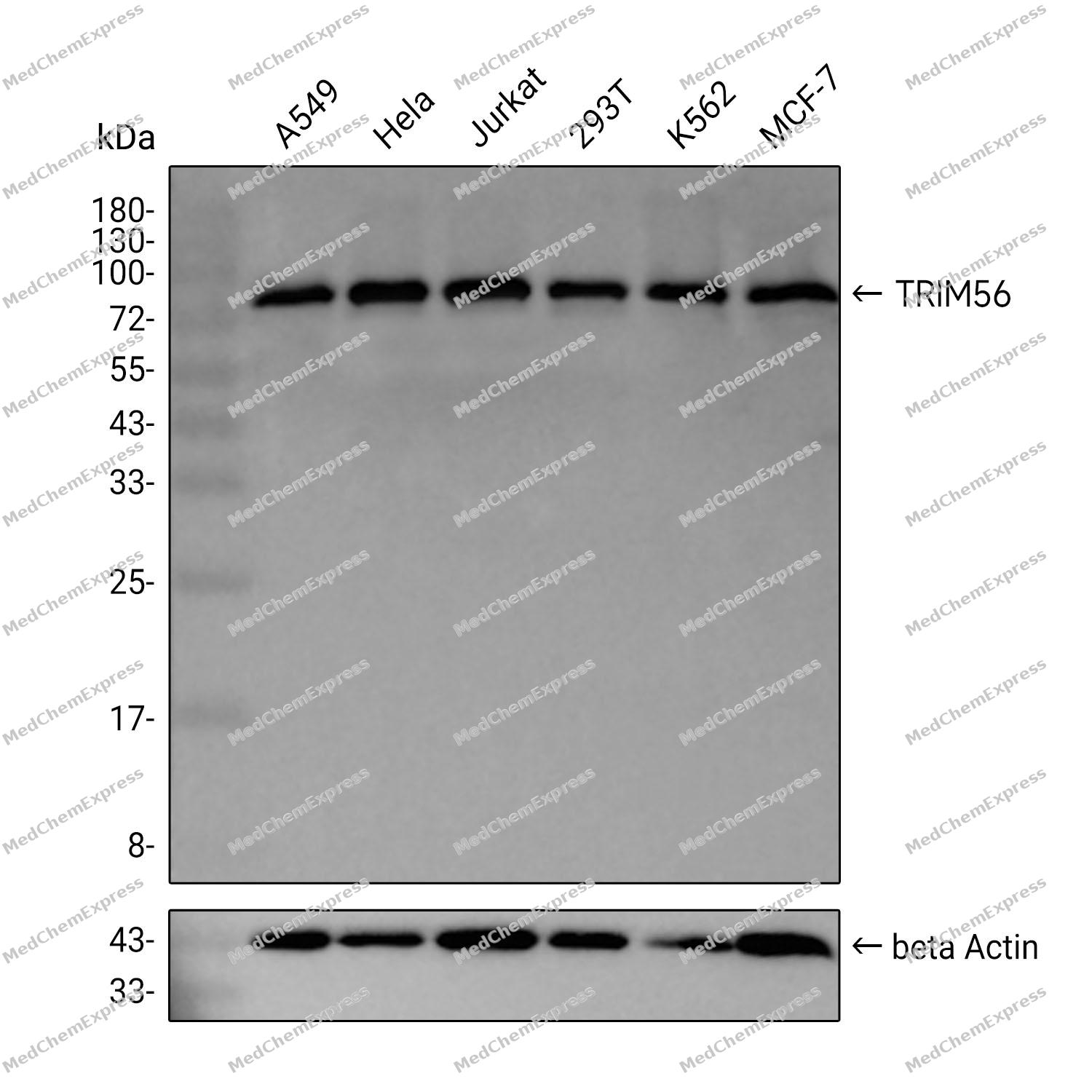
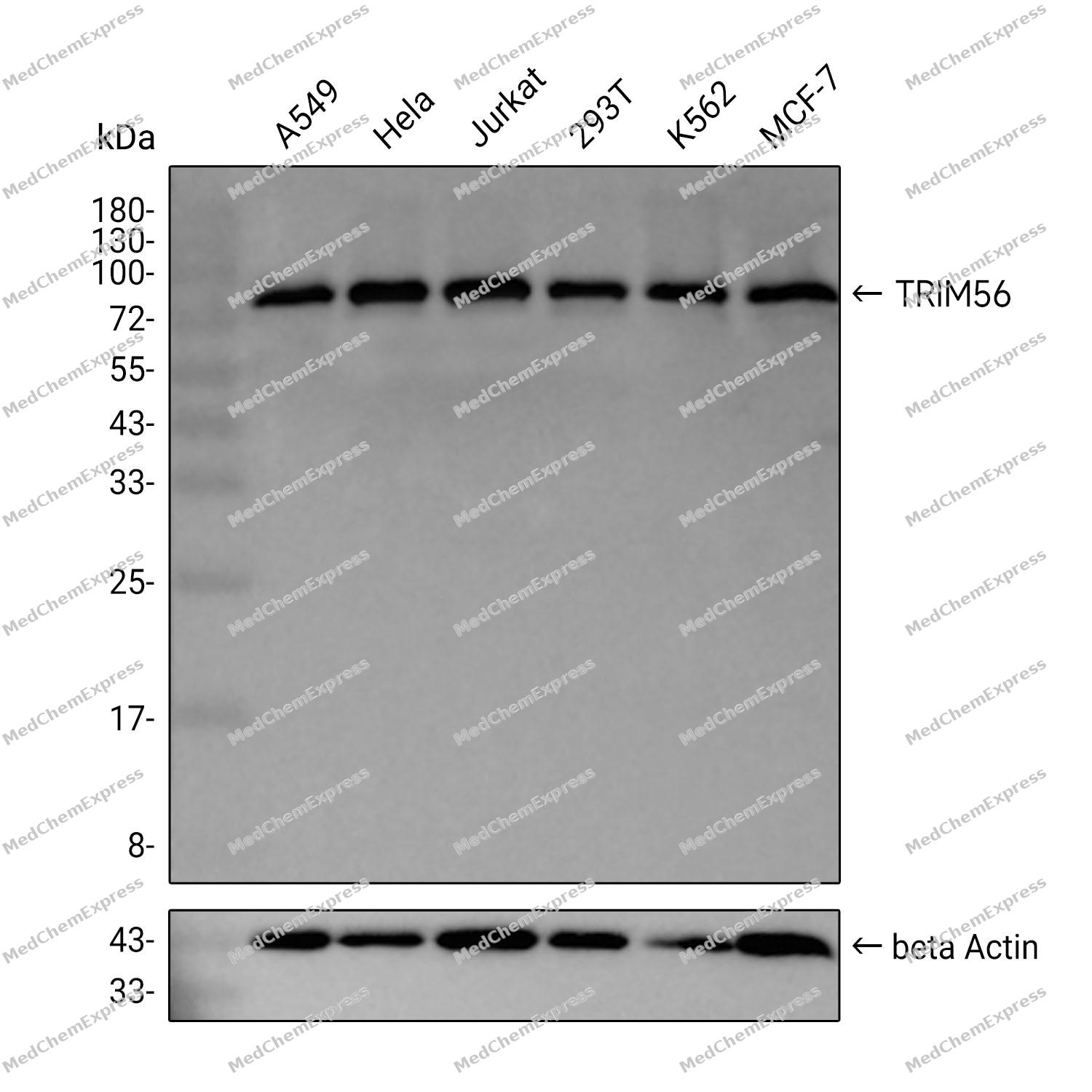 Western blot analysis was performed on extracts from A549 (lane 1, 15 μg), Hela (lane 2, 15 μg), Jurkat (lane 3, 15 μg), 293T (lane 4, 15 μg), K562 (lane 5, 15 μg), and MCF-7 (lane 6, 15 μg) using TRIM56 Rabbit mAb.Proteins were transferred to a PVDF membrane and blocked with 5% non-fat milk in TBST at 4°C overnight.The primary antibody (1:1000 dilution) and the loading control antibody (beta-Actin, HY-P80438, 1:5000 dilution) was incubated in 5% non-fat milk in TBST for 1 hour at 37°C.Goat Anti-Rabbit IgG-HRP Secondary Antibody (1:20000 dilution) was then applied for 40 minutes at 37°C.
 -
 Immunocytochemistry analysis of Hela cells labeling TRIM56 with TRIM56 Antibody (HY-P81639) at 1/100 dilution. Cells were fixed in 4% paraformaldehyde for 15 minutes at room temperature, permeabilized with 0.1% Triton X-100 in PBS for 15 minutes at room temperature, then blocked with quick block buffer for 10 minutes at room temperature. Cells were then incubated with TRIM56 Antibody (HY-P81639) at 1/100 dilution in quick block buffer overnight at 4 ℃. AF488-conjugated Goat Anti-Rabbit IgG H&L (HY-P8002, Green) was used as the secondary antibody at 1/1,000 dilution. PBS instead of the primary antibody was used as the secondary antibody only control. The Nuclear counterstain was DAPI (Blue).
 -
 Immunocytochemistry analysis of Hela cells labeling TRIM56 with TRIM56 Antibody (HY-P81639) at 1/200 dilution. Cells were fixed in 4% paraformaldehyde for 15 minutes at room temperature, permeabilized with 0.1% Triton X-100 in PBS for 15 minutes at room temperature, then blocked with quick block buffer for 10 minutes at room temperature. Cells were then incubated with TRIM56 Antibody (HY-P81639) at 1/200 dilution in quick block buffer overnight at 4 ℃. AF488-conjugated Goat Anti-Rabbit IgG H&L (HY-P8002, Green) was used as the secondary antibody at 1/1,000 dilution. PBS instead of the primary antibody was used as the secondary antibody only control. The Nuclear counterstain was DAPI (Blue).


Background
-
Function
TRIM56 is an E3 ubiquitin-protein ligase that plays a key role in innate antiviral immunity by mediating ubiquitination of CGAS and STING1. In response to pathogen- and host-derived double-stranded DNA (dsDNA), targets STING1 to 'Lys-63'-linked ubiquitination, thereby promoting its homodimerization, a step required for the production of type I interferon IFN-beta. Also mediate monoubiquitination of CGAS, thereby promoting CGAS oligomerization and subsequent activation. Promotes also TNFalpha-induced NF-kappa-B signaling by mediating 'Lys-63'-linked ubiquitination TAK1, leading to enhanced interaction between TAK1 and CHUK/IKKalpha. Independently of its E3 ubiquitin ligase activity, positive regulator of TLR3 signaling. Potentiates extracellular double stranded RNA (dsRNA)-induced expression of IFNB1 and interferon-stimulated genes ISG15, IFIT1/ISG56, CXCL10, OASL and CCL5/RANTES. Promotes establishment of an antiviral state by TLR3 ligand and TLR3-mediated chemokine induction following infection by hepatitis C virus. Acts as a restriction factor of Zika virus through direct interaction with the viral RNA via its C-terminal region[1][2][3][4][5].
-
Subcellular Localization
Cytoplasm
-
Expression
Tissue_specificity:Widely expressed (at protein level)
Induction:Up-regulated by IFN-alpha -
Isoforms & Post-Translational Modification
Q9BRZ2 has 3 isomers: Q9BRZ2-1: 81488 Da (predicted); Q9BRZ2-2: 33550 Da (predicted); Q9BRZ2-3: 29185 Da (predicted).
(Microbial infection) Preferentially ubiquitinated with 'Lys-48' and 'Lys-11'-linked ubiquitin chains by Salmonella effector SopA leading to proteasomal targeting and degradation;Autoubiquitinated -
Subunit
Homooligomer. Interacts with TICAM1 (PubMed:22948160)
-
SwissProt ID
-
Synonyms
RING finger protein 109; RNF109
-
Research Field
Epigenetics and Nuclear Signaling


Documentation
-
Data Sheet (232 KB)
-
SDS (251 KB)
- English - EN (251 KB)
- Français - FR (251 KB)
- Deutsch - DE (251 KB)
- Norwegian - NO (251 KB)
- Español - ES (251 KB)
- Swedish - SV (251 KB)
- Italian - IT (251 KB)
- Korean - KR (251 KB)
- Portuguese - PT (251 KB)
-
User Guide for Antibodies (1077 KB)

 Powered by Bioz
