



Tuberin Antibody (YA3037)
(Synonyms: TSC2; Tuberous sclerosis 2 homolog protein; Tuberous sclerosis 2 protein; Tuberin; TSC4)
Based on 1 Customer Validation
Tuberin Antibody (YA3037) is a Rabbit-derived and non-conjugated IgG monoclonal antibody, targeting to Tuberin.
-
Host:
Rabbit
-
Isotype:
IgG
-
Application:
WB, IHC-P, FC
-
Reactivity :
Human, Mouse, Rat
-
Formulation:
Supplied in 50mM Tris-Glycine(pH 7.4), 0.15M NaCl, 40%Glycerol, 0.01% sodium azide and 0.05% BSA.
-
Conjugation:
Non-conjugated


To place orders, for customer services and technical support, please contact: MedChemExpress USA
Tel: 609-228-6898 E-mail: [email protected] [email protected]





Applications
| Application |
WB

WB: Western Blot
|
IHC-P
IHC-P: Immunohistochemistry-Paraffin
|
FC
FC: Flow Cytometry
|
|---|---|---|---|
| Dilution Ratio | 1:500-1:1000 | 1:50-1:100 | 1:50-1:100 |


Product Details
Tuberin Antibody (YA3037) is a Rabbit-derived and non-conjugated IgG monoclonal antibody, targeting to Tuberin.
-
Host Rabbit

-
Clonality Recombinant,Monoclonal

-
Species ReactivityHuman, Mouse, Rat
-
Observed Molecular WeightObserved band size: 201 kDa
Note: Due to possible protein modifications or aggregation, the molecular weight should be confirmed by actual measurement, and the predicted value is for reference only.

-
Calculated Molecular Weight Predicted band size: 201 kDa

Entrez Gene: 7249 Human ; 24855 Rat
SwissProt: P49815 Human ; Q61037 Mouse ; P49816 Rat
OMIM: 613254 Human
A synthesized peptide derived from human Tuberin aa1750-1807.
Endogenous
Affinity Chromatography
Non-conjugated
Unmodified
IgG


Product Properties
-
Appearance
Solution
-
Formulation
Supplied in 50mM Tris-Glycine(pH 7.4), 0.15M NaCl, 40%Glycerol, 0.01% sodium azide and 0.05% BSA.
-
Concentration
Batch-dependent, Please check the COA for the concentration of each lot. Check Lot Concentration
-
Storage & Stability
Stored at -20°C for 1 year. Avoid repeated freeze / thaw cycles.
-
Shipping
Shipping with blue ice.


Verification Images
-
 Western blot analysis of extracts from Jurkat (lane 2(20μg) and Jurkat (lane 3(40μg) using Tuberin (HY-P83292) Rabbit mAb. Proteins were transferred to a PVDF membrane and blocked with 5% non-fat milk in TBST for 2 hour at room temperature. The primary antibody (1/1000) and Loading control antibody (Beta Actin, HY-P80438, 1/10000) was used in 5% non-fat milk in TBST at 4°C overnight. Goat Anti-Rabbit IgG-HRP Secondary Antibody (1/10000) was used for 1 hour at room temperature.
 -
 Immunohistochemical analysis of paraffin-embedded mouse testis tissue using Tuberin Antibody. The section was pre-treated using heat mediated antigen retrieval with sodium citrate buffer (pH 6.0) for 8 minutes. The tissues were blocked in QuickBlock for 20 minutes at room temperature, washed with ddH2O and PBS, and then probed with the primary antibody at 1/100 dilution in 4℃ overnight. The detection was performed using an HRP conjugated compact polymer system. DAB was used as the chromogen. Tissues were counterstained with hematoxylin and mounted with DPX.
 -
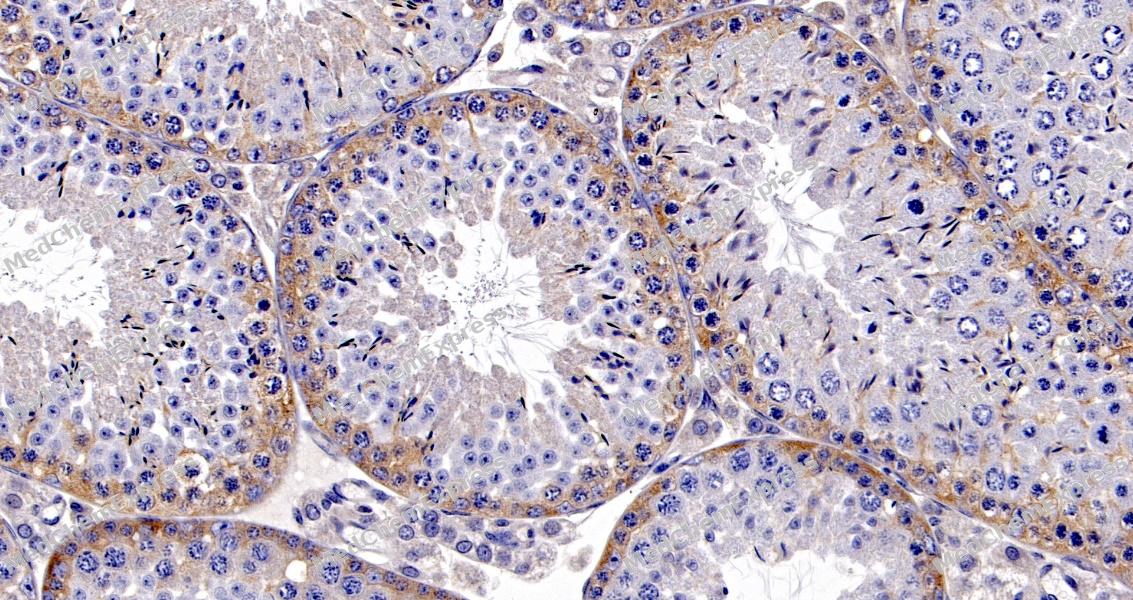 Immunohistochemical analysis of paraffin-embedded mouse testis tissue using Tuberin Antibody. The section was pre-treated using heat mediated antigen retrieval with sodium citrate buffer (pH 6.0) for 8 minutes. The tissues were blocked in QuickBlock for 20 minutes at room temperature, washed with ddH2O and PBS, and then probed with the primary antibody at 1/100 dilution in 4℃ overnight. The detection was performed using an HRP conjugated compact polymer system. DAB was used as the chromogen. Tissues were counterstained with hematoxylin and mounted with DPX.
 -
 Flow cytometric analysis of 1X10⁶ Jurkat cells labeling Tuberin Antibody (HY-P83292, red). Cells were fixed with 4% paraformaldehyde and permeabilised with 90% methanol. Then stained with the primary antibody at 1/50 dilution for an hour at 4℃. AF488-conjugated Goat Anti-Rabbit IgG H&L (HY-P8002) was used as the secondary antibody at 1/1,000 dilution for 30 minutes at 4℃. Rabbit IgG Isotype Control (HY-P80879, blue) was used as the isotype control, cells without incubation with primary antibody were used as the unlabeled control (black).


Background
-
Function
Tuberin is a Catalytic component of the TSC-TBC complex, a multiprotein complex that acts as a negative regulator of the canonical mTORC1 complex, an evolutionarily conserved central nutrient sensor that stimulates anabolic reactions and macromolecule biosynthesis to promote cellular biomass generation and growth. Within the TSC-TBC complex, TSC2 acts as a GTPase-activating protein (GAP) for the small GTPase RHEB, a direct activator of the protein kinase activity of mTORC1. In absence of nutrients, the TSC-TBC complex inhibits mTORC1, thereby preventing phosphorylation of ribosomal protein S6 kinase (RPS6KB1 and RPS6KB2) and EIF4EBP1 (4E-BP1) by the mTORC1 signaling. The TSC-TBC complex is inactivated in response to nutrients, relieving inhibition of mTORC1. Involved in microtubule-mediated protein transport via its ability to regulate mTORC1 signaling. Also stimulates the intrinsic GTPase activity of the Ras-related proteins RAP1A and RAB5[1][2][3][4][5][6][7][8][9][10][11].
-
Subcellular Localization
Lysosome membrane; Peripheral membrane protein; Cytoplasm, cytosol
-
Expression
Tissue_specificity:Liver, brain, heart, lymphocytes, fibroblasts, bile duct epithelial cells, pancreas, skeletal muscle, kidneys, lungs, and placenta -
Isoforms & Post-Translational Modification
P49815 has 8 isomers: P49815-1: 200608 Da (predicted); P49815-2: 195847 Da (predicted); P49815-3: 195760 Da (predicted); P49815-4: 198097 Da (predicted); P49815-5: 193249 Da (predicted); P49815-6: 189298 Da (predicted); P49815-7: 187956 Da (predicted); P49815-8: 25773 Da (predicted).
Phosphorylation at Ser-939 and Thr-1462 by PKB/AKT1 in response to insulin signaling and growth factor stimulation inhibits the ability of the TSC-TBC complex to suppress mTORC1 signaling: phosphorylation promotes dissociation of the TSC-TBC complex from lysosomal membranes, leading to activation of mTORC1 by RHEB (PubMed:12150915, PubMed:12172553, PubMed:24529379). Phosphorylation at Ser-1387, Ser-1418 or Ser-1420 does not affect interaction with TSC1 (PubMed:15963462). Phosphorylation by AMPK activates it and leads to negative regulation of the mTORC1 complex (PubMed:14651849). Phosphorylated at Ser-1798 by RPS6KA1; phosphorylation inhibits TSC2 ability to suppress mTORC1 signaling (PubMed:15342917). Phosphorylated by DAPK1 (PubMed:18974095);Ubiquitinated by the DCX(FBXW5) E3 ubiquitin-protein ligase complex, leading to its subsequent degradation (PubMed:18381890, PubMed:27278822). Ubiquitinated by MYCBP2 independently of its phosphorylation status leading to subsequent degradation; association with TSC1 protects from ubiquitination (PubMed:18308511) -
Subunit
Component of the TSC-TBC complex (also named Rhebulator complex), composed of 2 molecules of TSC1, 2 molecules of TSC2 and 1 molecule of TBC1D7 (PubMed:10585443, PubMed:12172553, PubMed:12842888, PubMed:12906785, PubMed:15963462, PubMed:22795129, PubMed:24529379, PubMed:28215400, PubMed:33436626, PubMed:9580671). Probably forms a complex composed of chaperones HSP90 and HSP70, co-chaperones STIP1/HOP, CDC37, PPP5C, PTGES3/p23, TSC1 and client protein TSC2 (PubMed:29127155). Probably forms a complex composed of chaperones HSP90 and HSP70, co-chaperones CDC37, PPP5C, TSC1 and client protein TSC2, CDK4, AKT, RAF1 and NR3C1; this complex does not contain co-chaperones STIP1/HOP and PTGES3/p23 (PubMed:29127155). Forms a complex containing HSP90AA1, TSC1 and TSC2; TSC1 is required to recruit TCS2 to the complex thereby stabilizing TSC2 (PubMed:29127155). Interacts with TSC1 and HERC1; the interaction with TSC1 stabilizes TSC2 and prevents the interaction with HERC1 (PubMed:16464865). May also interact with the adapter molecule RABEP1 (PubMed:9045618). The final complex may contain TSC2 and RABEP1 linked to RAB5 (PubMed:9045618). Interacts with HSPA1 and HSPA8 (PubMed:15963462). Interacts with NAA10 (via C-terminal domain) (PubMed:20145209). Interacts with RRAGA (polyubiquitinated) (PubMed:25936802). Interacts with WDR45B (PubMed:28561066). Interacts with RPAP3 and URI1 (PubMed:28561026). Interacts with YWHAG (PubMed:33473107). Interacts with RHEB (PubMed:25816988)
-
SwissProt ID
-
Synonyms
TSC2; Tuberous sclerosis 2 homolog protein; Tuberous sclerosis 2 protein; Tuberin; TSC4
-
Research Field
Cell Biology


Documentation
-
Data Sheet (234 KB)
-
SDS (251 KB)
- English - EN (251 KB)
- Français - FR (251 KB)
- Deutsch - DE (251 KB)
- Norwegian - NO (251 KB)
- Español - ES (251 KB)
- Swedish - SV (251 KB)
- Italian - IT (251 KB)
- Korean - KR (251 KB)
- Portuguese - PT (251 KB)
-
User Guide for Antibodies (1077 KB)

 Powered by Bioz
