



VAV3 Antibody (YA2515)
(Synonyms: RGD1565941; VAV 3; Vav3; VAV3 oncogene)
Based on 1 Customer Validation
VAV3 Antibody (YA2515) is a Rabbit-derived and non-conjugated IgG monoclonal antibody, targeting to VAV3.
-
Host:
Rabbit
-
Isotype:
IgG
-
Application:
WB, ICC/IF, IP, FC
-
Reactivity :
Human, Mouse
-
Formulation:
Supplied in 50mM Tris-Glycine(pH 7.4), 0.15M NaCl, 40%Glycerol, 0.01% sodium azide and 0.05% BSA.
-
Conjugation:
Non-conjugated


To place orders, for customer services and technical support, please contact: MedChemExpress USA
Tel: 609-228-6898 E-mail: [email protected] [email protected]





Applications
| Application |
WB

WB: Western Blot
|
ICC/IF
ICC/IF: Immunocytochemistry/
Immunofluorescence |
IP
IP: Immunoprecipitation
|
FC
FC: Flow Cytometry
|
|---|---|---|---|---|
| Dilution Ratio | 1:500-1:1000 | 1:50-1:200 | 1:50 | 1:50-1:100 |


Product Details
VAV3 Antibody (YA2515) is a Rabbit-derived and non-conjugated IgG monoclonal antibody, targeting to VAV3.
-
Host Rabbit

-
Clonality Recombinant,Monoclonal

-
Species ReactivityHuman, Mouse
-
Observed Molecular WeightObserved band size: 98 kDa
Note: Due to possible protein modifications or aggregation, the molecular weight should be confirmed by actual measurement, and the predicted value is for reference only.

-
Calculated Molecular Weight Predicted band size: 98 kDa

Entrez Gene: 10451 Human ; 57257 Mouse ;
SwissProt: Q9UKW4 Human ; Q9R0C8 Mouse ;
OMIM: 605541 Human
A synthesized peptide derived from human VAV3 aa750-800/847.
Endogenous
Affinity Purified
Non-conjugated
Unmodified
IgG


Product Properties
-
Appearance
Solution
-
Formulation
Supplied in 50mM Tris-Glycine(pH 7.4), 0.15M NaCl, 40%Glycerol, 0.01% sodium azide and 0.05% BSA.
-
Concentration
Batch-dependent, Please check the COA for the concentration of each lot. Check Lot Concentration
-
Storage & Stability
Stored at -20°C for 1 year. Avoid repeated freeze / thaw cycles.
-
Shipping
Shipping with blue ice.


Verification Images
-
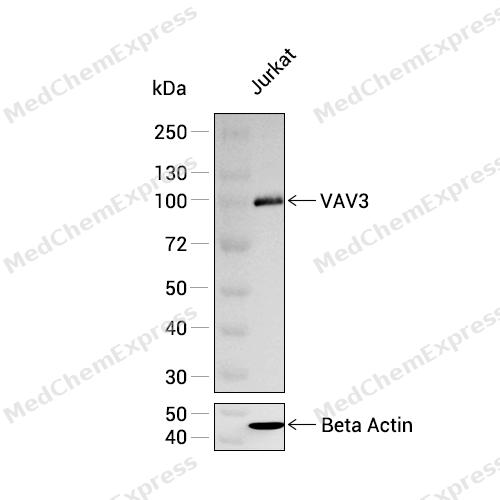 Western blot analysis was performed on extracts from Jurkat (lane 1, 15 μg) using VAV3 Rabbit mAb.Proteins were transferred to a PVDF membrane and blocked with 5% non-fat milk in TBST at 4°C overnight.The primary antibody (1:1000 dilution) and the loading control antibody (beta-Actin, HY-P83730, 1:20000 dilution) were incubated in 5% non-fat milk in TBST for 1 hour at 37°C.Goat Anti-Rabbit IgG-HRP Secondary Antibody (1:20000 dilution) was then applied for 40 minutes at 37°C.
 -
 Western blot analysis of extracts from Jurkat(lane 2(20ug),Hela(lane 3(20ug) using VAV3 Antibody (HY-P82770) Rabbit mAb. Proteins were transferred to a PVDF membrane and blocked with 5% non-fat milk in TBST for 2 hour at room temperature. The primary antibody (1/1000) and Loading control antibody (Beta Actin, HY-P83730, 1/10000) was used in 5% non-fat milk in TBST at 4°C overnight. Goat Anti-Mouse/Rabbit IgG-HRP Secondary Antibody (1/10000) was used for 1 hour at room temperature.
 -
 Flow cytometric analysis of 1X10⁶ Jurkat cells labeling VAV3 Antibody (HY-P82770, red). Cells were fixed with 4% paraformaldehyde and permeabilised with 90% methanol. Then stained with the primary antibody at 1/50 dilution for an hour at 4℃. AF488-conjugated Goat Anti-Rabbit IgG H&L (HY-P8002) was used as the secondary antibody at 1/1,000 dilution for 30 minutes at 4℃. Rabbit IgG Isotype Control (HY-P80879, blue) was used as the isotype control, cells without incubation with primary antibody were used as the unlabeled control (black).


Background
-
Function
VAV3 is an Exchange factor for GTP-binding proteins RhoA, RhoG and, to a lesser extent, Rac1. Binds physically to the nucleotide-free states of those GTPases. Plays an important role in angiogenesis. Its recruitment by phosphorylated EPHA2 is critical for EFNA1-induced RAC1 GTPase activation and vascular endothelial cell migration and assembly. May be important for integrin-mediated signaling, at least in some cell types. In osteoclasts, along with SYK tyrosine kinase, required for signaling through integrin alpha-v/beta-1 (ITAGV-ITGB1), a crucial event for osteoclast proper cytoskeleton organization and function. This signaling pathway involves RAC1, but not RHO, activation. Necessary for proper wound healing. In the course of wound healing, required for the phagocytotic cup formation preceding macrophage phagocytosis of apoptotic neutrophils. Responsible for integrin beta-2 (ITGB2)-mediated macrophage adhesion and, to a lesser extent, contributes to beta-3 (ITGB3)-mediated adhesion. Does not affect integrin beta-1 (ITGB1)-mediated adhesion
-
Expression
Tissue_specificity:Isoform 1 and isoform 3 are widely expressed; both are expressed at very low levels in skeletal muscle. In keratinocytes, isoform 1 is less abundant than isoform 3. Isoform 3 is detected at very low levels, if any, in adrenal gland, bone marrow, spleen, fetal brain and spinal cord; in these tissues, isoform 1 is readily detectable
Induction:Down-regulated by EGF and TGF-beta -
Isoforms & Post-Translational Modification
Q9UKW4 has 4 isomers: Q9UKW4-1: 97776 Da (predicted); Q9UKW4-2: 86696 Da (predicted); Q9UKW4-3: 32604 Da (predicted); Q9UKW4-4: 100828 Da (predicted).
Phosphorylated. Phosphorylation can be mediated by ROS1. In osteoclasts, undergoes tyrosine phosphorylation in response to CSF1 (By similarity) -
Subunit
Interacts with the PH domain of SH2B2. Interacts (via SH2 domains) with the phosphorylated form of EPHA2. Interacts with ROS1; constitutive interaction that mediates VAV3 phosphorylation
-
SwissProt ID
-
Synonyms
RGD1565941; VAV 3; Vav3; VAV3 oncogene
-
Research Field
Signal Transduction


Documentation
-
Data Sheet (234 KB)
-
SDS (252 KB)
- English - EN (252 KB)
- Français - FR (252 KB)
- Deutsch - DE (252 KB)
- Norwegian - NO (252 KB)
- Español - ES (252 KB)
- Swedish - SV (252 KB)
- Italian - IT (252 KB)
- Korean - KR (252 KB)
- Portuguese - PT (252 KB)
-
User Guide for Antibodies (1077 KB)

 Powered by Bioz
