



VPS26 Antibody (YA1546)
(Synonyms: HB58; Hbeta58; hVPS26; PEP8A; VPS 26; VPS26A)
Based on 1 Customer Validation
VPS26 Antibody (YA1546) is a Rabbit-derived and non-conjugated IgG monoclonal antibody, targeting to VPS26.
-
Host:
Rabbit
-
Isotype:
IgG
-
Application:
WB, ICC/IF, IP
-
Reactivity :
Human, Mouse, Rat
-
Formulation:
Supplied in Rabbit IgG in 10mM phosphate buffered saline , pH 7.4, 150mM sodium chloride, 0.05% BSA, 0.02% sodium azide and 50% glycerol.
-
Conjugation:
Non-conjugated


To place orders, for customer services and technical support, please contact: MedChemExpress USA
Tel: 609-228-6898 E-mail: [email protected] [email protected]





Applications
| Application |
WB

WB: Western Blot
|
ICC/IF
ICC/IF: Immunocytochemistry/
Immunofluorescence |
IP
IP: Immunoprecipitation
|
|---|---|---|---|
| Dilution Ratio | 1:500-1:1000 | 1:50-1:200 | 1:50 |


Product Details
VPS26 Antibody (YA1546) is a Rabbit-derived and non-conjugated IgG monoclonal antibody, targeting to VPS26.
-
Host Rabbit

-
Clonality Recombinant, Monoclonal

-
Species ReactivityHuman, Mouse, Rat
-
Observed Molecular WeightObserved band size: 38 kDa
Note: Due to possible protein modifications or aggregation, the molecular weight should be confirmed by actual measurement, and the predicted value is for reference only.

-
Calculated Molecular Weight Predicted band size: 38 kDa

Entrez Gene: 9559 Human ; 30930 Mouse ; 361846 Rat
SwissProt: O75436 Human ; P40336 Mouse ; Q6AY86 Rat
OMIM: 605506 Human
A synthesized peptide derived from human VPS26 aa270-327/327.
Endogenous
Affinity Chromatography
Non-conjugated
Unmodified
IgG


Product Properties
-
Appearance
Liquid
-
Formulation
Supplied in Rabbit IgG in 10mM phosphate buffered saline , pH 7.4, 150mM sodium chloride, 0.05% BSA, 0.02% sodium azide and 50% glycerol.
-
Concentration
Batch-dependent, Please check the COA for the concentration of each lot. Check Lot Concentration
-
Storage & Stability
Stored at -20°C for 1 year. Avoid repeated freeze / thaw cycles.
-
Shipping
Shipping with blue ice.


Verification Images
-
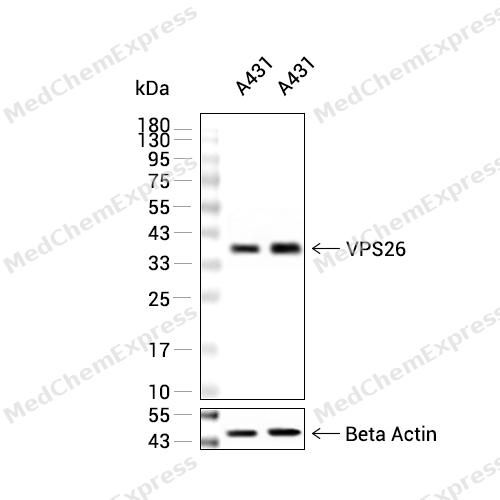 Western blot analysis of extracts from A431 (lane 2(20μg), A431 (lane 3(40μg), using VPS26 Antibody. Proteins were transferred to a PVDF membrane and blocked with 5% BSA in TBST for 2 hour at room temperature. The primary antibody and Loading control antibody (Beta Actin, HY-P80438, 1/3000) was used in 5% BSA in TBST at 4°C overnight. Goat Anti-Mouse/Rabbit IgG-HRP Secondary Antibody (HY-P8004/HY-P8001, 1/10,000) was used for 1 hour at room temperature.
 -
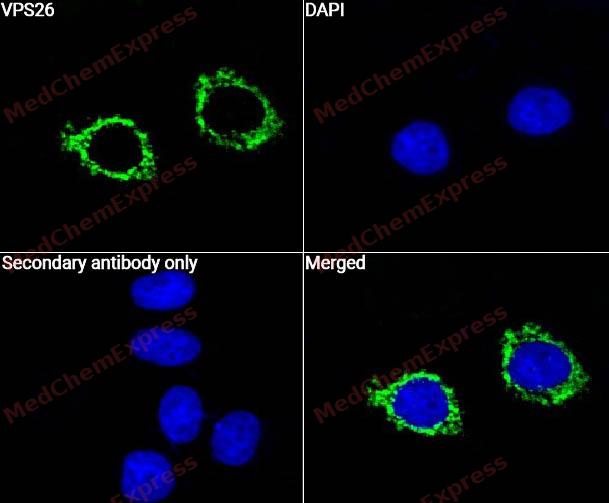 Immunocytochemistry analysis of Hela cells labeling VPS26 with VPS26 Antibody (HY-P81801) at 1/50 dilution. Cells were fixed in 4% paraformaldehyde for 15 minutes at room temperature, permeabilized with 0.1% Triton X-100 for 10 minutes at room temperature, then blocked with QuickBlock™ Blocking Buffer for Immunol Staining for 10 min at room temperature. Cells were then incubated with VPS26 Antibody (HY-P81801) at 1/50 dilution in QuickBlock™ Blocking Buffer for Immunol Staining at 4 ℃. Alexa Fluor® 488-conjugated AffiniPure Goat Anti-Rabbit IgG H&L(HY-P8002, Green) was used as the secondary antibody at 1/1,000 dilution. PBS instead of the primary antibody was used as the secondary antibody only control. The Nuclear counterstain was DAPI (Blue).
 -
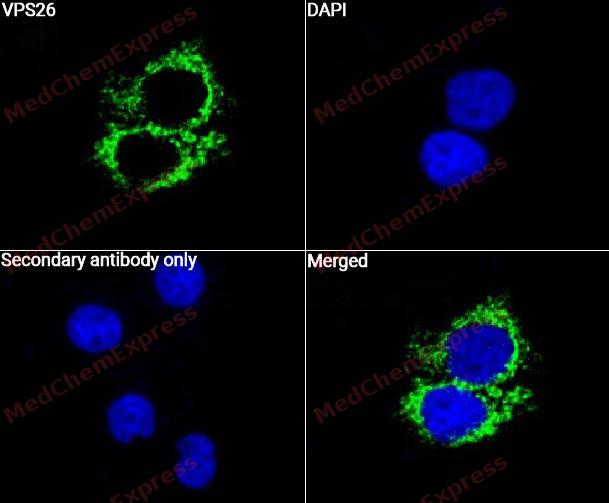 Immunocytochemistry analysis of PC-3 cells labeling VPS26 with VPS26 Antibody (HY-P81801) at 1/50 dilution. Cells were fixed in 4% paraformaldehyde for 15 minutes at room temperature, permeabilized with 0.1% Triton X-100 for 10 minutes at room temperature, then blocked with QuickBlock™ Blocking Buffer for Immunol Staining for 10 min at room temperature. Cells were then incubated with VPS26 Antibody (HY-P81801) at 1/50 dilution in QuickBlock™ Blocking Buffer for Immunol Staining at 4 ℃. Alexa Fluor® 488-conjugated AffiniPure Goat Anti-Rabbit IgG H&L(HY-P8002, Green) was used as the secondary antibody at 1/1,000 dilution. PBS instead of the primary antibody was used as the secondary antibody only control. The Nuclear counterstain was DAPI (Blue).


Background
-
Function
VPS26 acts as a component of the retromer cargo-selective complex (CSC). The CSC is believed to be the core functional component of retromer or respective retromer complex variants acting to prevent missorting of selected transmembrane cargo proteins into the lysosomal degradation pathway. The recruitment of the CSC to the endosomal membrane involves RAB7A and SNX3. The SNX-BAR retromer mediates retrograde transport of cargo proteins from endosomes to the trans-Golgi network (TGN) and is involved in endosome-to-plasma membrane transport for cargo protein recycling. The SNX3-retromer mediates the retrograde endosome-to-TGN transport of WLS distinct from the SNX-BAR retromer pathway. The SNX27-retromer is believed to be involved in endosome-to-plasma membrane trafficking and recycling of a broad spectrum of cargo proteins (Probable). The CSC seems to act as recruitment hub for other proteins, such as the WASH complex and TBC1D5 (Probable). Required for retrograde transport of lysosomal enzyme receptor IGF2R. Required to regulate transcytosis of the polymeric immunoglobulin receptor (pIgR-pIgA). Required for the endosomal localization of WASHC2A (indicative for the WASH complex). Required for the endosomal localization of TBC1D5. Mediates retromer cargo recognition of SORL1 and is involved in trafficking of SORL1 implicated in sorting and processing of APP. Involved in retromer-independent lysosomal sorting of F2R. Involved in recycling of ADRB2. Enhances the affinity of SNX27 for PDZ-binding motifs in cargo proteins[1][2][3][4][5][6][7][8].
-
Subcellular Localization
Cytoplasm; Endosome membrane; Peripheral membrane protein; Early endosome
-
Expression
Induction:Down-regulated in Alzheimer disease. No polymorphism or variant is however associated with Alzheimer disease for VPS26A -
Isoforms & Post-Translational Modification
O75436 has 2 isomers: O75436-1: 38170 Da (predicted); O75436-2: 28938 Da (predicted).
-
Subunit
Component of the heterotrimeric retromer cargo-selective complex (CSC), also described as vacuolar protein sorting subcomplex (VPS), formed by VPS26 (VPS26A or VPS26B), VPS29 and VPS35 (PubMed:11102511, PubMed:28892079). The CSC has a highly elongated structure with VPS26 and VPS29 binding independently at opposite distal ends of VPS35 as central platform (By similarity). The CSC is believed to associate with variable sorting nexins to form functionally distinct retromer complex variants. The originally described retromer complex (also called SNX-BAR retromer) is a pentamer containing the CSC and a heterodimeric membrane-deforming subcomplex formed between SNX1 or SNX2 and SNX5 or SNX6 (also called SNX-BAR subcomplex); the respective CSC and SNX-BAR subcomplexes associate with low affinity. The CSC associates with SNX3 to form a SNX3-retromer complex. The CSC associates with SNX27, the WASH complex and the SNX-BAR subcomplex to form the SNX27-retromer complex (Probable). Interacts with VPS29, VPS35, SNX1, SNX2, SNX5, SNX6, SNX3, SNX27, RAB7A, ECPAS, EHD1, WASHC5, SORL1 (PubMed:11102511, PubMed:16190980, PubMed:16732284, PubMed:17868075, PubMed:19531583, PubMed:19619496, PubMed:20682791, PubMed:20923837, PubMed:21725319, PubMed:22279231, PubMed:24344282, PubMed:28892079, PubMed:30213940)
-
SwissProt ID
-
Synonyms
HB58; Hbeta58; hVPS26; PEP8A; VPS 26; VPS26A
-
Research Field
Signal Transduction


Documentation
-
Data Sheet (258 KB)
-
SDS (251 KB)
- English - EN (251 KB)
- Français - FR (251 KB)
- Deutsch - DE (251 KB)
- Norwegian - NO (251 KB)
- Español - ES (251 KB)
- Swedish - SV (251 KB)
- Italian - IT (251 KB)
- Korean - KR (251 KB)
- Portuguese - PT (251 KB)
-
User Guide for Antibodies (1077 KB)

 Powered by Bioz
