



YTHDF1 Antibody (YA1429)
(Synonyms: C20orf21; DF1)
Based on 1 Customer Validation
YTHDF1 Antibody (YA1429) is a Rabbit-derived and non-conjugated IgG monoclonal antibody, targeting to YTHDF1.
-
Host:
Rabbit
-
Isotype:
IgG
-
Application:
WB, IP
-
Reactivity :
Human, Hamster
-
Formulation:
Supplied in 50mM Tris-Glycine(pH 7.4), 0.15M NaCl, 40% Glycerol, 0.01% Sodium azide and 0.05% BSA
-
Conjugation:
Non-conjugated


To place orders, for customer services and technical support, please contact: MedChemExpress USA
Tel: 609-228-6898 E-mail: [email protected] [email protected]





Applications
| Application |
WB

WB: Western Blot
|
IP
IP: Immunoprecipitation
|
|---|---|---|
| Dilution Ratio | 1:500-1:1000 | 1:20 |


Product Details
YTHDF1 Antibody (YA1429) is a Rabbit-derived and non-conjugated IgG monoclonal antibody, targeting to YTHDF1.
-
Host Rabbit

-
Clonality Recombinant,Monoclonal

-
Species ReactivityHuman, Hamster
-
Observed Molecular WeightObserved band size: 72 kDa
Note: Due to possible protein modifications or aggregation, the molecular weight should be confirmed by actual measurement, and the predicted value is for reference only.

-
Calculated Molecular Weight Predicted band size: 61 kDa

Recombinant protein of mouse YTHDF1
Endogenous
Affinity Purified
Non-conjugated
Unmodified
IgG


Product Properties
-
Appearance
Solution
-
Formulation
Supplied in 50mM Tris-Glycine(pH 7.4), 0.15M NaCl, 40% Glycerol, 0.01% Sodium azide and 0.05% BSA
-
Concentration
Batch-dependent, Please check the COA for the concentration of each lot. Check Lot Concentration
-
Storage & Stability
Stored at -20°C for 1 year. Avoid repeated freeze / thaw cycles.
-
Shipping
Shipping with blue ice.


Verification Images
-
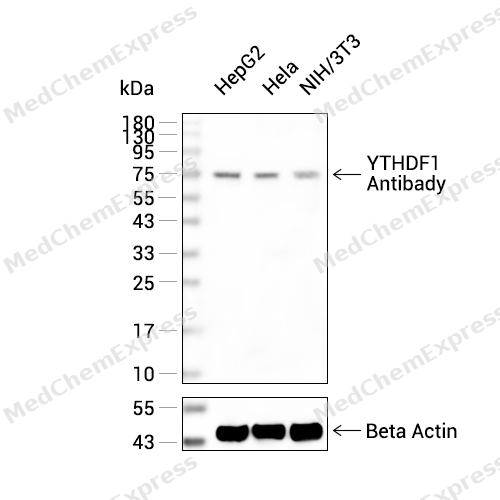 Western blot analysis of extracts from HepG2(lane 2(20ug) , Hela(lane 3(20ug) and NIH/3T3(lane 4(20ug) using YTHDF1 Antibody (HY-P81684) Rabbit mAb. Proteins were transferred to a PVDF membrane and blocked with 5% non-fat milk in TBST for 2 hour at room temperature. The primary antibody (1/1000) and Loading control antibody (Beta Actin, HY-P80438, 1/10000) was used in 5% non-fat milk in TBST at 4°C overnight. Goat Anti-Mouse/Rabbit IgG-HRP Secondary Antibody (1/10000) was used for 1 hour at room temperature.
 -
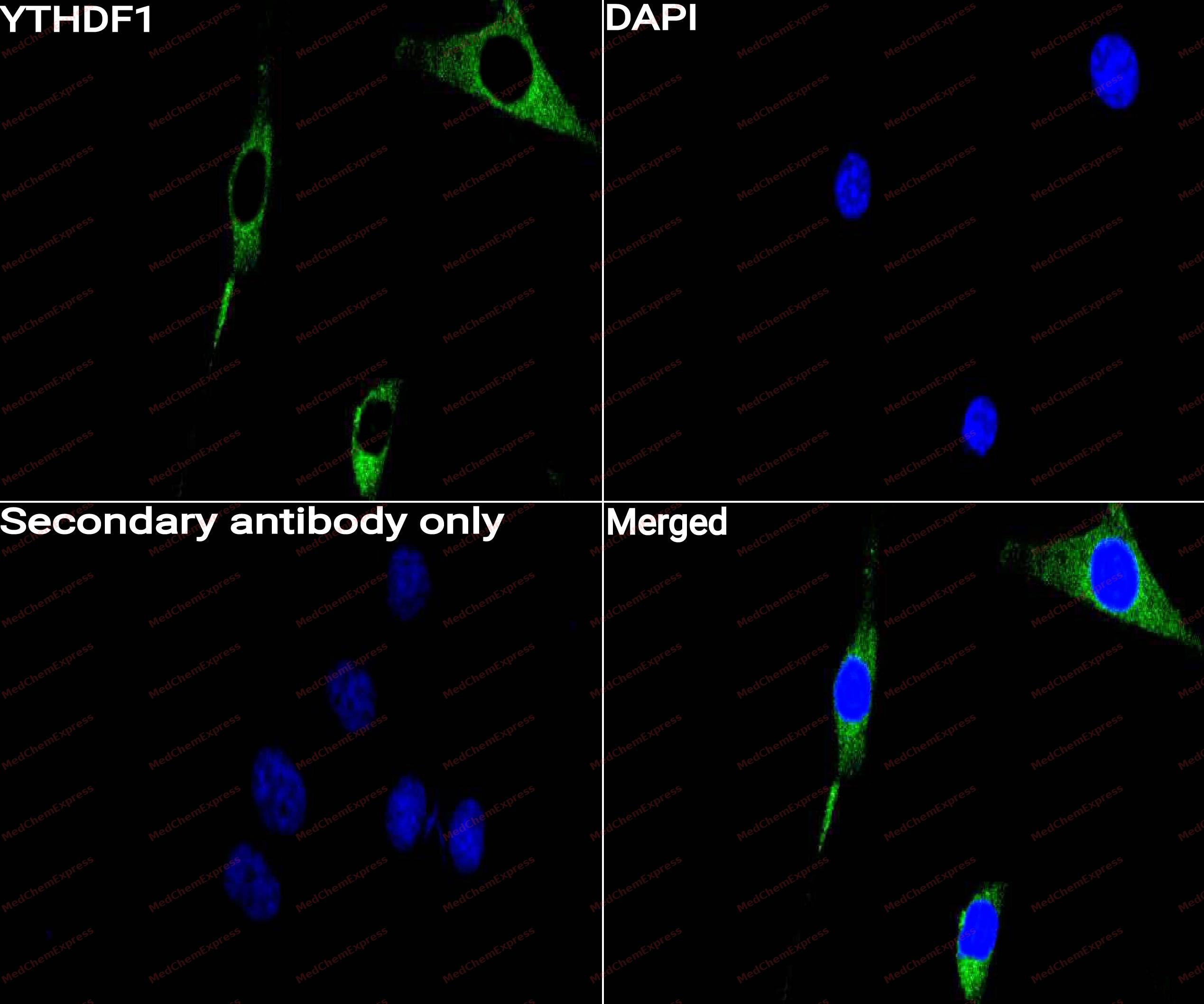 Immunocytochemistry analysis of NIH3T3 cells labeling YTHDF1 with YTHDF1 Antibody (HY-P81684) at 1/50 dilution. Cells were fixed in 4% paraformaldehyde for 15 minutes at room temperature, permeabilized with 0.1% Triton X-100 for 10 minutes at room temperature, then blocked with QuickBlock™ Blocking Buffer for Immunol Staining for 10 min at room temperature. Cells were then incubated with YTHDF1 Antibody (HY-P81684) at 1/50 dilution in QuickBlock™ Blocking Buffer for Immunol Staining at 4 ℃. Alexa Fluor® 488-conjugated AffiniPure Goat Anti-Rabbit IgG H&L(HY-P8002, Green) was used as the secondary antibody at 1/1,000 dilution. PBS instead of the primary antibody was used as the secondary antibody only control. The Nuclear counterstain was DAPI (Blue).
 -
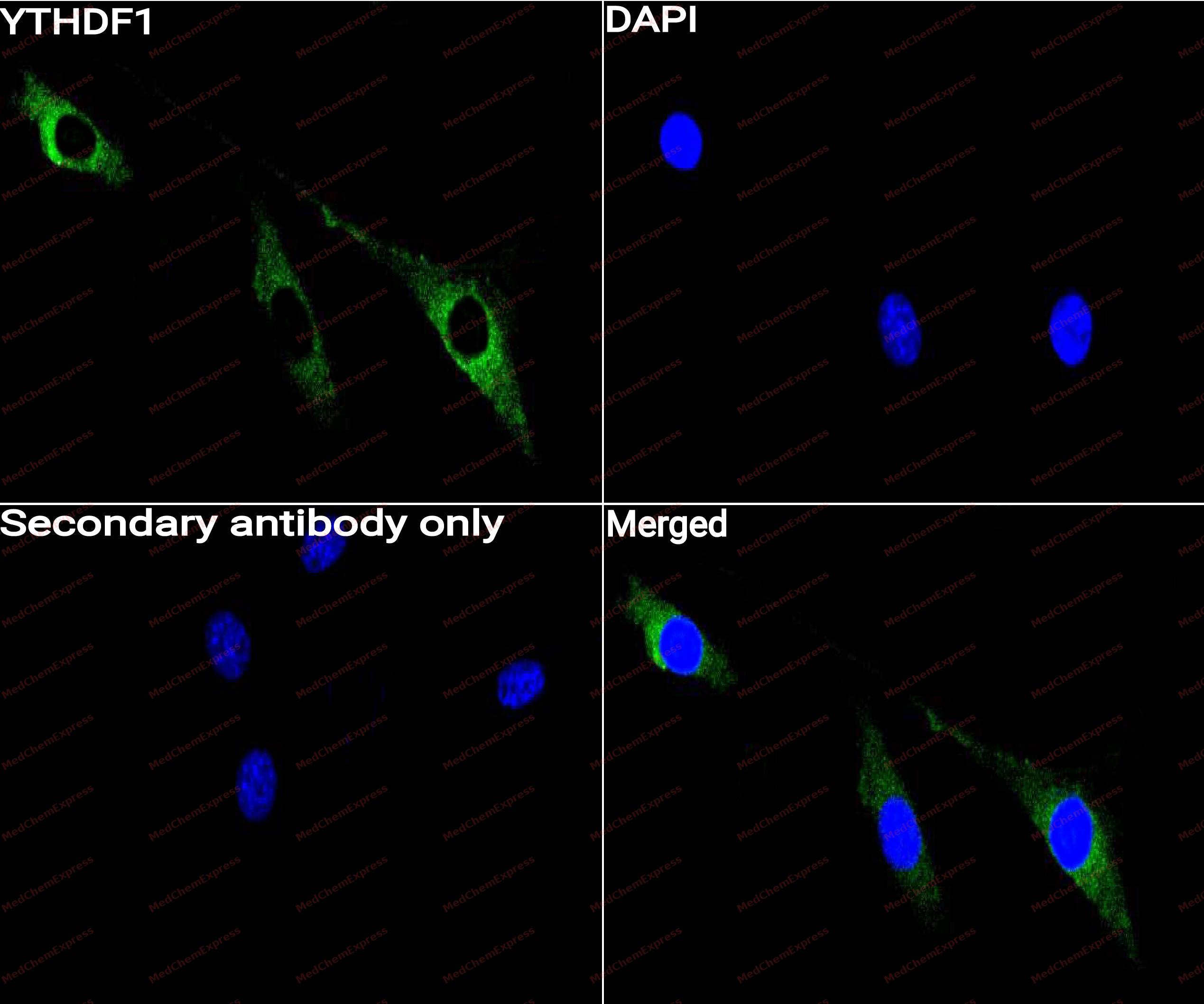 Immunocytochemistry analysis of NIH3T3 cells labeling YTHDF1 with YTHDF1 Antibody (HY-P81684) at 1/100 dilution. Cells were fixed in 4% paraformaldehyde for 15 minutes at room temperature, permeabilized with 0.1% Triton X-100 for 10 minutes at room temperature, then blocked with QuickBlock™ Blocking Buffer for Immunol Staining for 10 min at room temperature. Cells were then incubated with YTHDF1 Antibody (HY-P81684)at 1/100 dilution in QuickBlock™ Blocking Buffer for Immunol Staining at 4 ℃. Alexa Fluor® 488-conjugated AffiniPure Goat Anti-Rabbit IgG H&L(HY-P8002,Green) was used as the secondary antibody at 1/1,000 dilution. PBS instead of the primary antibody was used as the secondary antibody only control. The Nuclear counterstain was DAPI (Blue).


Background
-
Function
YTHDF1 (YTH N6-methyladenosine RNA Binding Protein 1) is a major m6A reader that recognizes N6-methyladenosine-modified transcripts and promotes the translation of methylated mRNAs, thereby regulating post-transcriptional gene expression and protein synthesis.[1][4] Mechanistically, YTHDF1 enhances the translational efficiency of its target transcripts through interactions with the translation machinery and translation initiation factors, making it a central effector of m6A-dependent gene regulation.[1][5][6] Beyond its role in RNA metabolism, YTHDF1 participates in immune regulation, where m6A-dependent YTHDF1 activity controls antigen-related responses and contributes to antitumor immunity pathways.[5] In disease contexts, elevated YTHDF1 expression has been reported across multiple malignancies, including ovarian, gastric, colorectal, hepatocellular, and lung cancers, where it promotes tumor growth, metastasis, stemness, or therapeutic resistance through enhanced translation of oncogenic targets.[1][2][3][9][10] Representative downstream effectors include EIF3C, USP14, FZD7, and YAP, which link YTHDF1-mediated translational control to cancer progression and cellular adaptation.[1][2][3][9] Compared with related YTH-domain family members, YTHDF1 is primarily characterized by its translation-promoting activity, whereas YTHDF2 is widely associated with mRNA decay and degradation pathways, highlighting a functional distinction frequently exploited in mechanistic studies of m6A signaling.[5][11] Consequently, genetic silencing or functional inhibition of YTHDF1 is widely used in experimental models to investigate m6A-dependent translation, tumor biology, immune regulation, and therapeutic target validation.[5][10]
-
Subcellular Localization
Cytoplasm; Cytoplasm, P-body; Cytoplasm, Stress granule
-
Expression
Tissue_specificity:In brain, preferentially expressed in the hippocampus -
Subunit
Interacts with CNOT1; promoting recruitment of the CCR4-NOT complex (By similarity). Interacts with ribosomes (By similarity). Interacts with eIF3 (EIF3A or EIF3B). Interacts with YTHDF3 (By similarity)
-
SwissProt ID
-
Synonyms
C20orf21; DF1
-
Research Field
Epigenetics and Nuclear Signaling


Documentation
-
Data Sheet (262 KB)
-
SDS (251 KB)
- English - EN (251 KB)
- Français - FR (251 KB)
- Deutsch - DE (251 KB)
- Norwegian - NO (251 KB)
- Español - ES (251 KB)
- Swedish - SV (251 KB)
- Italian - IT (251 KB)
- Korean - KR (251 KB)
- Portuguese - PT (251 KB)
-
User Guide for Antibodies (1077 KB)
References
[1]. Siehler S, et al. Characterisation of human recombinant somatostatin receptors. 3. Modulation of adenylate cyclase activity. Naunyn Schmiedebergs Arch Pharmacol. 1999 Nov;360(5):510-21. [Content Brief]
[2]. Smalley KS, et al. The pivotal role of phosphoinositide-3 kinase in the human somatostatin sst(4) receptor-mediated stimulation of p44/p42 mitogen-activated protein kinase and extracellular acidification. Biochem Biophys Res Commun. 1999 Sep 16;263(1):239-43. [Content Brief]
[3]. Xu Y, et al. Molecular cloning and sequencing of a human somatostatin receptor, hSSTR4. Biochem Biophys Res Commun. 1993 Jun 15;193(2):648-52. [Content Brief]
[4]. Liu T, et al. The m6A reader YTHDF1 promotes ovarian cancer progression via augmenting EIF3C translation. Nucleic Acids Res. 2020 Apr 17;48(7):3816-3831. [Content Brief]
[5]. Drago SFA, et al. Effects of a Dietary Supplement Composed of Baicalin, Bromelain and Escin for Venous Chronic Insufficiency Treatment: Insights from a Retrospective Observational Study. Pharmaceuticals (Basel). 2024 Jun 14;17(6):779. [Content Brief]
[6]. Pi J, et al. YTHDF1 Promotes Gastric Carcinogenesis by Controlling Translation of FZD7. Cancer Res. 2021 May 15;81(10):2651-2665. [Content Brief]

 Powered by Bioz
