



Pimavanserin
Based on 12 publication(s) in Google Scholar
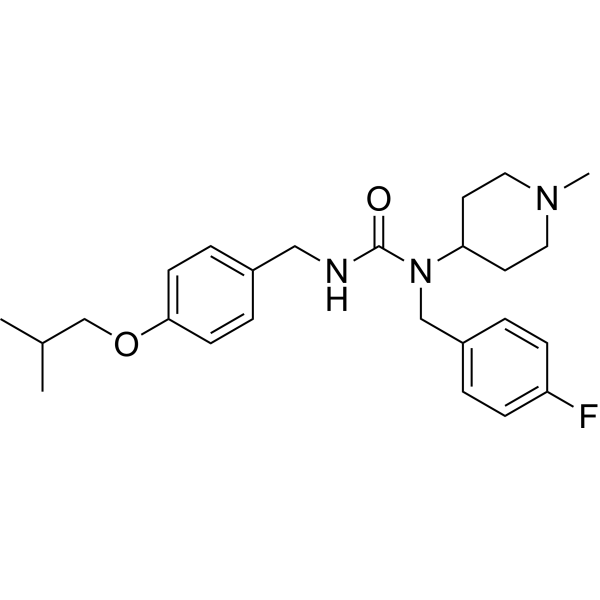
Pimavanserin is a selective, brain-penetrant, inverse agonist of the 5-HT2A receptor with pIC50 and pKd of 8.73 and 9.3, respectively.
Nur für Forschungszwecke. Wir verkaufen nicht an Patienten.
- Reinheit: 99.92%
- CAS. Nr.: 706779-91-1
- Formel: C25H34FN3O2
- Molecular Weight:427.55
-
Speicherung:Powder -20°C, 3 years , 4°C, 2 years ; In solvent -80°C, 2 years , -20°C, 1 year

To place orders, for customer services and technical support, please contact: MedChemExpress USA
Tel: 609-228-6898 E-mail: [email protected] [email protected]


-
 Biologische Aktivität
-
Chemical Information
-
Lösungsmittel & Löslichkeit
- Protokoll
- Reinheit & Dokumentation
- Verweise
-
 Help & FAQs


Publications Citing Use of MedChemExpress (MCE) Pimavanserin
More- Nat Commun. 2023 Dec 15;14(1):8221. [Abstract]
- Proc Natl Acad Sci U S A. 2020 Oct 20;117(42):26438-26447. [Abstract]
- J Med Chem. 2023 Jul 13;66(13):9057-9075. [Abstract]
- Sci Rep. 2024 Jan 16;14(1):1396. [Abstract]
- Int J Neuropsychopharmacol. 2021 Sep 21;24(9):749-757. [Abstract]
- ACS Chem Neurosci. 2019 Nov 20;10(11):4476-4491. [Abstract]
- Food Chem Toxicol. 2023 Jun:176:113800. [Abstract]
- Int J Clin Exp Med. 2019;12(8):10342-10349
- bioRxiv. 2023 Jul 31:2023.07.29.551106. [Abstract]
- Patent. US20200352950A1.
- bioRxiv. 2020 Feb.
- Virginia Commonwealth University. 2016 Oct.
 Customer Validation & Images

-
Bio/Physico-chemical Assay

-
Bio/Physico-chemical Assay

-
Bio/Physico-chemical Assay

-
In Vivo Efficacy Study

Alle 5-HT Receptor Isoform-spezifische Produkte anzeigen
More

Biologische Aktivität
|
5-HT2A Receptor 8.7 (pIC50) |
5-HT2A Receptor |
|
Cell Line

|
Type | Value | Description | References |
|---|---|---|---|---|
| HEK293 | IC50 |
22 nM
Compound: 1
|
Antagonist activity at 5HT2A receptor (unknown origin) expressed in HEK293 cells assessed as inhibition of serotonin hydrochloride-induced calcium flux preincubated for 1 hr followed by serotonin hydrochloride addition by calcium 6 dye based FLIPR assay
Antagonist activity at 5HT2A receptor (unknown origin) expressed in HEK293 cells assessed as inhibition of serotonin hydrochloride-induced calcium flux preincubated for 1 hr followed by serotonin hydrochloride addition by calcium 6 dye based FLIPR assay
|
[PMID: 32285676] |
Pimavanserin (ACP-103) competitively antagonizes the binding of [3H]ketanserin to heterologously expressed human 5-HT2A receptors with a mean pKi of 9.3 in membranes and 9.70 in whole cells. Pimavanserin demonstrates lesser affinity (mean pKi of 8.80 in membranes and 8.00 in whole cells, as determined by radioligand binding) and potency as an inverse agonist (mean pIC50 7.1 in R-SAT) at human 5-HT2C receptors, and lacked affinity and functional activity at 5-HT2B receptors, dopamine D2 receptors, and other human monoaminergic receptors[1]. Pimavanserin (ACP-103) is highly selective for 5-HT2A receptors, lacking affinity for other receptors in a broad profile screen including 65 different molecular targets; the only other receptor for which Pimavanserin demonstrates affinity is 5-HT2C, and Pimavanserin is approximately 30-fold selective for 5-HT2A receptors over 5-HT2C receptors depending on the assay[2].
MedChemExpress (MCE) has not independently confirmed the accuracy of these methods. They are for reference only.
MedChemExpress (MCE) has not independently confirmed the accuracy of these methods. They are for reference only.
| NCT Number | Sponsor | Condition | Start Date |
Phase
|
|---|---|---|---|---|
| NCT01329991 | Plexxikon| | 2011-05 | PHASE1 |


Chemical Information
-
CAS. Nr. 706779-91-1
-
Appearance Solid
-
Molecular Weight 427.55
-
Formel C25H34FN3O2
-
Color White to off-white
-
SMILES
CC(C)COC1=CC=C(CNC(N(CC2=CC=C(F)C=C2)C3CCN(C)CC3)=O)C=C1
-
Synonyms
ACP-103
-
Versand
Room temperature in continental US; may vary elsewhere.
-
Speicherung
Powder -20°C 3 years 4°C 2 years In solvent -80°C 2 years -20°C 1 year


Publications (12)
-
Journal Impact Factor
-
Most Recent
-
Nat Commun
Identification of 5-HT2A receptor signaling pathways associated with psychedelic potential. [Abstract]2023 Dec 15;14(1):8221. PMID: 38102107 -
Proc Natl Acad Sci U S A
2020 Oct 20;117(42):26438-26447. PMID: 33024014 -
J Med Chem
Design, Synthesis, Molecular Docking, and Biological Evaluation of Novel Pimavanserin-Based Analogues as Potential Serotonin 5-HT2A Receptor Inverse Agonists. [Abstract]2023 Jul 13;66(13):9057-9075. PMID: 37378639
Pimavanserin purchased from MedChemExpress. Usage Cited in: J Med Chem. 2023 Jul 13;66(13):9057-9075. [Abstract]
Compounds 2 and 4 showed similar IC50 values between them and higher potencies than pimavanserin.
Pimavanserin purchased from MedChemExpress. Usage Cited in: J Med Chem. 2023 Jul 13;66(13):9057-9075. [Abstract]
[35S]GTPγS binding values obtained in the presence of pimavanserin, compound 2, compound 3, and compound 4 at 10−5 M in postmortem human prefrontal cortex membrane homogenates both in the absence (plain bars) and in the presence (striped bars) of MDL 11,939 (10−6 M).
-
Sci Rep
Mechanisms of 5-HT receptor antagonists in the regulation of fibrosis in a 3D human liver spheroid model. [Abstract]2024 Jan 16;14(1):1396. PMID: 38228622
Pimavanserin purchased from MedChemExpress. Usage Cited in: Sci Rep. 2024 Jan 16;14(1):1396. [Abstract]
Pimavanserin (1 μM) decreased COL1A1, TGF-β1, and vimentin deposition, although its effect was rather variable and thus non-significant.
-
Int J Neuropsychopharmacol
A Complex Impact of Systemically Administered 5-HT2A Receptor Ligands on Conditioned Fear. [Abstract]2021 Sep 21;24(9):749-757. PMID: 34228806
Pimavanserin purchased from MedChemExpress. Usage Cited in: Int J Neuropsychopharmacol. 2021 Sep 21;24(9):749-757. [Abstract]
Number of animals per group = 11–12. a = P < .001 vs saline; b = P < .01 vs escitalopram; c = P < .01 vs pimavanserin (0.3 mg/kg).
-
ACS Chem Neurosci
Big Data Challenges Targeting Proteins in GPCR Signaling Pathways; Combining PTML-ChEMBL Models and [35S]GTPγS Binding Assays. [Abstract]2019 Nov 20;10(11):4476-4491. PMID: 31618004 -
Food Chem Toxicol
Non-clinical pharmacology and toxicology studies of LPM6690061, a novel 5-hydroxytryptamine (5-HT)2A receptor inverse agonist. [Abstract]2023 Jun:176:113800. PMID: 37100235 -
-
bioRxiv
Identification of 5-HT2A Receptor Signaling Pathways Responsible for Psychedelic Potential. [Abstract]2023 Jul 31:2023.07.29.551106. PMID: 37577474 -
-
-


Lösungsmittel & Löslichkeit
DMSO : 50 mg/mL (116.95 mM; Need ultrasonic; Hygroscopic DMSO has a significant impact on the solubility of product, please use newly opened DMSO)
Please refer to the solubility information to select the appropriate solvent. Once prepared, please aliquot and store the solution to prevent product inactivation from repeated freeze-thaw cycles.
Storage method and period of stock solution: -80°C, 2 years; -20°C, 1 year. When stored at -80°C, please use it within 2 years. When stored at -20°C, please use it within 1 year.
Please refer to the solubility information to select the appropriate solvent. Once prepared, please aliquot and store the solution to prevent product inactivation from repeated freeze-thaw cycles.
Storage method and period of stock solution: -80°C, 2 years; -20°C, 1 year. When stored at -80°C, please use it within 2 years. When stored at -20°C, please use it within 1 year.
Konzentration (Stammlösung) × Volumen (Stammlösung) = Konzentration (Ziellösung) × Volumen (Ziellösung)
Select the appropriate dissolution method based on your experimental animal and administration route.
- For the following dissolution methods, please ensure to first prepare a clear stock solution using an In Vitro approach and then sequentially add co-solvents:
- To ensure reliable experimental results, the clarified stock solution can be appropriately stored based on storage conditions. As for the working solution for In Vivo experiments, it is recommended to prepare freshly and use it on the same day.
- The percentages shown for the solvents indicate their volumetric ratio in the final prepared solution. If precipitation or phase separation occurs during preparation, heat and/or sonication can be used to aid dissolution.
Add each solvent one by one: 10% DMSO 40% PEG300 5% Tween-80 45% Saline
Solubility: ≥ 2.5 mg/mL (5.85 mM); Clear solution
This protocol yields a clear solution of ≥ 2.5 mg/mL (saturation unknown).
Taking 1 mL working solution as an example, add 100 μL DMSO stock solution (25.0 mg/mL) to 400 μL PEG300, and mix evenly; then add 50 μL Tween-80 and mix evenly; then add 450 μL Saline to adjust the volume to 1 mL.
Preparation of Saline: Dissolve 0.9 g sodium chloride in ddH₂O and dilute to 100 mL to obtain a clear Saline solution.
Add each solvent one by one: 10% DMSO 90% (20% SBE-β-CD in Saline)
Solubility: ≥ 2.5 mg/mL (5.85 mM); Clear solution
This protocol yields a clear solution of ≥ 2.5 mg/mL (saturation unknown).
Taking 1 mL working solution as an example, add 100 μL DMSO stock solution (25.0 mg/mL) to 900 μL 20% SBE-β-CD in Saline, and mix evenly.
Preparation of 20% SBE-β-CD in Saline (4°C, storage for one week): 2 g SBE-β-CD powder is dissolved in 10 mL Saline, completely dissolve until clear.
Please enter the basic information of animal experiments:
-
-
-
-
Recommended: Prepare an additional quantity of animals to account for potential losses during experiments.
Please enter your animal formula composition:
-
%DMSO +
Recommended: Keep the proportion of DMSO in working solution below 2% if your animal is weak.
-
%+
-
+%Tween-80 + +
-
%Saline +
The co-solvents required include: DMSO, . All of co-solvents are available by MedChemExpress (MCE). , Tween 80. All of co-solvents are available by MedChemExpress (MCE).
Working solution concentration: 0.22 mg/mL
Method for preparing stock solution: mg drug dissolved in μL DMSO. Stock solution concentration: mg/mL.
1. Take μL DMSO stock solution;
2. Add μL .
μL , mix evenly;
3. Then add μL Tween 80, mix evenly;
4. Then add μL
Please ensure that the stock solution in the first step is dissolved to a clear state, and add co-solvents in sequence. You can use ultrasonic heating (ultrasonic cleaner, recommended frequency 20-40 kHz), vortexing, etc. to assist dissolution.

Protokoll
For the membrane binding, NIH-3T3 cells are grown to 70% confluence in 15 cm2 dishes and transfected with 10 μg of receptor plasmid DNA using Polyfect transfection reagent. Two days after transfection, cells expressing the desired serotonin receptor are homogenized in 20 mM HEPES/10 mM EDTA and spun down at 11,000g at 4°C for 30 min. The supernatant is discarded, and the pellet is resuspended in 20 mM HEPES/1 mM EDTA and spun down at the same setting. The pellet is then resuspended in 20 mM HEPES/0.5 mM EDTA, and membranes are used for binding assays. Bradford analysis is used to determine total membrane protein. Kd and Bmax values are derived from 12-point concentration experiments using 1 nM [3H]ketanserin for the 5-HT2A receptor and 3 nM [3H]mesulergine for the 5-HT2B and 5-HT2C receptors. Membranes are incubated at room temperature for 3 h with various concentrations of test ligand in the presence of a fixed concentration of radioligand. The suspension is filtered as explained below for whole-cell binding, washed with ice-cold buffer, and dried, and radioactivity is determined using TopCount[1].
MedChemExpress (MCE) has not independently confirmed the accuracy of these methods. They are for reference only.
For the whole-cell binding, 6 million human embryonic kidney 293T cells are plated in 10-cm dishes and transfected with 5 μg of plasmid DNA using Polyfect. Two days after transfection, cells are harvested with 10 mM EDTA, washed, and resuspended in binding buffer (1× DMEM with 0.1% bovine serum albumin). Then, 60,000 cells transfected with the 5-HT2A receptor or 20,000 cells transfected with the 5-HT2C-INI receptor are incubated at 37°C for 3 h in the presence of 5 nM radioligand ([3H]ketanserin for 5-HT2A receptors and [3H]mesulergine for 5-HT2C-INI receptors) and varying concentrations of ligands (total volume 100 μL in a 96-well plate). Cells are filtered onto a 96-well GF/B filter plate and washed with 300 mL of wash buffer (25 mM HEPES, 1 mM CaCl2, 5 mM MgCl2, and 0.25 M NaCl) using a Filtermate 196 harvester. The filter plates are dried under a heat lamp before addition of 50 μL of scintillation fluid to each well. Plates are counted on a TopCount. Separately, the hydrochloride salt form of Pimavanserin (10 μM) is evaluated at MDS Pharma Services for activity in a broad screen of radioligand binding assays at 65 different receptors[1].
MedChemExpress (MCE) has not independently confirmed the accuracy of these methods. They are for reference only.
Mice[1]
Non-Swiss albino mice are used for locomotor activity experiments. For determination of spontaneous activity, Pimavanserin is administered alone (s.c. 60 min before session start or p.o. 60 min before session start). For hyperactivity experiments, mice are treated with 0.3 mg/kg MK-801 (i.p.) 15 min presession (the peak dose for producing hyperactivity in an inverted-U dose-effect curve as determined in pilot experiments) in combination with vehicle or Pimavanserin. Motor activity data are collected during a 15-min session in a lit room. Mice had no prior exposure to the motor cages. Immediately before placing the mice in the locomotor chambers, effects on myorelaxation/ataxia are determined by placing each of the mouse's forepaws in contact with a horizontal wire while holding the mouse by the base of the tail. Mice are required to bring at least one hindpaw in contact with the wire within 10 s to be scored as a “pass” and failure to do so is considered ataxic. Each dose or dose combination is tested in a separate group of mice (n=8).
Rats[1]
For DOI head-twitch experiments in rats, vehicle or a dose of Pimavanserin is administered orally 120 min before DOI administration. DOI HCl (2.5 mg/kg i.p.) is administered immediately before observations. After injection of DOI, each rat is placed into an empty cage and observed. Latency to the first head twitch and the number of head twitches occurring over 5 min are recorded. Each rat is used only once with eight to 16 rats per dose group.
MedChemExpress (MCE) has not independently confirmed the accuracy of these methods. They are for reference only.


Reinheit & Dokumentation
-
Data Sheet (279 KB)
-
SDS (396 KB)
- English - EN (396 KB)
- Français - FR (396 KB)
- Deutsch - DE (396 KB)
- Norwegian - NO (396 KB)
- Español - ES (396 KB)
- Swedish - SV (396 KB)
- Italian - IT (396 KB)
- Korean - KR (396 KB)
- Portuguese - PT (396 KB)
-
Handling Instructions (2659 KB)
Verweise
[1]. Vanover KE, et al. Pharmacological and behavioral profile of N-(4-fluorophenylmethyl)-N-(1-methylpiperidin-4-yl)-N'-(4-(2-methylpropyloxy)phenylmethyl) carbamide (2R,3R)-dihydroxybutanedioate (2:1) (ACP-103), a novel 5-hydroxytryptamine(2A) receptor inverse agonist. J Pharmacol Exp Ther. 2006 May;317(2):910-8. [Content Brief]
[2]. Vanover KE, et al. A 5-HT2A receptor inverse agonist, ACP-103, reduces tremor in a rat model and levodopa-induced dyskinesias in a monkey model. Pharmacol Biochem Behav. 2008 Oct;90(4):540-4. [Content Brief]
[3]. Ezzeldin E, et al. A rapid, simple and highly sensitive UPLC-MS/MS method for quantitation of pimavanserin in plasma and tissues: Application to pharmacokinetics and brain uptake studies in mice. J Chromatogr B Analyt Technol Biomed Life Sci. 2020 Apr 15;1143:122015. [Content Brief]


Complete Stock Solution Preparation Table
Please refer to the solubility information to select the appropriate solvent. Once prepared, please aliquot and store the solution to prevent product inactivation from repeated freeze-thaw cycles.
Storage method and period of stock solution: -80°C, 2 years; -20°C, 1 year. When stored at -80°C, please use it within 2 years. When stored at -20°C, please use it within 1 year.
| Optional Solvent | Concentration Solvent Mass | 1 mg | 5 mg | 10 mg | 25 mg |
|---|---|---|---|---|---|
| DMSO | 1 mM | 2.3389 mL | 11.6945 mL | 23.3891 mL | 58.4727 mL |
| 5 mM | 0.4678 mL | 2.3389 mL | 4.6778 mL | 11.6945 mL | |
| 10 mM | 0.2339 mL | 1.1695 mL | 2.3389 mL | 5.8473 mL | |
| 15 mM | 0.1559 mL | 0.7796 mL | 1.5593 mL | 3.8982 mL | |
| 20 mM | 0.1169 mL | 0.5847 mL | 1.1695 mL | 2.9236 mL | |
| 25 mM | 0.0936 mL | 0.4678 mL | 0.9356 mL | 2.3389 mL | |
| 30 mM | 0.0780 mL | 0.3898 mL | 0.7796 mL | 1.9491 mL | |
| 40 mM | 0.0585 mL | 0.2924 mL | 0.5847 mL | 1.4618 mL | |
| 50 mM | 0.0468 mL | 0.2339 mL | 0.4678 mL | 1.1695 mL | |
| 60 mM | 0.0390 mL | 0.1949 mL | 0.3898 mL | 0.9745 mL | |
| 80 mM | 0.0292 mL | 0.1462 mL | 0.2924 mL | 0.7309 mL | |
| 100 mM | 0.0234 mL | 0.1169 mL | 0.2339 mL | 0.5847 mL |


Pimavanserin Related Classifications
HY-14557 Related Classifications
 Powered by Bioz