



Supinoxin

Based on 1 Customer Validation
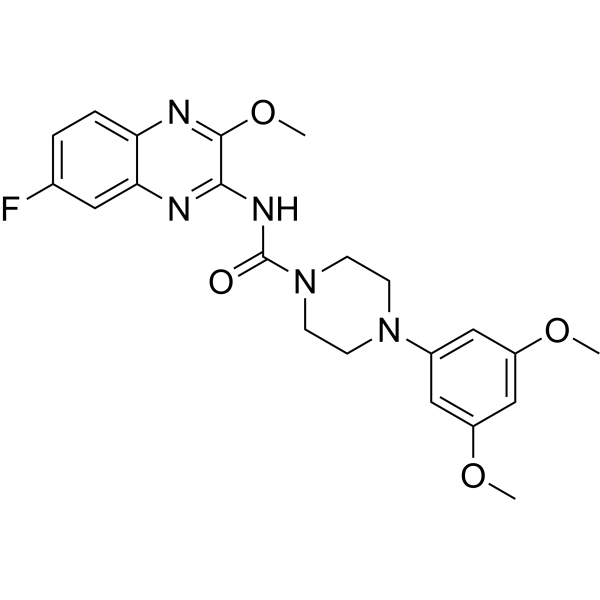
Supinoxin (RX-5902) is an orally active inhibitor of phosphorylated-p68 RNA helicase (P-p68) and a potent first-in-class anti-cancer agent. Supinoxin interacts with Y593 phosphorylated-p68 and attenuates the nuclear shuttling of β-catenin. Supinoxin induces cell apoptosis and inhibits growth of TNBC cancer cell lines with IC50s ranging from 10 nM to 20 nM.
Nos produits utilisent uniquement pour la recherche. Nous ne vendons pas aux patients.
- Pureté : 99.67%
- CAS No.: 888478-45-3
- Formule: C22H24FN5O4
- Masse moléculaire:441.46
-
Stockage:Powder -20°C, 3 years , 4°C, 2 years ; In solvent -80°C, 6 months , -20°C, 1 month

To place orders, for customer services and technical support, please contact: MedChemExpress USA
Tel: 609-228-6898 E-mail: [email protected] [email protected]


-
 Activité biologique
-
Chemical Information
-
Solvant et solubilité
- Protocole
- Pureté et documentation
- Références
-
 Help & FAQs



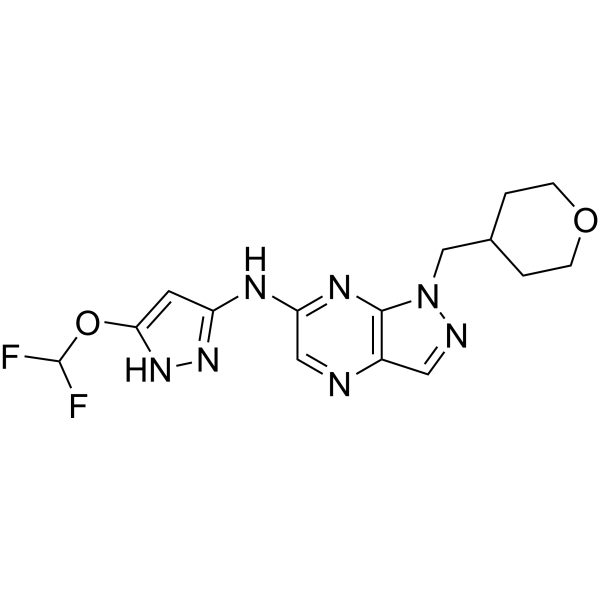
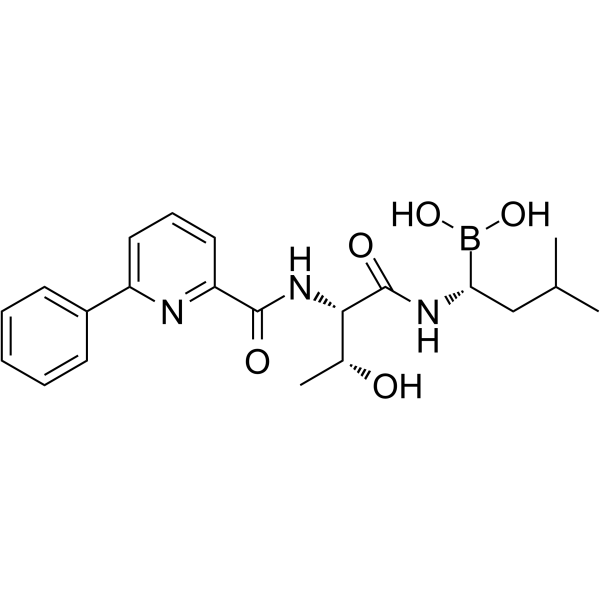
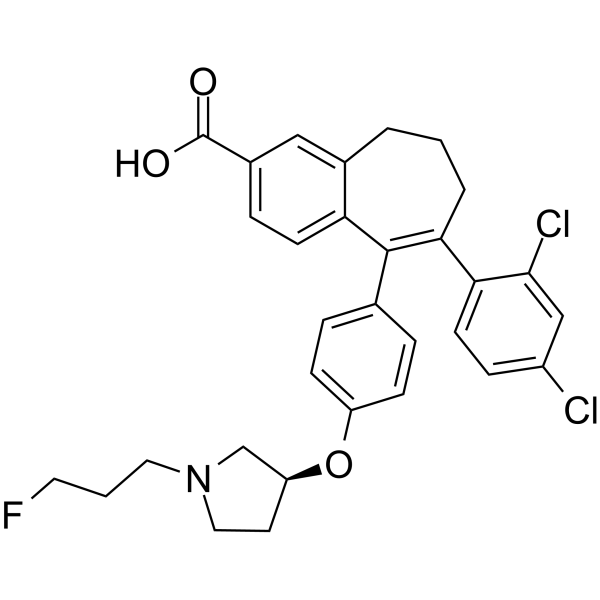
Voir tous les produits spécifiques à Isoform DNA/RNA Synthesis
More

Activité biologique
Description
IC50 & Target
|
Helicase |
Cellular Effect
|
Cell Line

|
Type | Value | Description | References |
|---|---|---|---|---|
| A549 | IC50 |
0.021 μM
Compound: 25
|
Growth inhibition of human A549 cells after 96 hrs by sulforhodamine B assay
Growth inhibition of human A549 cells after 96 hrs by sulforhodamine B assay
|
[PMID: 20943401] |
| CAKI-1 | IC50 |
0.011 μM
Compound: 25
|
Growth inhibition of human Caki1 cells after 96 hrs by sulforhodamine B assay
Growth inhibition of human Caki1 cells after 96 hrs by sulforhodamine B assay
|
[PMID: 20943401] |
| HCT-116 | IC50 |
0.02 μM
Compound: 25
|
Growth inhibition of human HCT116 cells after 96 hrs by sulforhodamine B assay
Growth inhibition of human HCT116 cells after 96 hrs by sulforhodamine B assay
|
[PMID: 20943401] |
| HCT-15 | IC50 |
21 nM
Compound: 25
|
Growth inhibition of human HCT15 cells after 96 hrs by sulforhodamine B assay
Growth inhibition of human HCT15 cells after 96 hrs by sulforhodamine B assay
|
[PMID: 20943401] |
| HeLa | IC50 |
0.021 μM
Compound: 25
|
Growth inhibition of human HeLa cells after 96 hrs by sulforhodamine B assay
Growth inhibition of human HeLa cells after 96 hrs by sulforhodamine B assay
|
[PMID: 20943401] |
| HepG2 | IC50 |
0.019 μM
Compound: 25
|
Growth inhibition of human HepG2 cells after 96 hrs by sulforhodamine B assay
Growth inhibition of human HepG2 cells after 96 hrs by sulforhodamine B assay
|
[PMID: 20943401] |
| HT-29 | IC50 |
0.021 μM
Compound: 25
|
Growth inhibition of human HT-29 cells after 96 hrs by sulforhodamine B assay
Growth inhibition of human HT-29 cells after 96 hrs by sulforhodamine B assay
|
[PMID: 20943401] |
| MDA-MB-231 | IC50 |
0.012 μM
Compound: 25
|
Growth inhibition of human MDA-MB-231 cells after 96 hrs by sulforhodamine B assay
Growth inhibition of human MDA-MB-231 cells after 96 hrs by sulforhodamine B assay
|
[PMID: 20943401] |
| MKN-45 | IC50 |
0.02 μM
Compound: 25
|
Growth inhibition of human MKN45 cells after 96 hrs by sulforhodamine B assay
Growth inhibition of human MKN45 cells after 96 hrs by sulforhodamine B assay
|
[PMID: 20943401] |
| OVCAR-3 | IC50 |
0.012 μM
Compound: 25
|
Growth inhibition of human OVCAR-3 cells after 96 hrs by sulforhodamine B assay
Growth inhibition of human OVCAR-3 cells after 96 hrs by sulforhodamine B assay
|
[PMID: 20943401] |
| PANC-1 | IC50 |
0.021 μM
Compound: 25
|
Growth inhibition of human PANC1 cells after 96 hrs by sulforhodamine B assay
Growth inhibition of human PANC1 cells after 96 hrs by sulforhodamine B assay
|
[PMID: 20943401] |
| PC-3 | IC50 |
0.021 μM
Compound: 25
|
Growth inhibition of human PC3 cells after 96 hrs by sulforhodamine B assay
Growth inhibition of human PC3 cells after 96 hrs by sulforhodamine B assay
|
[PMID: 20943401] |
| SK-MEL-28 | IC50 |
0.02 μM
Compound: 25
|
Growth inhibition of human SK-MEL-28 cells after 96 hrs by sulforhodamine B assay
Growth inhibition of human SK-MEL-28 cells after 96 hrs by sulforhodamine B assay
|
[PMID: 20943401] |
| U-251 | IC50 |
0.015 μM
Compound: 25
|
Growth inhibition of human U251 cells after 96 hrs by sulforhodamine B assay
Growth inhibition of human U251 cells after 96 hrs by sulforhodamine B assay
|
[PMID: 20943401] |
In Vitro
RX-5902 (0-10 μM; 72 hours) is active against cell lines of all TNBC molecular subtypes and is active against cell lines with mutations in p53, RB1, CDKN2A, and loss of PTEN[1].RX-5902 (20-100 nM; 24 hours) treatment results in a dose-dependent increase in tetraploid cells, consistent with induction of G2–M cell-cycle arrest[1].RX-5902 (0-100 nM; 72 hours) exhibits no significant induction of apoptosis in cell lines resistant to the antiproliferative effects of RX5902. But in sensitive cells, the observed activation of apoptosis begins at 24–48 hours and reaches a peak at 72 hours. The induced apoptosis is greasted with a dose of 100 nM[1].RX-5902 (0-100 nM; 24 or 48 hours) decreases MCL-1 expression as a dose-dependent manner in TNBC cell lines sensitive to RX-5902[1].RX-5902 inhibits cell growth, MDA-MB-231, Caki-1, UMRC2, PANC-1, A549, MKN-45, HepG2, HCT116, HT29, PC-3, U251, HeLa, SK-MEL-28 and OVCAR-3 with IC50 values range from 0.01 μM to 0.021 μM in the growth inhibition of cancer cells[2].
MedChemExpress (MCE) has not independently confirmed the accuracy of these methods. They are for reference only.
-
Cell Line:MDA-MB-231, HCC1806, Hs578t, CAL-85-1, HCC38, HCC1187, MDA-MB-436, CAL-51, HCC38, BT549, MDAMB-157, HDQ-P1, HCC1395, MDA-MB-436, HCC1937, CAL-120, BT20 cells
-
Concentration:0-10 μM
-
Incubation Time:72 hours
-
Result:Displayed the average IC50 of the cell lines sensitive to RX-5902 treatment is 56 nM.
-
Cell Line:Sensitive (MDA-MB-231 and HCT1806) and two resistant (MDA-MB-436 and CAL-120) cell lines
-
Concentration:20 nM; 100 nM
-
Incubation Time:24 hours
-
Result:Led to G2-M cell-cycle arrest at sensitive cells.
-
Cell Line:Sensitive (MDA-MB-231 and HCT1806) and two resistant (MDA-MB-436 and CAL-120) cell lines
-
Concentration:0-100 nM
-
Incubation Time:24-72 hours
-
Result:Induced cell apoptosis in sensitive cell lines and peaks at 72 hours.
-
Cell Line:Cal-51, HCC-1806, and MDA-MB-468 cells
-
Concentration:20 nM; 100 nM
-
Incubation Time:24 hours
-
Result:Induced inhibition of MCL-1 expression in Cal-51, HCC-1806, and MDA-MB-468 cells.
In Vivo
MedChemExpress (MCE) has not independently confirmed the accuracy of these methods. They are for reference only.
-
Animal Model:MDAMD-231 xenograft model in mice[1]
-
Dosage:160 mg/kg; 320 mg/kg; 600 mg/kg
-
Administration:Oral administration; once weekly for 3 weeks
-
Result:Decreased tumor volume as a dose-dependent manner.
Essai clinique
| NCT Number | Sponsor | Condition | Start Date |
Phase
|
|---|---|---|---|---|
| NCT01329991 | 2011-05 | PHASE1 |


Chemical Information
-
CAS No. 888478-45-3
-
Appearance Solid
-
Masse moléculaire 441.46
-
Formule C22H24FN5O4
-
Color White to off-white
-
SMILES
O=C(N1CCN(C2=CC(OC)=CC(OC)=C2)CC1)NC3=NC4=CC(F)=CC=C4N=C3OC
-
Synonyms
RX-5902
-
Livraison
Room temperature in continental US; may vary elsewhere.
-
Stockage
Powder -20°C 3 years 4°C 2 years In solvent -80°C 6 months -20°C 1 month


Solvant et solubilité
In Vitro:
DMSO : 100 mg/mL (226.52 mM; Need ultrasonic; Hygroscopic DMSO has a significant impact on the solubility of product, please use newly opened DMSO)
Please refer to the solubility information to select the appropriate solvent. Once prepared, please aliquot and store the solution to prevent product inactivation from repeated freeze-thaw cycles.
Storage method and period of stock solution: -80°C, 6 months; -20°C, 1 month. When stored at -80°C, please use it within 6 months. When stored at -20°C, please use it within 1 month.
Please refer to the solubility information to select the appropriate solvent. Once prepared, please aliquot and store the solution to prevent product inactivation from repeated freeze-thaw cycles.
Storage method and period of stock solution: -80°C, 6 months; -20°C, 1 month. When stored at -80°C, please use it within 6 months. When stored at -20°C, please use it within 1 month.
Concentration (start) × Volume (start) = Concentration (final) × Volume (final)
In Vivo:
Select the appropriate dissolution method based on your experimental animal and administration route.
- For the following dissolution methods, please ensure to first prepare a clear stock solution using an In Vitro approach and then sequentially add co-solvents:
- To ensure reliable experimental results, the clarified stock solution can be appropriately stored based on storage conditions. As for the working solution for In Vivo experiments, it is recommended to prepare freshly and use it on the same day.
- The percentages shown for the solvents indicate their volumetric ratio in the final prepared solution. If precipitation or phase separation occurs during preparation, heat and/or sonication can be used to aid dissolution.
Add each solvent one by one: 10% DMSO 90% (20% SBE-β-CD in Saline)
Solubility: ≥ 2.5 mg/mL (5.66 mM); Clear solution
This protocol yields a clear solution of ≥ 2.5 mg/mL (saturation unknown).
Taking 1 mL working solution as an example, add 100 μL DMSO stock solution (25.0 mg/mL) to 900 μL 20% SBE-β-CD in Saline, and mix evenly.
Preparation of 20% SBE-β-CD in Saline (4°C, storage for one week): 2 g SBE-β-CD powder is dissolved in 10 mL Saline, completely dissolve until clear.
In Vivo Dissolution Calculator
Please enter the basic information of animal experiments:
-
-
-
-
Recommended: Prepare an additional quantity of animals to account for potential losses during experiments.
Please enter your animal formula composition:
-
%DMSO +
Recommended: Keep the proportion of DMSO in working solution below 2% if your animal is weak.
-
%+
-
+%Tween-80 + +
-
%Saline +
The co-solvents required include: DMSO, . All of co-solvents are available by MedChemExpress (MCE). , Tween 80. All of co-solvents are available by MedChemExpress (MCE).
Working solution concentration: 0.22 mg/mL
Method for preparing stock solution: mg drug dissolved in μL DMSO. Stock solution concentration: mg/mL.
1. Take μL DMSO stock solution;
2. Add μL .
μL , mix evenly;
3. Then add μL Tween 80, mix evenly;
4. Then add μL
Please ensure that the stock solution in the first step is dissolved to a clear state, and add co-solvents in sequence. You can use ultrasonic heating (ultrasonic cleaner, recommended frequency 20-40 kHz), vortexing, etc. to assist dissolution.


Pureté et documentation
-
Fiche technique (278 KB)
-
SDS (252 KB)
- English - EN (252 KB)
- Français - FR (252 KB)
- Deutsch - DE (252 KB)
- Norwegian - NO (252 KB)
- Español - ES (252 KB)
- Swedish - SV (252 KB)
- Italian - IT (252 KB)
- Korean - KR (252 KB)
- Portuguese - PT (252 KB)
-
Instruction de manipulation (2659 KB)
Références
[1]. Kost GC, et al. A Novel Anti-Cancer Agent, 1-(3,5-Dimethoxyphenyl)-4-[(6-Fluoro-2-Methoxyquinoxalin-3-yl)Aminocarbonyl] Piperazine (RX-5902), Interferes With β-Catenin Function Through Y593 Phospho-p68 RNA Helicase.J Cell Biochem. 2015 Aug;116(8):1595-601. [Content Brief]
[2]. Capasso A, et al. First-in-Class Phosphorylated-p68 Inhibitor RX-5902 Inhibits β-Catenin Signaling and Demonstrates Antitumor Activity in Triple-Negative Breast Cancer.Nov;18(11):1916-1925. [Content Brief]


Complete Stock Solution Preparation Table
Please refer to the solubility information to select the appropriate solvent. Once prepared, please aliquot and store the solution to prevent product inactivation from repeated freeze-thaw cycles.
Storage method and period of stock solution: -80°C, 6 months; -20°C, 1 month. When stored at -80°C, please use it within 6 months. When stored at -20°C, please use it within 1 month.
| Optional Solvent | Concentration Solvent Mass | 1 mg | 5 mg | 10 mg | 25 mg |
|---|---|---|---|---|---|
| DMSO | 1 mM | 2.2652 mL | 11.3261 mL | 22.6521 mL | 56.6303 mL |
| 5 mM | 0.4530 mL | 2.2652 mL | 4.5304 mL | 11.3261 mL | |
| 10 mM | 0.2265 mL | 1.1326 mL | 2.2652 mL | 5.6630 mL | |
| 15 mM | 0.1510 mL | 0.7551 mL | 1.5101 mL | 3.7754 mL | |
| 20 mM | 0.1133 mL | 0.5663 mL | 1.1326 mL | 2.8315 mL | |
| 25 mM | 0.0906 mL | 0.4530 mL | 0.9061 mL | 2.2652 mL | |
| 30 mM | 0.0755 mL | 0.3775 mL | 0.7551 mL | 1.8877 mL | |
| 40 mM | 0.0566 mL | 0.2832 mL | 0.5663 mL | 1.4158 mL | |
| 50 mM | 0.0453 mL | 0.2265 mL | 0.4530 mL | 1.1326 mL | |
| 60 mM | 0.0378 mL | 0.1888 mL | 0.3775 mL | 0.9438 mL | |
| 80 mM | 0.0283 mL | 0.1416 mL | 0.2832 mL | 0.7079 mL | |
| 100 mM | 0.0227 mL | 0.1133 mL | 0.2265 mL | 0.5663 mL |


Supinoxin Related Classifications
HY-123611 Related Classifications
 Powered by Bioz