



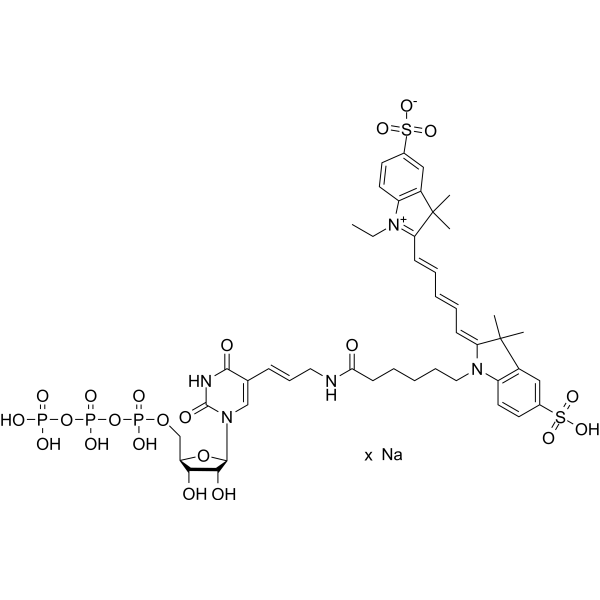
Cy5-UTP sodium (10 mM in water)

Based on 1 Customer Validation
Cy5-UTP sodium (10 mM in water) is a fluorescently labeled ribonucleotide triphosphate that can be used as a substrate for terminal deoxynucleotide transferase (TdT). Cy5-UTP sodium can be used to label RNA probes generated in vitro (Ex/Em: 650/665 nm). Cy5-UTP sodium can be applied in FISH, multi-color fluorescence analysis, especially in dual-color expression arrays combined with Cy5-UTP.
For research use only. We do not sell to patients.
- Purity : 99.26%
- Formula: C45H58N5O22P3S2.xNa
-
Storage:
-20°C, sealed storage, away from moisture and light
* In solvent : -80°C, 6 months; -20°C, 1 month (sealed storage, away from moisture and light)

To place orders, for customer services and technical support, please contact: MedChemExpress USA
Tel: 609-228-6898 E-mail: [email protected] [email protected]


-
 Biological Activity
-
Chemical Information
-
Solvent & Solubility
- Purity & Documentation
- References
-
 Help & FAQs




Biological Activity
Description
In Vitro
Cy5-UTP sodium can replace UTP as the substrate for T7 RNA polymerase and can be used for in vitro transcription to generate labeled probes. With the participation of Cy5-UTP sodium, the final assembled mRNA will emit orange fluorescence. Moreover, the cy5-labeled mRNA can be easily observed under ultraviolet light after gel electrophoresis without the need for further staining[1][2].
Protocol (The following is our recommended solution. This solution is merely a guideline and should be modified according to your specific needs.)
1. Prepare reagents
Apart from this product, prepare the following:
(1) T7 RNA polymerase (HY-E70090)
(2) Reaction buffer: 0.1 M sodium bicarbonate buffer (pH: 7-8.5)
(3) 50 mM UTP stock solution
(4) ATP/CTP/GTP stock solutions, with each ribonucleotide at 25 mM.
Note: Thaw the above reagents (except enzymes) on ice.
2. Experimental Procedures
(1) Add the following to an RNA-free Eppendorf tube: 2 μL reaction buffer, 6 μL ATP/CTP/GTP stock solution, 2 μL UTP stock solution, 6 μL Cy5-UTP solution, and 4 μL sterile water; mix thoroughly.
(2) Add the DNA template and T7 RNA polymerase; gently stir to mix evenly.
(3) Incubate in the dark at 37°C for 30 minutes to several hours (depending on the yield).
(4) Add 1 μL of Recombinant DNase I (RNase-free) (HY-108882A) to remove the template DNA. Mix gently and centrifuge. Then incubate at 37 °C for an additional 10 minutes.
3. Detection: The fluorescently labeled RNA can be directly observed under ultraviolet light after gel electrophoresis, or it can be examined using a fluorescence microscope.
Note: (1) Only water and consumables without RNase should be used.
(2) The ratio of Cy5-UTP to natural UTP usually needs to be adjusted to strike a balance between optimal labeling efficiency and transcriptional yield.
MedChemExpress (MCE) has not independently confirmed the accuracy of these methods. They are for reference only.


Chemical Information
-
Appearance Liquid
-
Formula C45H58N5O22P3S2.xNa
-
Color Blue to dark blue
-
SMILES
OP(OP(OP(OC[C@@H]1[C@@H](O)[C@@H](O)[C@H](N2C=C(/C=C/CNC(CCCCCN(/C(C3(C)C)=C/C=C/C=C/C4=[N+](CC)C5=C(C4(C)C)C=C(S([O-])(=O)=O)C=C5)C6=C3C=C(S(O)(=O)=O)C=C6)=O)C(NC2=O)=O)O1)(O)=O)(O)=O)(O)=O.[x].[Na]
-
Shipping
Room temperature in continental US; may vary elsewhere.
-
Storage
-20°C, sealed storage, away from moisture and light
* In solvent : -80°C, 6 months; -20°C, 1 month (sealed storage, away from moisture and light)


Solvent & Solubility
In Vitro:
H2O : ≥ 250 mg/mL
* "≥" means soluble, but saturation unknown.


Purity & Documentation
-
Data Sheet (274 KB)
-
SDS (252 KB)
- English - EN (252 KB)
- Français - FR (252 KB)
- Deutsch - DE (252 KB)
- Norwegian - NO (252 KB)
- Español - ES (252 KB)
- Swedish - SV (252 KB)
- Italian - IT (252 KB)
- Korean - KR (252 KB)
- Portuguese - PT (252 KB)
-
Handling Instructions (2659 KB)
References
[1]. Custer TC, et al. In vitro labeling strategies for in cellulo fluorescence microscopy of single ribonucleoprotein machines. Protein Sci. 2017 Jul;26(7):1363-1379. [Content Brief]
[2]. Guerra CE. Analysis of oligonucleotide microarrays by 3' end labeling using fluorescent nucleotides and terminal transferase. Biotechniques. 2006 Jul;41(1):53-6. [Content Brief]

Calculators
Concentration (start) × Volume (start) = Concentration (final) × Volume (final)


Cy5-UTP sodium (10 mM in water) Related Classifications
HY-150145A Related Classifications
 Powered by Bioz