



Adiponectin/Acrp30 Protein, Human (HEK293)
Based on 1 publication(s) in Google Scholar
Adiponectin/Acrp30 Protein, Human (HEK293) could increase cell sensitivity to insulin and can be used as a potential protein for studying diabetic tendinopathy.
- Species: Human
- Source: HEK293
-
Storage:Stored at -20°C for 2 years from date of receipt. After reconstitution, it is stable at 4°C for 1 week or -20°C for longer (with carrier protein). It is recommended to freeze aliquots at -20°C or -80°C for extended storage.


To place orders, for customer services and technical support, please contact: MedChemExpress USA
Tel: 609-228-6898 E-mail: [email protected] [email protected]


-
 Biological Activity
-
Technical Parameters
-
Product Properties
- Documentation
- References
- Help & FAQs




Biological Activity
Description
Adiponectin/Acrp30 Protein, Human (HEK293) could increase cell sensitivity to insulin and can be used as a potential protein for studying diabetic tendinopathy.
Background
Recombinant Human Adiponectin can be used in the injured artery and attenuates vascular inflammatory response. It is reported that physiological concentrations of Recombinant Human Adiponectin suppress tumor necrosis factor-α(TNF-α)-induced endothelial adhesion molecule expression, transformation from macrophage to foam cell, and TNF-α expression in macrophages[1]. Recombinant Human Adiponectin can be used as a potential protein for treating diabetic tendinopathy promotes tenocyte progenitor cells proliferation and tenogenic differentiation in vitro[2].
Verified Bioactivity
1.The ED50 is <2 μg/mL as measured by M1 cells.
2.Measured by its ability to induce TIMP-1 secretion by RAW264.7 mouse macrophages cell. The ED50 for this effect is 1.2-5.0 μg/mL.
MCE Validation Data
-
Purity - SDS-PAGE
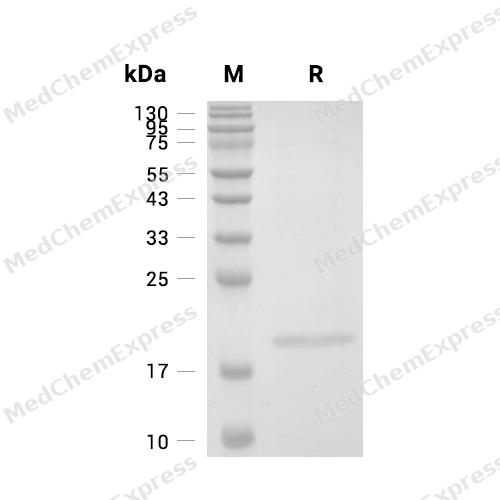
Purity - SDS-PAGE
-
Bioactivity - Cell-Based Assay
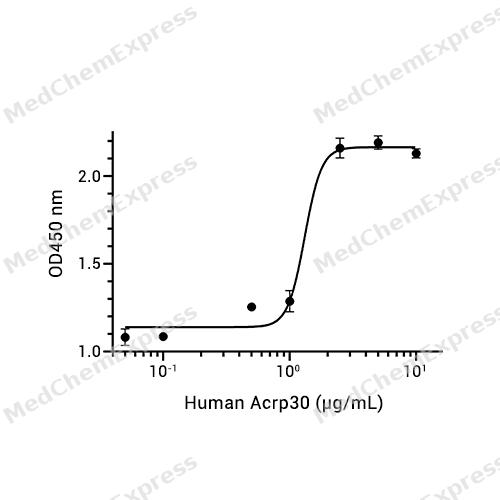
Bioactivity - Cell-Based Assay


Publications (1)
-
Journal Impact Factor
-
Most Recent


Technical Parameters
-
Species Human
-
Source HEK293
-
Tag Tag Free
-
Accession
Q15848 (K101-N244)
-
Molecular Construction
-
N-term
-
Acrp30 (K101-N244)
Accession # Q15848 -
C-term
-
-
Protein Length
Partial
-
Synonyms
ADIPOQ; Adipocyte, C1Q And Collagen Domain Containing; Prev. ACDC; Adipose Specific Collagen-Like Factor; Adiponectin; Gelatin-Binding Protein 28; ACRP30; Gelatin-Binding Protein; GBP28; Adiponectin Precursor; ApM1; ADIPQTL1; Adipose Most Abundant Gene Tr
-
AA Sequence
KGEPGEGAYVYRSAFSVGLETYVTIPNMPIRFTKIFYNQQNHYDGSTGKFHCNIPGLYYFAYHITVYMKDVKVSLFKKDKAMLFTYDQYQENNVDQASGSVLLHLEVGDQVWLQVYGEGERNGLYADNDNDSTFTGFLLYHDTN
-
Molecular Weight
Approximately 16-19 kDa, based on SDS-PAGE under reducing conditions, due to the glycosylation.
-
Glycosylation
Yes
-
Purity
≥ 95%, as determined by reducing SDS-PAGE.


Product Properties
Lyophilized powder
1.Lyophilized from a 0.22 μm filtered solution of PBS.
2.Lyophilized from a 0.22 μm filtered solution of PBS, pH 7.4.
Please refer to the lot-specific COA for specific buffer information.
<0.2 EU/μg, determined by LAL method.
It is not recommended to reconstitute to a concentration less than 100 μg/mL in ddH2O. For long term storage it is recommended to add a carrier protein (0.1% BSA, 5% HSA, 10% FBS or 5% Trehalose).
Stored at -20°C for 2 years from date of receipt. After reconstitution, it is stable at 4°C for 1 week or -20°C for longer (with carrier protein). It is recommended to freeze aliquots at -20°C or -80°C for extended storage.
Room temperature in continental US; may vary elsewhere.


Documentation
-
Data Sheet (262 KB)
-
SDS (251 KB)
- English - EN (251 KB)
- Français - FR (251 KB)
- Deutsch - DE (251 KB)
- Norwegian - NO (251 KB)
- Español - ES (251 KB)
- Swedish - SV (251 KB)
- Italian - IT (251 KB)
- Korean - KR (251 KB)
- Portuguese - PT (251 KB)
-
Handling Instructions (2659 KB)


References
[1]. Kumada M, et al. Adiponectin specifically increased tissue inhibitor of metalloproteinase-1 through interleukin-10 expression in human macrophages. Circulation. 2004 May 4;109(17):2046-9. [Content Brief]
[2]. Rothan HA, et al. Recombinant human adiponectin as a potential protein for treating diabetic tendinopathy promotes tenocyte progenitor cells proliferation and tenogenic differentiation in vitro. Int J Med Sci. 2013 Nov 27;10(13):1899-906. [Content Brief]

Calculators
Concentration (start) × Volume (start) = Concentration (final) × Volume (final)


 Powered by Bioz

