



Resistin Protein, Human (His)
Based on 1 publication(s) in Google Scholar
Resistin, a hormone linking obesity to diabetes, may hinder insulin's glucose uptake stimulation in adipose cells, contributing to metabolic dysregulation. Additionally, it promotes myeloid cell chemotaxis and forms homodimers through disulfide linkages, interacting with DEFA1. Resistin's involvement in diverse cellular processes suggests its pivotal role in the complex interplay of metabolism, inflammation, and insulin responsiveness. Resistin Protein, Human (His) is the recombinant human-derived Resistin protein, expressed by E. coli , with C-6*His labeled tag.
- Species: Human
- Source: E. coli
-
Storage:Stored at -20°C for 2 years from date of receipt. After reconstitution, it is stable at 4°C for 1 week or -20°C for longer (with carrier protein). It is recommended to freeze aliquots at -20°C or -80°C for extended storage.


To place orders, for customer services and technical support, please contact: MedChemExpress USA
Tel: 609-228-6898 E-mail: [email protected] [email protected]


-
 Biological Activity
-
Technical Parameters
-
Product Properties
- Documentation
- Help & FAQs




Biological Activity
Description
Resistin, a hormone linking obesity to diabetes, may hinder insulin's glucose uptake stimulation in adipose cells, contributing to metabolic dysregulation. Additionally, it promotes myeloid cell chemotaxis and forms homodimers through disulfide linkages, interacting with DEFA1. Resistin's involvement in diverse cellular processes suggests its pivotal role in the complex interplay of metabolism, inflammation, and insulin responsiveness. Resistin Protein, Human (His) is the recombinant human-derived Resistin protein, expressed by E. coli , with C-6*His labeled tag.
Background
Resistin, a hormone implicated in connecting obesity to diabetes, exerts its effects by potentially suppressing insulin's ability to stimulate glucose uptake into adipose cells. Not only does it play a role in metabolic regulation, but it also promotes chemotaxis in myeloid cells. Structurally, Resistin forms homodimers through disulfide linkages and interacts with DEFA1, indicating its involvement in diverse cellular processes. This multifaceted hormone emerges as a potential key player in the intricate interplay between metabolism, inflammation, and insulin responsiveness.
Verified Bioactivity
Measured by its binding ability in a functional ELISA.Immobilized Human Resistin at 0.5 μg/mL (100μL/well) can bind Biotinylated Recombinant Mouse Leptin (HY-P7232). The ED50 for this effect is 79.14 ng/mL.
MCE Validation Data
-
Purity - SDS-PAGE
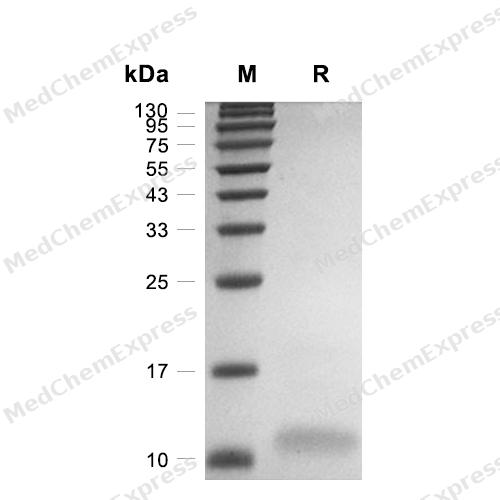
Purity - SDS-PAGE
-
Bioactivity - ELISA
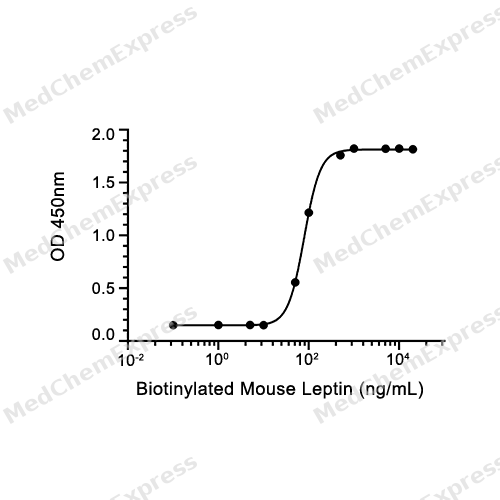
Bioactivity - ELISA


Publications (1)
-
Journal Impact Factor
-
Most Recent
-
J Proteome Res
Tandem Mass Tag-Based Proteomic Profiling Identifies Biomarkers in Drainage Fluid for Early Detection of Anastomotic Leakage after Rectal Cancer Resection. [Abstract]2023 Nov 3;22(11):3559-3569. PMID: 37793102


Technical Parameters
-
Species Human
-
Source E. coli
-
Tag C-6*His
-
Accession
Q9HD89-1 (K19-P108)
-
Molecular Construction
-
N-term
-
Resistin (K19-P108)
Accession # Q9HD89-1 -
6*His
-
C-term
-
-
Protein Length
Full Length of Isoform-1
-
Synonyms
RETN; Cysteine-Rich Secreted Protein FIZZ3; Resistin; RSTN; FIZZ3; C/EBP-Epsilon Regulated Myeloid-Specific Secreted Cysteine-Rich Protein Precursor 1; ADSF; Found In Inflammatory Zone 3; RETN1; Resistin Delta2; C/EBP-Epsilon-Regulated Myeloid-Specific Se
-
AA Sequence
KTLCSMEEAINERIQEVAGSLIFRAISSIGLECQSVTSRGDLATCPRGFAVTGCTCGSACGSWDVRAETTCHCQCAGMDWTGARCCRVQP
-
Molecular Weight
Approximately 10—14 kDa, based on SDS-PAGE under reducing conditions.
-
Purity
≥ 95%, as determined by reducing SDS-PAGE.


Product Properties
Lyophilized powder
Lyophilized from a 0.2 μm filtered solution of 20 mM Acetic acid, pH 3.0.
<1 EU/μg, determined by LAL method.
It is not recommended to reconstitute to a concentration less than 100 μg/mL in ddH2O. For long term storage it is recommended to add a carrier protein (0.1% BSA, 5% HSA, 10% FBS or 5% Trehalose).
Stored at -20°C for 2 years from date of receipt. After reconstitution, it is stable at 4°C for 1 week or -20°C for longer (with carrier protein). It is recommended to freeze aliquots at -20°C or -80°C for extended storage.
Room temperature in continental US; may vary elsewhere.


Documentation
-
Data Sheet (235 KB)
-
SDS (252 KB)
- English - EN (252 KB)
- Français - FR (252 KB)
- Deutsch - DE (252 KB)
- Norwegian - NO (252 KB)
- Español - ES (252 KB)
- Swedish - SV (252 KB)
- Italian - IT (252 KB)
- Korean - KR (252 KB)
- Portuguese - PT (252 KB)
-
Handling Instructions (2659 KB)

Calculators
Concentration (start) × Volume (start) = Concentration (final) × Volume (final)


 Powered by Bioz

