



GRO-gamma/CXCL3 Protein, Human

Based on 1 Customer Validation
CXCL3 is a chemoattractant for neutrophils and belongs to CXC chemokine subfamily. CXCL3 is a secreted growth factor that signals through its cognate receptor CXCR2. CXCL3 is involved in many immune responses including wound healing, cancer metastasis, and angiogenesis. GRO-ganma/CXCL3 Protein, Human is produced in E. coli , and consists of 73 amino acids (A35-N107).
- Species: Human
- Source: E. coli
-
Storage:Stored at -20°C for 2 years from date of receipt. After reconstitution, it is stable at 4°C for 1 week or -20°C for longer (with carrier protein). It is recommended to freeze aliquots at -20°C or -80°C for extended storage.


To place orders, for customer services and technical support, please contact: MedChemExpress USA
Tel: 609-228-6898 E-mail: [email protected] [email protected]


-
 Biological Activity
-
Technical Parameters
-
Product Properties
- Documentation
- References
- Help & FAQs




Biological Activity
Description
CXCL3 is a chemoattractant for neutrophils and belongs to CXC chemokine subfamily. CXCL3 is a secreted growth factor that signals through its cognate receptor CXCR2. CXCL3 is involved in many immune responses including wound healing, cancer metastasis, and angiogenesis[1][2]. GRO-ganma/CXCL3 Protein, Human is produced in E. coli , and consists of 73 amino acids (A35-N107).
Background
CXCL3 is also known as MIP-2 beta, or DCIP-1 in mouse, CINC2 in rat, and GRO-gamma in humans. CXCL3 is a member of the CXC chemokine subfamily, and it is subclassified as a Glu-Leu-Arg (ELR+) CXC chemokine. CXCL3 is originally identified in the supernatants of melanoma cell lines in culture, and is referred to as GRO (growth-related oncogene)[1]. Previous studies have reported that CXCL3 is produced by macrophages, osteoblasts, airway epithelium, dendritic cells, synovial fibroblasts, and cancers[2].
The amino acid sequence of human CXCL3 protein has low homology between mouse and rat CXCL3 protein.
CXCL3 plays an important role in leukocyte chemotaxis, angiogenesis, tumorigenesis, and cell invasion. CXCL3 exerts its functions through a number of signaling pathways including p38 MAPK, ERK1/2 MAPK and JAK2/STAT3 etc., by activating CXCR2 receptor. CXCL3 is highly expressed during the number of tumorous conditions including melanoma, prostate, colorectal, aggressive breast cancer tumors, hepatocellular carcinoma (HCC) and also during hepatic injury and inflammation[3][4].
The cancer types affected by the action of CXCL3 (along with CXCL1 and CXCL2) include prostate cancer, pancreatic cancer, melanoma, lung cancer, hepatocellular carcinoma, and gastric cancer[1]. CXCL3 facilitates adipogenic differentiation through ERK- and JNK-induced induction of c/ebpb and c/ebpd by autocrine/paracrine manners in adipocytes[2]. Furthermore, CXCL3 is also associated with vascular invasion and tumor capsule formation[3]. CXCL3 plays a role in asthma severity and asthmatic airway remodeling[5].
In Vitro
Recombinant human CXCL3 (2, 5, 10, and 20 ng/mL) increases the proliferation and migration abilities of HSC4, KB, and CAL27 cells[6].
Verified Bioactivity
Full biological activity determined by a chemotaxis bioassay using human CXCR2 transfected human 293 cells is in a concentration range of 10-100 ng/mL.
MCE Validation Data
-
Purity - SDS-PAGE
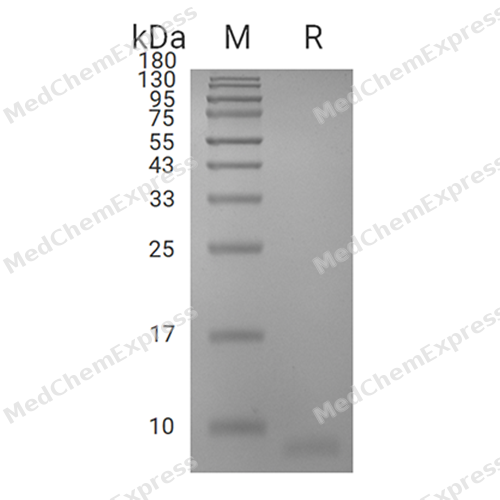
Purity - SDS-PAGE


Technical Parameters
-
Species Human
-
Source E. coli
-
Tag Tag Free
-
Accession
P19876 (A35-N107)
-
Molecular Construction
-
N-term
-
CXCL3 (A35-N107)
Accession # P19876 -
C-term
-
-
Protein Length
Full Length of C-X-C motif chemokine 3 Chain
-
Synonyms
CXCL3; C-X-C Motif Chemokine 3; Prev. GRO3; GRO3 Oncogene; SCYB3; GRO-Gamma; CINC-2b; MIP2-Beta; MIP-2b; Melanoma Growth Stimulatory Activity Gamma; GROg; MGSA Gamma; Macrophage Inflammatory Protein 2-Beta; MIP2B; Chemokine (C-X-C Motif) Ligand 3; GROG; G
-
AA Sequence
ASVVTELRCQCLQTLQGIHLKNIQSVNVRSPGPHCAQTEVIATLKNGKKACLNPASPMVQKIIEKILNKGSTN
-
Predicted Molecular Mass
7.9 kDa
-
Purity
≥ 95%, as determined by reducing SDS-PAGE.


Product Properties
Lyophilized powder.
Lyophilized from a 0.22 μm filtered solution of 20 mM PB, pH 7.4, 50 mM NaCl.
<1 EU/μg, determined by LAL method.
It is not recommended to reconstitute to a concentration less than 100 μg/mL in ddH2O. For long term storage it is recommended to add a carrier protein (0.1% BSA, 5% HSA, 10% FBS or 5% Trehalose).
Stored at -20°C for 2 years from date of receipt. After reconstitution, it is stable at 4°C for 1 week or -20°C for longer (with carrier protein). It is recommended to freeze aliquots at -20°C or -80°C for extended storage.
Room temperature in continental US; may vary elsewhere.


Documentation
-
Data Sheet (263 KB)
-
SDS (252 KB)
- English - EN (252 KB)
- Français - FR (252 KB)
- Deutsch - DE (252 KB)
- Norwegian - NO (252 KB)
- Español - ES (252 KB)
- Swedish - SV (252 KB)
- Italian - IT (252 KB)
- Korean - KR (252 KB)
- Portuguese - PT (252 KB)
-
Handling Instructions (2659 KB)


References
[1]. Niradiz Reyes, et al. CXCL3 Signaling in the Tumor Microenvironment. Adv Exp Med Biol. 2021;1302:15-24. [Content Brief]
[2]. Joji Kusuyama, et al. CXCL3 positively regulates adipogenic differentiation. J Lipid Res. 2016 Oct;57(10):1806-1820. [Content Brief]
[3]. Khushboo Gulati, et al. Molecular cloning and biophysical characterization of CXCL3 chemokine. Int J Biol Macromol. 2018 Feb;107(Pt A):575-584. [Content Brief]
[4]. Jinru Weng, et al. CXCL3 overexpression affects the malignant behavior of oral squamous cell carcinoma cells via the MAPK signaling pathway. J Oral Pathol Med. 2021 Oct;50(9):902-910. [Content Brief]
[5]. Laila A Al-Alwan, et al. Differential roles of CXCL2 and CXCL3 and their receptors in regulating normal and asthmatic airway smooth muscle cell migration. J Immunol. 2013 Sep 1;191(5):2731-41. [Content Brief]
[6]. Jian Guan, et al. Clinical significance and biological functions of chemokine CXCL3 in head and neck squamous cell carcinoma. Biosci Rep. 2021 Dec 22;41(12):BSR20212403. [Content Brief]

Calculators
Concentration (start) × Volume (start) = Concentration (final) × Volume (final)


 Powered by Bioz

