



6Ckine/CCL21B Protein, Mouse

Based on 1 Customer Validation
6Ckine/CCL21B Protein, Mouse is a homeostatic lymphoid chemokine that contributes to the entry of T cells and dendritic cells into the lymphoid T-zone. It acts through chemokine receptors CCR7 and CXCR3 to promote fibrogenic and inflammatory cytokine production. Exodus-2/CCL21 Protein, Mouse is a recombinant mouse 6Ckine/CCL21B (S24-G133) expressed by E. coli.
- Species: Mouse
- Source: E. coli
-
Storage:Stored at -20°C for 2 years from date of receipt. After reconstitution, it is stable at 4°C for 1 week or -20°C for longer (with carrier protein). It is recommended to freeze aliquots at -20°C or -80°C for extended storage.


To place orders, for customer services and technical support, please contact: MedChemExpress USA
Tel: 609-228-6898 E-mail: [email protected] [email protected]


-
 Biological Activity
-
Technical Parameters
-
Product Properties
- Documentation
- References
- Help & FAQs




Biological Activity
Description
6Ckine/CCL21B Protein, Mouse is a homeostatic lymphoid chemokine that contributes to the entry of T cells and dendritic cells into the lymphoid T-zone. It acts through chemokine receptors CCR7 and CXCR3 to promote fibrogenic and inflammatory cytokine production. Exodus-2/CCL21 Protein, Mouse is a recombinant mouse 6Ckine/CCL21B (S24-G133) expressed by E. coli[1].
Background
CCL21, also known as exodus-2 and secondary lymphoid chemokine (SLC), is a small cytokine belonging to the CC chemokine family and is located on chromosome 9 in the human genome. It binds to glycosaminoglycan (GAG) and is anchored to the surface of endothelial cells. As a chemokine, CCL21 inhibits hematopoiesis and stimulates chemotaxis, and is chemotactic in vitro for thymocytes and activated T cells, but not for B cells, macrophages or neutrophils. At the same time, CCL21 is a potent stimulator of T cell migration and adhesion, binding to the glycoprotein PSGL-1 on T cells to promote the migration of T cells to secondary lymphoid organs. CCL21 can act through chemokine receptors CCR7 and CXCR3. Among them, CCR7 is a GPCR that is normally expressed by T cell subsets central memory cells, thymic T cells, B cells, mature DCs and other rare cell subsets. ccl21 can function as a microglia activator in the CNS and is expressed exclusively in endangered or mechanically damaged neurons[1][2].
In Vitro
CCL21 (intrathecal administration, 0.06 μg/mouse, once, 14 days) results in a significant and instantaneous decrease in paw withdrawal threshold (PWT) to 0.93 g, which returns to the control value of 1.44 g within 48 hours in wild-type C57BL/6 mice, also causes a rapid decrease in PWT to 0.721 g and does not show any recovery throughout the experiment in paucity of lymphoid T cells (plt) mutation mice[2].
CCL21 (antibodies neutralization 10 μg/injection, twice weekly) reduces Pancreatic ductal adenocarcinoma (PDAC)-induced abdominal hypersensitivity, alleviates pain associated with pancreatic ductal adenocarcinoma and improves health status in situ mouse model of PDAC in C57BL/6 mice injected with K8484 cells[3].
In Vivo
CCL21(0-3 nM, 24 h) induces a rapid and significant upregulation of P2X4 protein expression of microglia at concentrations as low as 1 nM[2].
Verified Bioactivity
1.Full biological activity determined by a chemotaxis bioassay using murine T-lymphocytes is in a concentration range of 10-100 ng/mL.
2.Determined by its ability to chemoattract BaF3 mouse pro-B cells transfected with human CCR7.The ED50 for this effect is 13.57 ng/mL, corresponding to a specific activity is 7.37×10⁴ U/mg.
MCE Validation Data
-
Purity - SDS-PAGE
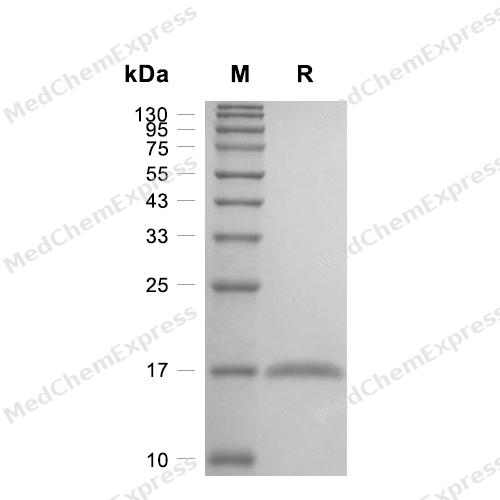
Purity - SDS-PAGE
-
Bioactivity - Cell-Based Assay
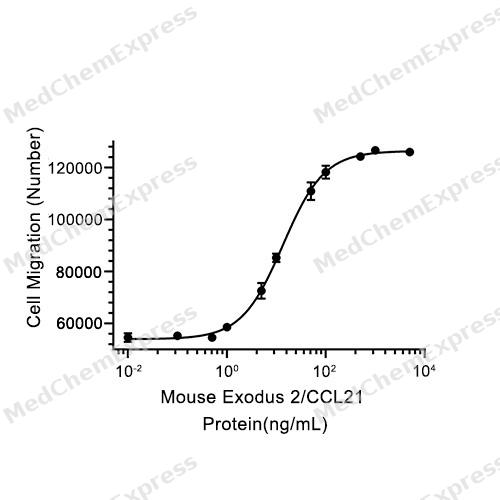
Bioactivity - Cell-Based Assay


Technical Parameters
-
Species Mouse
-
Source E. coli
-
Tag Tag Free
-
Accession
P86792 (S24-G133)
-
Gene ID65956
-
Molecular Construction
-
N-term
-
CC21B (S24-G133)
Accession # P86792 -
C-term
-
-
Protein Length
Full Length of Mature Protein
-
Synonyms
Scya21b; Scya21; Ccl21b; TCA4; Thymus-derived chemotactic agent 4; Small-inducible cytokine A21b; Beta-chemokine exodus-2; 6Ckine; C-C motif chemokine 21b
-
AA Sequence
SDGGGQDCCLKYSQKKIPYSIVRGYRKQEPSLGCPIPAILFLPRKHSKPELCANPEEGWVQNLMRRLDQPPAPGKQSPGCRKNRGTSKSGKKGKGSKGCKRTEQTQPSRG
-
Predicted Molecular Mass
12.1 kDa
-
Molecular Weight
Approximately 17 kDa, based on SDS-PAGE under reducing conditions.
-
Purity
≥ 95%, as determined by reducing SDS-PAGE.


Product Properties
Lyophilized powder
Lyophilized after extensive dialysis against 20 mM PB, pH 7.4-8.0, 150 mM NaCl.
<1 EU/μg, determined by LAL method.
It is not recommended to reconstitute to a concentration less than 100 μg/mL in ddH2O. For long term storage it is recommended to add a carrier protein (0.1% BSA, 5% HSA, 10% FBS or 5% Trehalose).
Stored at -20°C for 2 years from date of receipt. After reconstitution, it is stable at 4°C for 1 week or -20°C for longer (with carrier protein). It is recommended to freeze aliquots at -20°C or -80°C for extended storage.
Room temperature in continental US; may vary elsewhere.


Documentation
-
Data Sheet (263 KB)
-
SDS (251 KB)
- English - EN (251 KB)
- Français - FR (251 KB)
- Deutsch - DE (251 KB)
- Norwegian - NO (251 KB)
- Español - ES (251 KB)
- Swedish - SV (251 KB)
- Italian - IT (251 KB)
- Korean - KR (251 KB)
- Portuguese - PT (251 KB)
-
Handling Instructions (2659 KB)


References
[1]. Balsam Rizeq, et al. The Role of CCL21/CCR7 Chemokine Axis in Breast Cancer Progression. Cancers (Basel). 2020 Apr 23;12(4):1036. [Content Brief]
[2]. Förster R, et al. CCR7 and its ligands: balancing immunity and tolerance. Nat Rev Immunol. 2008 May;8(5):362-71. [Content Brief]
[3]. Knut Biber, et al. Neuronal CCL21 up-regulates microglia P2X4 expression and initiates neuropathic pain development. EMBO J. 2011 May 4;30(9):1864-73. [Content Brief]
[5]. Michael Hirth, et al. CXCL10 and CCL21 Promote Migration of Pancreatic Cancer Cells Toward Sensory Neurons and Neural Remodeling in Tumors in Mice, Associated With Pain in Patients. Gastroenterology. 2020 Aug;159(2):665-681.e13. [Content Brief]
[6]. Alt C, et al. Functional expression of the lymphoid chemokines CCL19 (ELC) and CCL 21 (SLC) at the blood-brain barrier suggests their involvement in G-protein-dependent lymphocyte recruitment into the central nervous system during experimental autoimmune encephalomyelitis. Eur J Immunol. 2002 Aug;32(8):2133-44. [Content Brief]

Calculators
Concentration (start) × Volume (start) = Concentration (final) × Volume (final)


 Powered by Bioz

