



LY456236 (Standard)
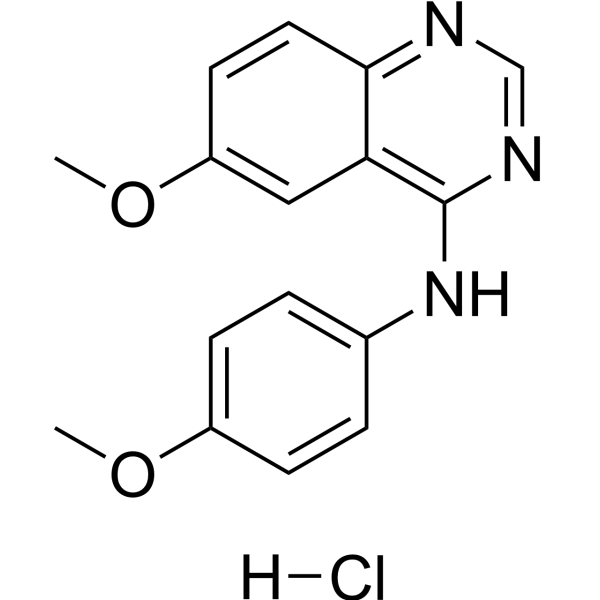
LY456236 (Standard) is the analytical standard of LY456236 (HY-103566). This product is intended for research and analytical applications. LY456236 is a selective, non-competitive and orally active antagonist of glutamate receptor 1 (mGlu1), which can inhibit phosphatidylinositol hydrolysis with an IC50 of 0.145 μM. LY456236 can also inhibit EGFR, with an IC50 of 0.918 μM. LY456236 has anticonvulsant effects and blocks cell proliferation by inhibiting the MAPK pathway, reversing the anti-apoptotic effect of DHPG (HY-12598A). LY456236 can be used in epilepsy research.
Nur für Forschungszwecke. Wir verkaufen nicht an Patienten.
- CAS. Nr.: 338736-46-2
- Formel: C16H16ClN3O2
- Molecular Weight:317.78
-
Speicherung:
Please store the product under the recommended conditions in the Certificate of Analysis.


To place orders, for customer services and technical support, please contact: MedChemExpress USA
Tel: 609-228-6898 E-mail: [email protected] [email protected]


-
 Product Information
-
Chemical Information
- Reinheit & Dokumentation
-
 Help & FAQs


-
HY-103566
LY456236 -
HY-W011417
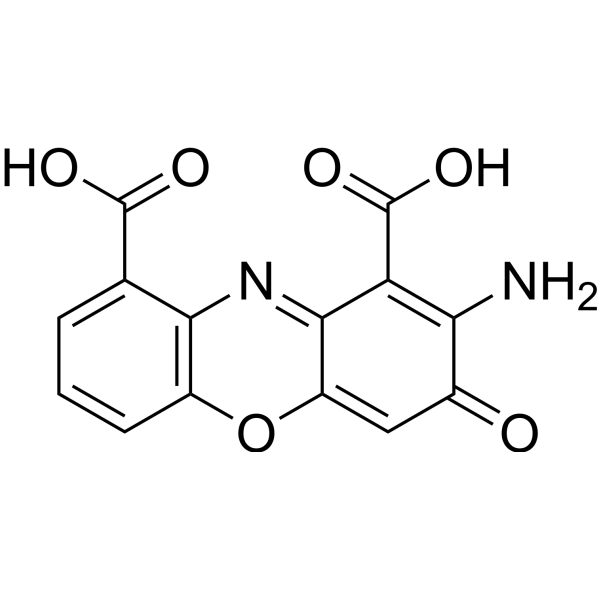
Cinnabarinic acid -
HY-W015546
β-N-methylamino-L-alanine hydrochloride -
HY-102095
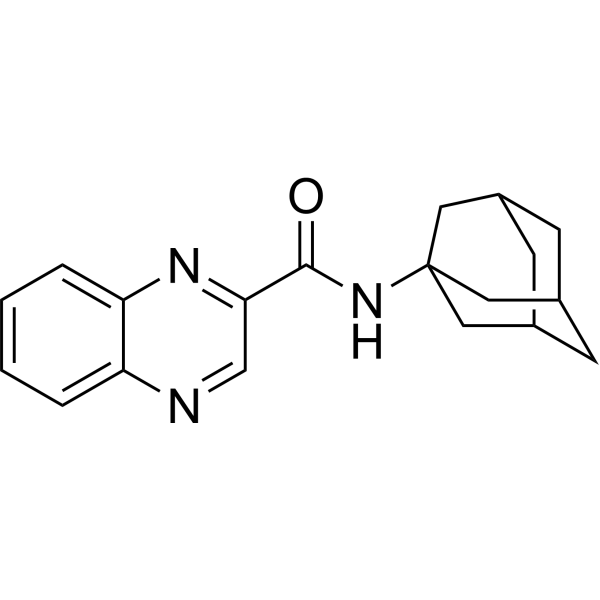
SIB-1757 -
HY-11095
NPS 2390 -
HY-W011417R
Cinnabarinic acid (Standard) -
HY-107509
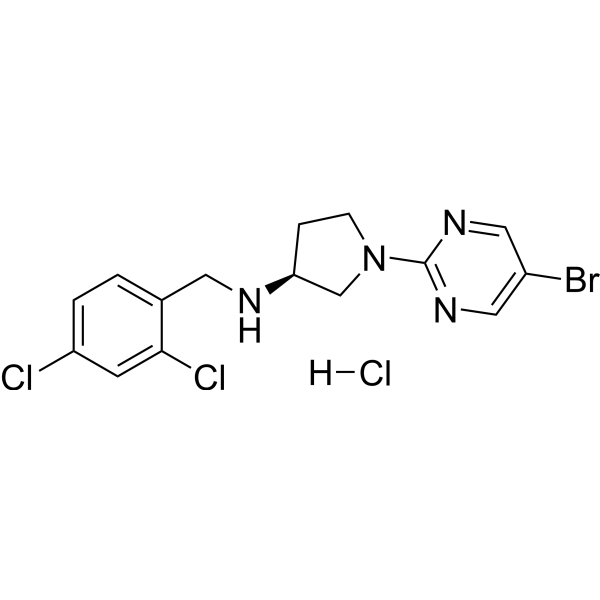
LY2389575 hydrochloride -

HY-102095R
SIB-1757 (Standard) -

HY-W015546R
β-N-methylamino-L-alanine hydrochloride (Standard) -

HY-107509R
LY2389575 hydrochloride (Standard)


Product Information
Information
Anwendung
The compound is the grade of analytical standard, which is the reference standard supplied assay. It is commonly used in qualitative, quantitative and methodological research experiments in HPLC, GC and MS.


Chemical Information
-
CAS. Nr. 338736-46-2
-
Molecular Weight 317.78
-
Formel C16H16ClN3O2
-
SMILES
COC1=CC=C(NC2=C3C=C(OC)C=CC3=NC=N2)C=C1.[H]Cl
-
Versand
Room temperature in continental US; may vary elsewhere.
-
Speicherung
Please store the product under the recommended conditions in the Certificate of Analysis.


Reinheit & Dokumentation
Verweise
[1]. Ravikumar B, et al. Chemogenomic Analysis of the Druggable Kinome and Its Application to Repositioning and Lead Identification Studies. Cell Chem Biol. 2019 Nov 21;26(11):1608-1622.e6. [Content Brief]
[2]. Kanaya S, et al. Metabotropic glutamate receptor 1 promotes cementoblast proliferation via MAP kinase signaling pathways. Connect Tissue Res. 2016 Sep;57(5):417-26. [Content Brief]
[3]. Shannon HE, et al. Anticonvulsant effects of LY456236, a selective mGlu1 receptor antagonist. Neuropharmacology. 2005;49 Suppl 1:188-95. [Content Brief]

Calculators
Konzentration (Stammlösung) × Volumen (Stammlösung) = Konzentration (Ziellösung) × Volumen (Ziellösung)


LY456236 (Standard) Related Classifications
HY-103566R Related Classifications
 Powered by Bioz