



Doxorubicinol hydrochloride

Based on 1 Customer Validation
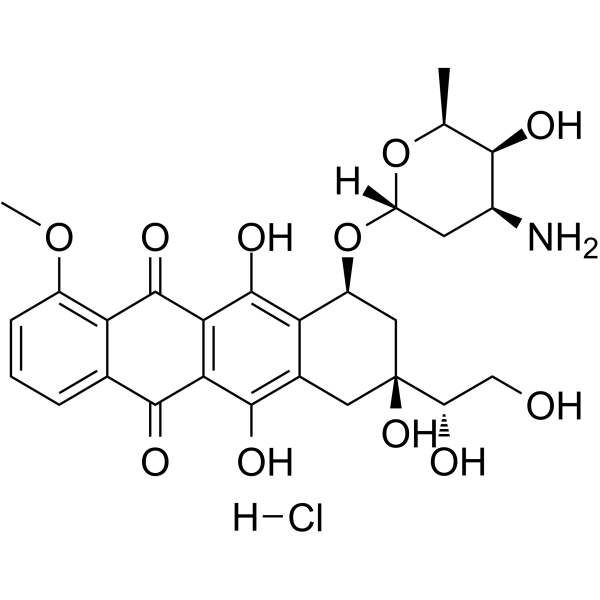
Doxorubicinol hydrochloride (13-Dihydroadriamycin hydrochloride) is a secondary alcohol metabolite of Doxorubicin.
For research use only. We do not sell to patients.
- Purity: 99.9%
- CAS No.: 63950-05-0
- Formula: C27H32ClNO11
- Molecular Weight:582.00
-
Storage:
-20°C, sealed storage, away from moisture
* In solvent : -80°C, 6 months; -20°C, 1 month (sealed storage, away from moisture)

To place orders, for customer services and technical support, please contact: MedChemExpress USA
Tel: 609-228-6898 E-mail: [email protected] [email protected]


-
 Biological Activity
-
Chemical Information
- Purity & Documentation
- References
-
 Help & FAQs




Biological Activity
Description
In Vitro
Doxorubicinol hydrochloride is produced by a two-electron, NADPH-dependent reduction of the Doxorubicin side-chain carbonyl group (C13) to a secondary alcohol[1].
Doxorubicinol hydrochloride has been shown to have significantly lower DNA binding activity as compared to DOX. Moreover, while Doxorubicinol hydrochloride is retained in the cytoplasm or lysosomes, Doxorubicin is mainly accumulated in the nucleus[1].
MedChemExpress (MCE) has not independently confirmed the accuracy of these methods. They are for reference only.
In Vivo
In comparison with wild-type mice, the terminal half-life and the area under the plasma concentration-time curve of Doxorubicin in mdr1a(-/-) mice are 1.6- and 1.2-fold higher respectively. The retention of both Doxorubicin and its metabolite Doxorubicinol hydrochloride in the hearts of mdr1a(-/-) mice is substantially prolonged[2].
MedChemExpress (MCE) has not independently confirmed the accuracy of these methods. They are for reference only.


Chemical Information
-
CAS No. 63950-05-0
-
Appearance Solid
-
Molecular Weight 582.00
-
Formula C27H32ClNO11
-
Color Pink to red
-
SMILES
OC1=C(C[C@]([C@@H](O)CO)(O)C[C@@H]2O[C@@](O[C@@H](C)[C@H]3O)([H])C[C@@H]3N)C2=C(O)C(C4=O)=C1C(C5=CC=CC(OC)=C45)=O.Cl[H]
-
Synonyms
13-Dihydroadriamycin hydrochloride
-
Shipping
Room temperature in continental US; may vary elsewhere.
-
Storage
-20°C, sealed storage, away from moisture
* In solvent : -80°C, 6 months; -20°C, 1 month (sealed storage, away from moisture)


Purity & Documentation
-
Data Sheet (275 KB)
-
SDS (252 KB)
- English - EN (252 KB)
- Français - FR (252 KB)
- Deutsch - DE (252 KB)
- Norwegian - NO (252 KB)
- Español - ES (252 KB)
- Swedish - SV (252 KB)
- Italian - IT (252 KB)
- Korean - KR (252 KB)
- Portuguese - PT (252 KB)
-
Handling Instructions (2659 KB)
References
[1]. Kamil Piska, et al. Metabolic carbonyl reduction of anthracyclines - role in cardiotoxicity and cancer resistance. Reducing enzymes as putative targets for novel cardioprotective and chemosensitizing agents. Invest New Drugs. 2017 Jun;35(3):375-385. [Content Brief]
[2]. J van Asperen, et al. Increased accumulation of doxorubicin and doxorubicinol in cardiac tissue of mice lacking mdr1a P-glycoprotein. Br J Cancer. 1999 Jan;79(1):108-13. [Content Brief]

Calculators
Concentration (start) × Volume (start) = Concentration (final) × Volume (final)


Doxorubicinol hydrochloride Related Classifications
HY-G0022 Related Classifications
 Powered by Bioz