



Rifaximin
Based on 8 publication(s) in Google Scholar
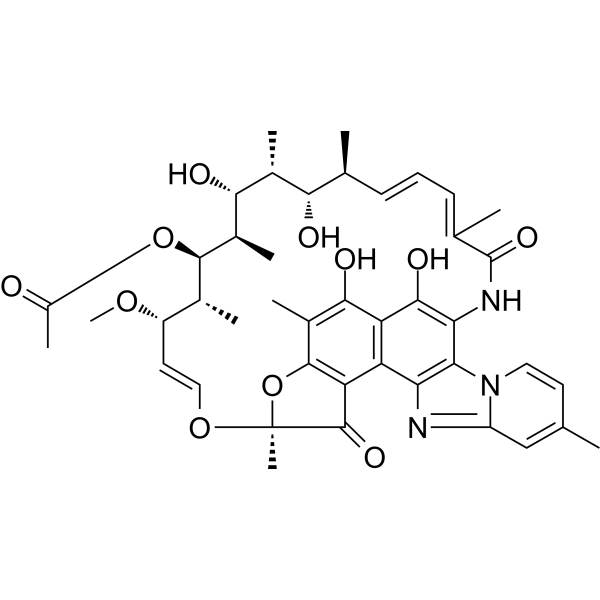
Rifaximin, a gastrointestinal-selective antibiotic, binds the β-subunit of bacterial DNA-dependent RNA polymerase, resulting in inhibition of bacterial RNA synthesis. Rifaximin susceptibility is higher against Gram-positive strains (MIC: 0.03-5 mg/ml) compared to Gram-negative bacteria (MIC: 8-50 mg/mL).
Para uso exclusivo en investigación. No vendemos a pacientes.
- Pureza: 99.64%
- No. CAS: 80621-81-4
- Fòrmula: C43H51N3O11
- Peso molecular:785.88
-
Almacenamiento:Powder -20°C, 3 years , 4°C, 2 years ; In solvent -80°C, 2 years , -20°C, 1 year

To place orders, for customer services and technical support, please contact: MedChemExpress USA
Tel: 609-228-6898 E-mail: [email protected] [email protected]


-
 Actividad biológica
-
Chemical Information
-
Solvente y solubilidad
- Pureza y Documentación
- Referencias
-
 Help & FAQs
-

Anti-Infection Compound Library
HY-L002
-
Cell Cycle/DNA Damage Compound Library
HY-L004
-
FDA-Approved Drug Library
HY-L022
-
Anti-Cancer Compound Library
HY-L025
-
Anti-Aging Compound Library
HY-L034
-
Drug Repurposing Compound Library
HY-L035
-
Covalent Screening Library
HY-L036
-
Macrocyclic Compound Library
HY-L041
-
Antibacterial Compound Library
HY-L049
-
NMPA-Approved Drug Library
HY-L053
-
Orally Active Compound Library
HY-L061
-
FDA Approved & Pharmacopeial Drug Library
HY-L066
-
Antibiotics Library
HY-L067
-
Drug-Induced Liver Injury (DILI) Compound Library
HY-L076
-
Rare Diseases Drug Library
HY-L102
-
FDA-Approved Anticancer Drug Library
HY-L122
-
Human Metabolite Library
HY-L123
-
Non-steroidal Anti-Inflammatory Compound Library
HY-L130
-
Heterocyclic Compound Library
HY-L138
-
Off-patent Drug Library
HY-L141
-
Highly Selective Inhibitors Library
HY-L158
-
Bioactive Compound Library Max
HY-L181
-
MCE Bioactive Compound Library
HY-L001V
-
Covalent Screening Library Plus
HY-L036P
-
Drug Repurposing Compound Library Plus
HY-L035P
-
FDA-Approved Drug Library Plus
HY-L022P
-
FDA-Approved Drug Library Mini
HY-L022M
-
Bioactive Compound Library
HY-L001
-
High-Throughput Bioactive Compound Library
HY-L205
-
Mass Spectrometry Human Metabolite Library
HY-L215
-
RNA Binding Bioactive Compound Library
HY-L248


Publications Citing Use of MedChemExpress (MCE) Rifaximin
More- J Exp Med. 2026 Mar 2;223(3):e20241287. [Abstract]
- Phytomedicine. 2024 Nov 28:136:156297. [Abstract]
- Sci Rep. 2025 Mar 21;15(1):9815. [Abstract]
- Mol Pharm. 2022 Nov 7;19(11):4320-4332. [Abstract]
- J Med Virol. 2025 Oct;97(10):e70655. [Abstract]
- Brain Behav. 2024 Jul;14(7):e3621. [Abstract]
- Hong Kong Polytechnic University. 2025.
- bioRxiv. 2024 May 10.
Ver todos los productos específicos de isoformas Antibiotic
MoreVer todos los productos específicos de isoformas DNA/RNA Synthesis
More

Actividad biológica
|
RNA Polymerase |
|
Cell Line

|
Type | Value | Description | References |
|---|---|---|---|---|
| HepG2 | EC50 |
11.2 μM
Compound: Rifaximin
|
Transactivation of full length human PXR transfected in human HepG2 cells after 18 hrs by luciferase reporter assay relative to rifaximin
Transactivation of full length human PXR transfected in human HepG2 cells after 18 hrs by luciferase reporter assay relative to rifaximin
|
[PMID: 26408814] |
| HepG2 | EC50 |
14.1 μM
Compound: Rifaximin
|
Activation of human PXR expressed in human HepG2 (DPX-2) cells after 24 hrs by luciferase reporter gene based luminescent analysis
Activation of human PXR expressed in human HepG2 (DPX-2) cells after 24 hrs by luciferase reporter gene based luminescent analysis
|
[PMID: 20966043] |
| HepG2 | EC50 |
14.1 μM
Compound: Rifaximin
|
Activation of human PXR expressed in human HepG2 (DPX-2) cells assessed as induction of CYP3A4 after 24 hrs by luminescent analysis
Activation of human PXR expressed in human HepG2 (DPX-2) cells assessed as induction of CYP3A4 after 24 hrs by luminescent analysis
|
[PMID: 20966043] |
| HepG2 | EC50 |
2.2 μM
Compound: rifaximin
|
Transactivation of human PXR expressed in HepG2 cells after 18 hrs by luciferase reporter gene assay
Transactivation of human PXR expressed in HepG2 cells after 18 hrs by luciferase reporter gene assay
|
[PMID: 21599020] |
| HepG2 | EC50 |
4 μM
Compound: rifaximin
|
Agonist activity at human full-length PXR transfected in human HepG2 cells co-transfected with pSG5-RXR assessed as induction of transactivation by dual-luciferase reporter gene assay
Agonist activity at human full-length PXR transfected in human HepG2 cells co-transfected with pSG5-RXR assessed as induction of transactivation by dual-luciferase reporter gene assay
|
[PMID: 24388834] |
Rifaximin has a good inhibitory activity against Staphylococcus, Streptococcus, Enterococcus, Escherichia coli, Shigella, Salmonella, Bacillus cereus, Moraxella catarrhalis, Haemophilus influenzae, Haemophilus ducreyi, Bacteroides bivius-disiens, Gardnerella vaginalis, Lactobacillus spp.,Mobiluncus spp.,Neisseria gonorrhoeae, Pseudomonas and Acinetobacter . Rifaximin rarely causes side effects[1].
Rifaximin (0.1, 1.0 and 10.0 μM) causes significant and concentration-dependent reduction of cell proliferation, cell migration and PCNA expression in the Caco-2 cells vs. untreated cells[2].
Rifaximin (0.1-10 μM) downregulates Akt/mTOR and p38MAPK/NF-κB pathways through a PXR-dependent mechanism[2].
MedChemExpress (MCE) has not independently confirmed the accuracy of these methods. They are for reference only.
-
Cell Line:Caco-2 cells
-
Concentration:0.1, 1.0 and 10.0 μM
-
Incubation Time:48 hours
-
Result:Caused a significant and concentration-dependent reduction in cell proliferation. Reduced the expression of PCNA in a concentration-dependent manner.
-
Cell Line:Caco-2 cells
-
Concentration:0.1, 1.0 and 10.0 μM
-
Incubation Time:24 hours
-
Result:Reduced Akt, mTOR, p38 MAPK and HIF-1α expression in a concentration-dependent manner. Inhibited NF-κB nuclear activation and p70S6K.
MedChemExpress (MCE) has not independently confirmed the accuracy of these methods. They are for reference only.
-
Animal Model:Balb/c mice (6–8 weeks old) bearing 2,4,6-trinitrobenzene sulfonic acid (TNBS)-induced colitis[3]
-
Dosage:10, 30 and 50 mg/kg/day
-
Administration:Orally, p.o. daily for 7 days
-
Result:Significantly reduced TNBS induced colitis at the dose of 30 and 50 mg/kg, but not 10 mg/kg. A 7-day course of 30 and 50 mg/kg resulted in an almost complete tissue protection.
| NCT Number | Sponsor | Condition | Start Date |
Phase
|
|---|---|---|---|---|
| NCT01329991 | Plexxikon| | 2011-05 | PHASE1 |


Chemical Information
-
No. CAS 80621-81-4
-
Appearance Solid
-
Peso molecular 785.88
-
Fòrmula C43H51N3O11
-
Color Yellow to orange
-
SMILES
O=C1C2=C(O[C@@]1(O/C=C/[C@@H]([C@H]([C@H]([C@@H]([C@@H]([C@@H]([C@@H](O)[C@@H](C)/C=C/C=C(C)\C3=O)C)O)C)OC(C)=O)C)OC)C)C(C)=C(O)C4=C2C5=C(C(N3)=C4O)N6C(C=C(C)C=C6)=N5
-
Envío
Room temperature in continental US; may vary elsewhere.
-
Almacenamiento
Powder -20°C 3 years 4°C 2 years In solvent -80°C 2 years -20°C 1 year


Publications (8)
-
Journal Impact Factor
-
Most Recent
-
J Exp Med
2026 Mar 2;223(3):e20241287. PMID: 41400657 -
Phytomedicine
Sarsasapogenin stimulates angiogenesis and osteogenesis coupling to treat estrogen deficiency-induced osteoporosis by activating the GPX4/SLIT3/ROBO1 axis. [Abstract]2024 Nov 28:136:156297. PMID: 39637471 -
Sci Rep
Mechanisms of rifaximin inhibition of hepatic fibrosis in mice with metabolic dysfunction associated steatohepatitis through the TLR4/NFκB pathway. [Abstract]2025 Mar 21;15(1):9815. PMID: 40118973 -
Mol Pharm
2022 Nov 7;19(11):4320-4332. PMID: 36269563 -
J Med Virol
Drug Repurposing: In Vitro Evaluation of Simeprevir as a Novel Antiviral Drug Against Severe Fever With Thrombocytopenia Syndrome Virus. [Abstract]2025 Oct;97(10):e70655. PMID: 41117261 -
Brain Behav
The effect of rifaximin and lactulose treatments to chronic hepatic encephalopathy rats: An [18F]PBR146 in-vivo neuroinflammation imaging study. [Abstract]2024 Jul;14(7):e3621. PMID: 38970239 -
-


Solvente y solubilidad
DMSO : ≥ 50 mg/mL (63.62 mM; Hygroscopic DMSO has a significant impact on the solubility of product, please use newly opened DMSO)
* "≥" means soluble, but saturation unknown.
Please refer to the solubility information to select the appropriate solvent. Once prepared, please aliquot and store the solution to prevent product inactivation from repeated freeze-thaw cycles.
Storage method and period of stock solution: -80°C, 2 years; -20°C, 1 year. When stored at -80°C, please use it within 2 years. When stored at -20°C, please use it within 1 year.
Please refer to the solubility information to select the appropriate solvent. Once prepared, please aliquot and store the solution to prevent product inactivation from repeated freeze-thaw cycles.
Storage method and period of stock solution: -80°C, 2 years; -20°C, 1 year. When stored at -80°C, please use it within 2 years. When stored at -20°C, please use it within 1 year.
Concentration (start) × Volume (start) = Concentration (final) × Volume (final)
Select the appropriate dissolution method based on your experimental animal and administration route.
- For the following dissolution methods, please ensure to first prepare a clear stock solution using an In Vitro approach and then sequentially add co-solvents:
- To ensure reliable experimental results, the clarified stock solution can be appropriately stored based on storage conditions. As for the working solution for In Vivo experiments, it is recommended to prepare freshly and use it on the same day.
- The percentages shown for the solvents indicate their volumetric ratio in the final prepared solution. If precipitation or phase separation occurs during preparation, heat and/or sonication can be used to aid dissolution.
Add each solvent one by one: 10% DMSO 40% PEG300 5% Tween-80 45% Saline
Solubility: ≥ 3 mg/mL (3.82 mM); Clear solution
This protocol yields a clear solution of ≥ 3 mg/mL (saturation unknown).
Taking 1 mL working solution as an example, add 100 μL DMSO stock solution (30.0 mg/mL) to 400 μL PEG300, and mix evenly; then add 50 μL Tween-80 and mix evenly; then add 450 μL Saline to adjust the volume to 1 mL.
Preparation of Saline: Dissolve 0.9 g sodium chloride in ddH₂O and dilute to 100 mL to obtain a clear Saline solution.
Add each solvent one by one: 10% DMSO 90% (20% SBE-β-CD in Saline)
Solubility: 2.08 mg/mL (2.65 mM); Suspended solution; Need ultrasonic
This protocol yields a suspended solution of 2.08 mg/mL. Suspended solution can be used for oral and intraperitoneal injection.
Taking 1 mL working solution as an example, add 100 μL DMSO stock solution (20.8 mg/mL) to 900 μL 20% SBE-β-CD in Saline, and mix evenly.
Preparation of 20% SBE-β-CD in Saline (4°C, storage for one week): 2 g SBE-β-CD powder is dissolved in 10 mL Saline, completely dissolve until clear.
Please enter the basic information of animal experiments:
-
-
-
-
Recommended: Prepare an additional quantity of animals to account for potential losses during experiments.
Please enter your animal formula composition:
-
%DMSO +
Recommended: Keep the proportion of DMSO in working solution below 2% if your animal is weak.
-
%+
-
+%Tween-80 + +
-
%Saline +
The co-solvents required include: DMSO, . All of co-solvents are available by MedChemExpress (MCE). , Tween 80. All of co-solvents are available by MedChemExpress (MCE).
Working solution concentration: 0.22 mg/mL
Method for preparing stock solution: mg drug dissolved in μL DMSO. Stock solution concentration: mg/mL.
1. Take μL DMSO stock solution;
2. Add μL .
μL , mix evenly;
3. Then add μL Tween 80, mix evenly;
4. Then add μL
Please ensure that the stock solution in the first step is dissolved to a clear state, and add co-solvents in sequence. You can use ultrasonic heating (ultrasonic cleaner, recommended frequency 20-40 kHz), vortexing, etc. to assist dissolution.


Pureza y Documentación
-
Ficha de datos (284 KB)
-
SDS (394 KB)
- English - EN (394 KB)
- Français - FR (394 KB)
- Deutsch - DE (394 KB)
- Norwegian - NO (394 KB)
- Español - ES (394 KB)
- Swedish - SV (394 KB)
- Italian - IT (394 KB)
- Korean - KR (394 KB)
- Portuguese - PT (394 KB)
-
Instrucciones de manejo (2659 KB)
Referencias
[1]. Veronica Ojetti, et al. Rifaximin pharmacology and clinical implications. Expert Opin Drug Metab Toxicol. 2009 Jun;5(6):675-82. [Content Brief]
[2]. Giuseppe Esposito,et al. Rifaximin, a non-absorbable antibiotic, inhibits the release of pro-angiogenic mediators in colon cancer cells through a pregnane X receptor-dependent pathway. Int J Oncol. 2016 Aug;49(2):639-45. [Content Brief]
[3]. Stefano Fiorucci,et al.Inhibition of intestinal bacterial translocation with rifaximin modulates lamina propria monocytic cells reactivity and protects against inflammation in a rodent model of colitis. Digestion. 2002;66(4):246-56. [Content Brief]


Complete Stock Solution Preparation Table
Please refer to the solubility information to select the appropriate solvent. Once prepared, please aliquot and store the solution to prevent product inactivation from repeated freeze-thaw cycles.
Storage method and period of stock solution: -80°C, 2 years; -20°C, 1 year. When stored at -80°C, please use it within 2 years. When stored at -20°C, please use it within 1 year.
| Optional Solvent | Concentration Solvent Mass | 1 mg | 5 mg | 10 mg | 25 mg |
|---|---|---|---|---|---|
| DMSO | 1 mM | 1.2725 mL | 6.3623 mL | 12.7246 mL | 31.8115 mL |
| 5 mM | 0.2545 mL | 1.2725 mL | 2.5449 mL | 6.3623 mL | |
| 10 mM | 0.1272 mL | 0.6362 mL | 1.2725 mL | 3.1811 mL | |
| 15 mM | 0.0848 mL | 0.4242 mL | 0.8483 mL | 2.1208 mL | |
| 20 mM | 0.0636 mL | 0.3181 mL | 0.6362 mL | 1.5906 mL | |
| 25 mM | 0.0509 mL | 0.2545 mL | 0.5090 mL | 1.2725 mL | |
| 30 mM | 0.0424 mL | 0.2121 mL | 0.4242 mL | 1.0604 mL | |
| 40 mM | 0.0318 mL | 0.1591 mL | 0.3181 mL | 0.7953 mL | |
| 50 mM | 0.0254 mL | 0.1272 mL | 0.2545 mL | 0.6362 mL | |
| 60 mM | 0.0212 mL | 0.1060 mL | 0.2121 mL | 0.5302 mL |


Rifaximin Related Classifications
HY-13234 Related Classifications
 Powered by Bioz