



HDAC-IN-35
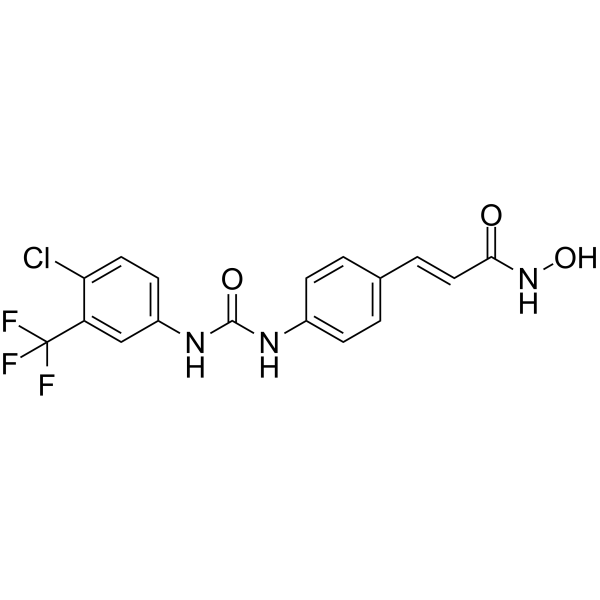
HDAC-IN-35 (Compound 14) is a potent, selective HDAC and VEGFR-2 inhibitor, with IC50 values of 0.166 and 13.2 µM for HDAC6 and VEGFR-2, respectively.
For research use only. We do not sell to patients.
- Formula: C17H13ClF3N3O3
- Molecular Weight:399.75
-
Storage:
Please store the product under the recommended conditions in the Certificate of Analysis.

To place orders, for customer services and technical support, please contact: MedChemExpress USA
Tel: 609-228-6898 E-mail: [email protected] [email protected]


-
 Biological Activity
-
Chemical Information
- Purity & Documentation
- References
-
 Help & FAQs


All VEGFR Isoforms
More

Biological Activity
Description
IC50 & Target
|
HDAC6 0.166 μM (IC50) |
HDAC8 1.99 μM (IC50) |
HDAC1 7.23 μM (IC50) |
VEGFR2 13.2 μM (IC50) |
Cellular Effect
|
Cell Line

|
Type | Value | Description | References |
|---|---|---|---|---|
| A549 | IC50 |
3.4 μM
Compound: 14
|
Anticancer activity against human A549 cells assessed as cell growth inhibition measured after 48 hrs by SRB assay
Anticancer activity against human A549 cells assessed as cell growth inhibition measured after 48 hrs by SRB assay
|
[PMID: 34634618] |
| PC-3 | IC50 |
1.9 μM
Compound: 14
|
Anticancer activity against human PC-3 cells assessed as cell growth inhibition measured after 48 hrs by SRB assay
Anticancer activity against human PC-3 cells assessed as cell growth inhibition measured after 48 hrs by SRB assay
|
[PMID: 34634618] |
| SK-HEP1 | IC50 |
3.2 μM
Compound: 14
|
Anticancer activity against human SK-HEP1 cells assessed as cell growth inhibition measured after 48 hrs by SRB assay
Anticancer activity against human SK-HEP1 cells assessed as cell growth inhibition measured after 48 hrs by SRB assay
|
[PMID: 34634618] |
In Vitro
HDAC-IN-35 (Compound 14) (0-10 µM, 48 h) shows anticancer effects in different cancer cells[1].
HDAC-IN-35 (0-10 µM, 48 h) exhibits potent anti-angiogenic activity with a GI>50 (50% growth inhibition) value of 1.0 μM on human endothelial progenitor cells (EPCs) through a VEGFR-2-dependent pathway, without obvious systemic toxicity[1].
HDAC-IN-35 exhibits moderate VEGFR-2 inhibitory activities and displays the anticancer effects by inhibiting the enzymatic activity of HDAC[1].
HDAC-IN-35 (0-10 µM, 24 h) concentration-dependently impedes the capillary-like tube formation in human EPCs[1].
MedChemExpress (MCE) has not independently confirmed the accuracy of these methods. They are for reference only.
-
Cell Line:A549, PC-3, and SK-Hep-1
-
Concentration:0-10 µM
-
Incubation Time:48 h
-
Result:Showed anticancer effects with IC50 values of 3.4, 1.9 and 3.2 µM against A549, PC-3, and SK-Hep-1 cells.
-
Cell Line:A549, PC-3, and SK-Hep-1, and human EPCs
-
Concentration:0, 5, and 10 µM
-
Incubation Time:24 h
-
Result:Increased the amount of acetylated α-tubulin and histone H3 in a concentration-dependent manner in cancer cells. Induced mild inhibition of the phosphorylation of VEGFR-2 in human EPCs.


Chemical Information
-
Molecular Weight 399.75
-
Formula C17H13ClF3N3O3
-
SMILES
O=C(NO)/C=C/C1=CC=C(C=C1)NC(NC2=CC=C(C(C(F)(F)F)=C2)Cl)=O
-
Shipping
Room temperature in continental US; may vary elsewhere.
-
Storage
Please store the product under the recommended conditions in the Certificate of Analysis.


Purity & Documentation
References

Calculators
Concentration (start) × Volume (start) = Concentration (final) × Volume (final)


HDAC-IN-35 Related Classifications
HY-146539 Related Classifications
 Powered by Bioz