



Imidapril hydrochloride

Based on 1 Customer Validation
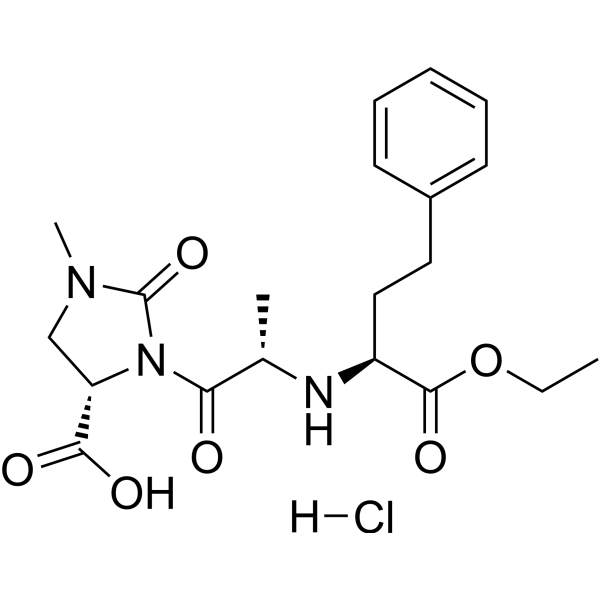
Imidapril hydrochloride (TA-6366) is an orally active dual inhibitor of angiotensin-converting enzyme (ACE) and MMP-9. Imidapril hydrochloride inhibits lipopolysaccharide-induced phosphorylation of c-Jun, MKK4 and JNK in monocytes, and downregulates the production of specific inflammatory factors such as TNF-α and IP-10, thereby exerting anti-inflammatory activity. Imidapril hydrochloride also effectively ameliorates mesangial expansion and reduces urinary albumin excretion by inhibiting angiotensin AngII production, lowering glomerular pressure and oxidative stress, thus delaying disease progression. Imidapril hydrochloride can also directly bind to the active site of MMP-9 to inhibit gelatinase activity, and suppress the enlargement of cerebral aneurysms without altering systemic blood pressure. Imidapril hydrochloride is widely applicable to related studies on autoimmune glomerulonephritis, diabetic nephropathy, cerebral aneurysms and other conditions.
For research use only. We do not sell to patients.
- Purity: 99.91%
- CAS No.: 89396-94-1
- Formula: C20H28ClN3O6
- Molecular Weight:441.91
-
Storage:
4°C, sealed storage, away from moisture
* In solvent : -80°C, 6 months; -20°C, 1 month (sealed storage, away from moisture)


-
 Biological Activity
-
Chemical Information
-
Solvent & Solubility
- Purity & Documentation
- References
-
 Help & FAQs
-

Immunology/Inflammation Compound Library
HY-L007
-
Kinase Inhibitor Library
HY-L009
-
MAPK Compound Library
HY-L010
-
Metabolism/Protease Compound Library
HY-L012
-
FDA-Approved Drug Library
HY-L022
-
Peptidomimetic Library
HY-L033
-
Drug Repurposing Compound Library
HY-L035
-
Covalent Screening Library
HY-L036
-
Differentiation Inducing Compound Library
HY-L038
-
Reprogramming Compound Library
HY-L039
-
Anti-diabetic Compound Library
HY-L040
-
Oxygen Sensing Compound Library
HY-L045
-
Anti-Cardiovascular Disease Compound Library
HY-L046
-
Anti-COVID-19 Compound Library
HY-L052
-
NMPA-Approved Drug Library
HY-L053
-
Orally Active Compound Library
HY-L061
-
FDA Approved & Pharmacopeial Drug Library
HY-L066
-
Anti-Pancreatic Cancer Compound Library
HY-L077
-
Anti-Parkinson's Disease Compound Library
HY-L085
-
Neurodegenerative Disease-related Compound Library
HY-L086
-
Anti-Obesity Compound Library
HY-L087
-
Angiogenesis-Related Compound Library
HY-L088
-
Transcription Factor-Targeted Library
HY-L090
-
Rare Diseases Drug Library
HY-L102
-
Antidepressant Compound Library
HY-L108
-
Human Metabolite Library
HY-L123
-
Anti-Pulmonary Fibrosis Compound Library
HY-L125
-
Cancer Stem Cells Compound Library
HY-L135
-
Heterocyclic Compound Library
HY-L138
-
Pain-Related Compound Library
HY-L139
-
Off-patent Drug Library
HY-L141
-
Antihypertensive Compound Library
HY-L145
-
Protease Inhibitor Library
HY-L147
-
Membrane Protein-targeted Compound Library
HY-L149
-
Highly Selective Inhibitors Library
HY-L158
-
Serine/Threonine Kinase Inhibitor Library
HY-L164
-
Multi-Target Compound Library
HY-L176
-
Bioactive Compound Library Max
HY-L181
-
MCE Bioactive Compound Library
HY-L001V
-
Covalent Screening Library Plus
HY-L036P
-
Drug Repurposing Compound Library Plus
HY-L035P
-
FDA-Approved Drug Library Plus
HY-L022P
-
FDA-Approved Drug Library Mini
HY-L022M
-
Bioactive Compound Library
HY-L001
-
Anti-Fibrosis Compound Library
HY-L185
-
Protein Kinase Compound Library
HY-L196
-
Cell Proliferation Compound Library
HY-L201
-
High-Throughput Bioactive Compound Library
HY-L205
-
Anti-Rheumatic Arthritis Compound Library
HY-L210
-
Mass Spectrometry Human Metabolite Library
HY-L215
-
FDA Kinase Inhibitor Library
HY-L230




Biological Activity
|
MMP-9 |
ACE |
Imidapril hydrochloride (1×10⁻⁹-1×10⁻⁷ μM; 2 h pre-treatment followed by 1 h LPS stimulation) inhibits the activation of the MKK4-JNK-c-Jun signaling pathway in LPS-induced human primary monocytes, with no effect on the activation of p38, ERK, or NF-κB p65[1].
Imidapril hydrochloride (0.1 μM; pre-treatment for 2 h followed by stimulation with LPS or poly I:C for 24 h) significantly downregulates LPS-induced TNF-α production and poly I:C-induced IP-10 production in THP-1 cells[1].
Imidapril hydrochloride (10-7-10-4 M) dose-dependently inhibits the gelatinase activity of recombinant MMP-9 in a cell-free in vitro system[3].
MedChemExpress (MCE) has not independently confirmed the accuracy of these methods. They are for reference only.
-
Cell Line:human monocytic THP-1 cell line
-
Concentration:0.1 μM
-
Incubation Time:2 h (pre-incubation); 24 h (LPS/poly I:C stimulation)
-
Result:Significantly downregulated LPS-induced TNF-α production in THP-1 cells.
Significantly suppressed poly I:C-induced IP-10 production in THP-1 cells.
Did not significantly downregulate LPS-induced IP-10 production in THP-1 cells.
Imidapril (3 mg/kg/day; i.p.; continuous; 1 month) suppresses cerebral aneurysm formation and medial thinning in rats via an ACE-independent, MMP-9-dependent mechanism, reducing mean aneurysm size to 32.9 mm and increasing mean medial thickness ratio to 0.73 without altering blood pressure[3].
MedChemExpress (MCE) has not independently confirmed the accuracy of these methods. They are for reference only.
-
Animal Model:BKS.cg-m +Lepr^db/+Lepr^db (db/db) (female, 6 weeks old, type 2 diabetes model with blood glucose >200 mg/dL); BKS.cg-m +Lepr^db/+Lepr^m (db/m) (female, littermate control)[2]
-
Dosage:1 mg/kg/day; 5 mg/kg/day
-
Administration:p.o.; ad libitum in drinking water; daily; 12 weeks
-
Result:Did not significantly affect blood glucose or body weight compared to non-treated db/db mice.
Significantly reduced systolic blood pressure in the 5 mg/kg/day treated group compared to non-treated db/db mice.
Significantly decreased relative mesangial area (mesangial area/total glomerular area ratio) in both treated groups, with a greater reduction in the 5 mg/kg/day group than the 1 mg/kg/day group.
Significantly inhibited increases in urinary albumin and urinary 8-OHdG at 12 weeks in a dose-dependent manner.
Significantly reduced the number of 8-OHdG-immunoreactive cells in glomeruli in both treated groups, with a greater reduction in the 5 mg/kg/day group than the 1 mg/kg/day group.
-
Animal Model:Sprague-Dawley (7-week-old male)[3]
-
Dosage:3 mg/kg/day
-
Administration:i.p.; continuous; 1 month
-
Result:Reduced mean cerebral aneurysm size to 32.9 mm.
Increased mean medial thickness ratio to 0.73.
Did not alter systolic or diastolic blood pressure.
Significantly inhibited upregulated gelatinolytic activity of MMP-9 in cerebral arterial walls.
Did not affect MMP-9 expression levels, ACE expression, or ACE activity in the arterial walls.
| NCT Number | Sponsor | Condition | Start Date |
Phase

|
|---|---|---|---|---|
| NCT01329991 | Plexxikon| | 2011-05 | PHASE1 |


Chemical Information
-
CAS No. 89396-94-1
-
Appearance Solid
-
Molecular Weight 441.91
-
Formula C20H28ClN3O6
-
Color White to off-white
-
SMILES
O=C([C@H](CN1C)N(C([C@@H](N[C@H](C(OCC)=O)CCC2=CC=CC=C2)C)=O)C1=O)O.[H]Cl
-
Synonyms
TA-6366
-
Shipping
Room temperature in continental US; may vary elsewhere.
-
Storage
4°C, sealed storage, away from moisture
* In solvent : -80°C, 6 months; -20°C, 1 month (sealed storage, away from moisture)


Solvent & Solubility
DMSO : 50 mg/mL (113.15 mM; Need ultrasonic; Hygroscopic DMSO has a significant impact on the solubility of product, please use newly opened DMSO)
H2O : 50 mg/mL (113.15 mM; Need ultrasonic)
Please refer to the solubility information to select the appropriate solvent. Once prepared, please aliquot and store the solution to prevent product inactivation from repeated freeze-thaw cycles.
Storage method and period of stock solution: -80°C, 6 months; -20°C, 1 month (sealed storage, away from moisture). When stored at -80°C, please use it within 6 months. When stored at -20°C, please use it within 1 month.
* Note: If you choose water as the stock solution, please dilute it to the working solution, then filter and sterilize it with a 0.22 μm filter before use.
Please refer to the solubility information to select the appropriate solvent. Once prepared, please aliquot and store the solution to prevent product inactivation from repeated freeze-thaw cycles.
Storage method and period of stock solution: -80°C, 6 months; -20°C, 1 month (sealed storage, away from moisture). When stored at -80°C, please use it within 6 months. When stored at -20°C, please use it within 1 month.
* Note: If you choose water as the stock solution, please dilute it to the working solution, then filter and sterilize it with a 0.22 μm filter before use.
Concentration (start) × Volume (start) = Concentration (final) × Volume (final)
Select the appropriate dissolution method based on your experimental animal and administration route.
- For the following dissolution methods, please ensure to first prepare a clear stock solution using an In Vitro approach and then sequentially add co-solvents:
- To ensure reliable experimental results, the clarified stock solution can be appropriately stored based on storage conditions. As for the working solution for In Vivo experiments, it is recommended to prepare freshly and use it on the same day.
- The percentages shown for the solvents indicate their volumetric ratio in the final prepared solution. If precipitation or phase separation occurs during preparation, heat and/or sonication can be used to aid dissolution.
Add each solvent one by one: 10% DMSO 40% PEG300 5% Tween-80 45% Saline
Solubility: ≥ 2.5 mg/mL (5.66 mM); Clear solution
This protocol yields a clear solution of ≥ 2.5 mg/mL (saturation unknown).
Taking 1 mL working solution as an example, add 100 μL DMSO stock solution (25.0 mg/mL) to 400 μL PEG300, and mix evenly; then add 50 μL Tween-80 and mix evenly; then add 450 μL Saline to adjust the volume to 1 mL.
Preparation of Saline: Dissolve 0.9 g sodium chloride in ddH₂O and dilute to 100 mL to obtain a clear Saline solution.
Add each solvent one by one: 10% DMSO 90% (20% SBE-β-CD in Saline)
Solubility: ≥ 2.5 mg/mL (5.66 mM); Clear solution
This protocol yields a clear solution of ≥ 2.5 mg/mL (saturation unknown).
Taking 1 mL working solution as an example, add 100 μL DMSO stock solution (25.0 mg/mL) to 900 μL 20% SBE-β-CD in Saline, and mix evenly.
Preparation of 20% SBE-β-CD in Saline (4°C, storage for one week): 2 g SBE-β-CD powder is dissolved in 10 mL Saline, completely dissolve until clear.
For the following dissolution methods, please prepare the working solution directly:
It is recommended to prepare fresh solutions and use them promptly within a short period of time.
The percentages shown for the solvents indicate their volumetric ratio in the final prepared solution. If precipitation or phase separation occurs during preparation, heat and/or sonication can be used to aid dissolution.
Add each solvent one by one: PBS
Solubility: 40 mg/mL (90.52 mM); Clear solution; Need ultrasonic
Please enter the basic information of animal experiments:
-
-
-
-
Recommended: Prepare an additional quantity of animals to account for potential losses during experiments.
Working solution concentration: 0.22 mg/mL
This product has good water solubility, please refer to the measured solubility data in water/PBS/Saline for details.


Purity & Documentation
-
Data Sheet (283 KB)
-
SDS (557 KB)
- English - EN (557 KB)
- Français - FR (557 KB)
- Deutsch - DE (557 KB)
- Norwegian - NO (557 KB)
- Español - ES (557 KB)
- Swedish - SV (557 KB)
- Italian - IT (557 KB)
- Portuguese - PT (557 KB)
-
Handling Instructions (2659 KB)
References
[1]. Tsai MK, et al. Suppressive effects of imidapril on Th1- and Th2-related chemokines in monocytes. J Investig Med. 2011;59(7):1141-1146. [Content Brief]
[3]. Ishibashi R, et al. Imidapril inhibits cerebral aneurysm formation in an angiotensin-converting enzyme-independent and matrix metalloproteinase-9-dependent manner. Neurosurgery. 2012;70(3):722-730. [Content Brief]


Complete Stock Solution Preparation Table
Please refer to the solubility information to select the appropriate solvent. Once prepared, please aliquot and store the solution to prevent product inactivation from repeated freeze-thaw cycles.
Storage method and period of stock solution: -80°C, 6 months; -20°C, 1 month (sealed storage, away from moisture). When stored at -80°C, please use it within 6 months. When stored at -20°C, please use it within 1 month.
| Optional Solvent | Concentration Solvent Mass | 1 mg | 5 mg | 10 mg | 25 mg |
|---|---|---|---|---|---|
| DMSO / H2O | 1 mM | 2.2629 mL | 11.3145 mL | 22.6290 mL | 56.5726 mL |
| 5 mM | 0.4526 mL | 2.2629 mL | 4.5258 mL | 11.3145 mL | |
| 10 mM | 0.2263 mL | 1.1315 mL | 2.2629 mL | 5.6573 mL | |
| 15 mM | 0.1509 mL | 0.7543 mL | 1.5086 mL | 3.7715 mL | |
| 20 mM | 0.1131 mL | 0.5657 mL | 1.1315 mL | 2.8286 mL | |
| 25 mM | 0.0905 mL | 0.4526 mL | 0.9052 mL | 2.2629 mL | |
| 30 mM | 0.0754 mL | 0.3772 mL | 0.7543 mL | 1.8858 mL | |
| 40 mM | 0.0566 mL | 0.2829 mL | 0.5657 mL | 1.4143 mL | |
| 50 mM | 0.0453 mL | 0.2263 mL | 0.4526 mL | 1.1315 mL | |
| 60 mM | 0.0377 mL | 0.1886 mL | 0.3772 mL | 0.9429 mL | |
| 80 mM | 0.0283 mL | 0.1414 mL | 0.2829 mL | 0.7072 mL | |
| 100 mM | 0.0226 mL | 0.1131 mL | 0.2263 mL | 0.5657 mL |
* Note: If you choose water as the stock solution, please dilute it to the working solution, then filter and sterilize it with a 0.22 μm filter before use.


 Powered by Bioz