



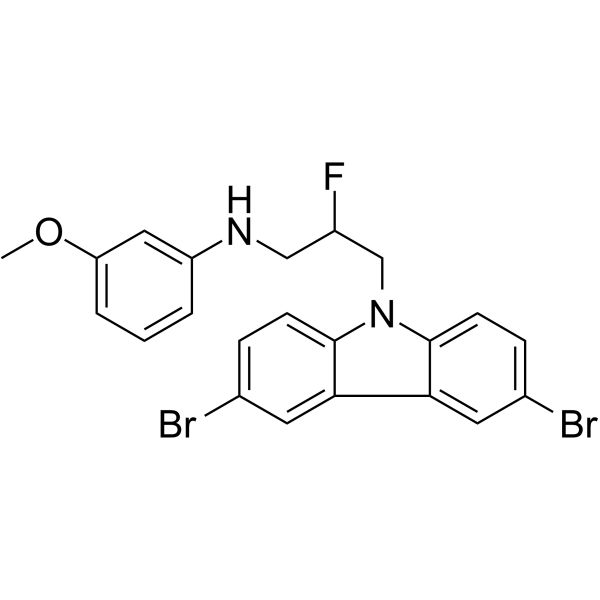
P7C3-A20
Based on 6 publication(s) in Google Scholar
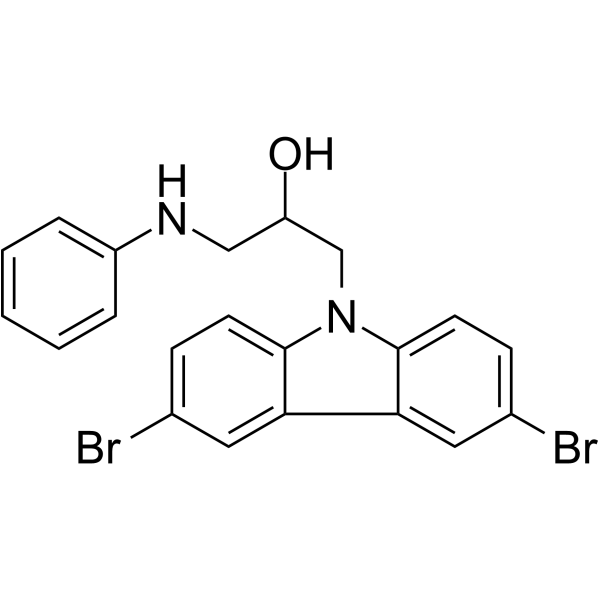
P7C3-A20 is a derivative of P7C3 with potent proneurogenic and neuroprotective activity. P7C3-A20 exerts an antidepressant-like effect. P7C3-A20 can cross the blood-brain barrier and therefore has the potential for brain injury treatment.
For research use only. We do not sell to patients.
- Purity: 99.32%
- CAS No.: 1235481-90-9
- Formula: C22H19Br2FN2O
- Molecular Weight:506.21
-
Storage:Powder -20°C, 3 years , 4°C, 2 years ; In solvent -80°C, 2 years , -20°C, 1 year

To place orders, for customer services and technical support, please contact: MedChemExpress USA
Tel: 609-228-6898 E-mail: [email protected] [email protected]


-
 Biological Activity
-
Chemical Information
-
Solvent & Solubility
- Purity & Documentation
- References
-
 Help & FAQs


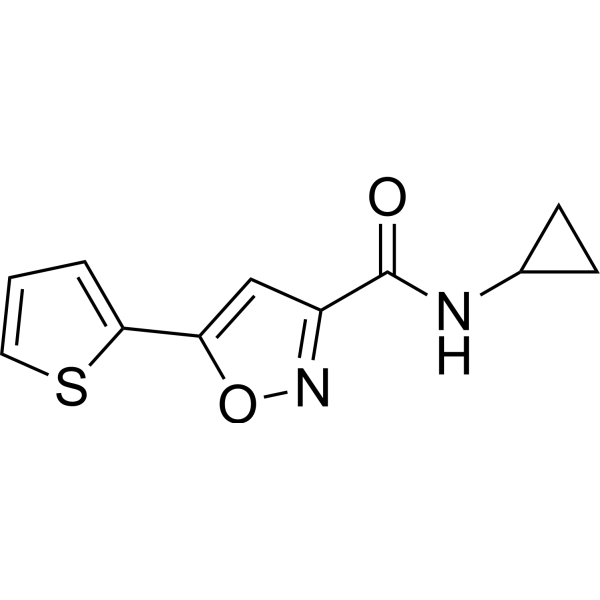
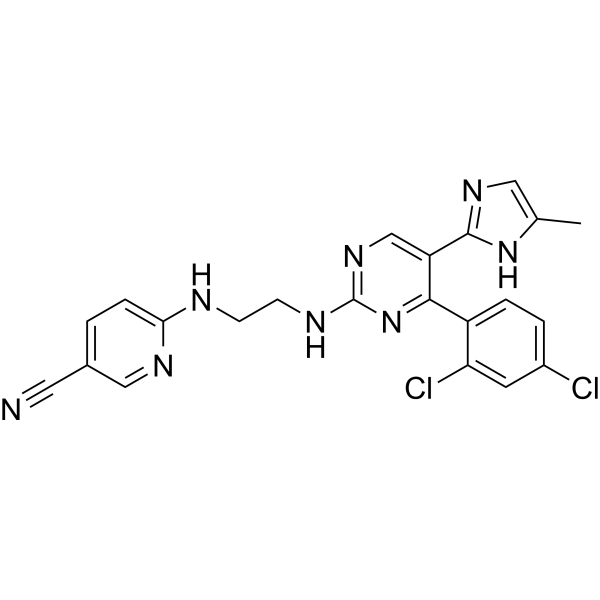
Publications Citing Use of MedChemExpress (MCE) P7C3-A20
More- Circ Res. 2021 May 28;128(11):1629-1641. [Abstract]
- Int J Mol Sci. 2023 Feb 14;24(4):3846. [Abstract]
- Neuroscience. 2020 Aug 10:441:197-208. [Abstract]
- Biomed Pharmacother. 2026 Jan:194:118963. [Abstract]
- Biomed Pharmacother. 2024 Jul:176:116778. [Abstract]
- Oxid Med Cell Longev. 2023 Feb 8:2023:7857760. [Abstract]
 Customer Validation & Images

-
WB


Biological Activity
P7C3-A20 (10-100 μM; 8 hours; PC12 cells) treatment alleviates oxygen-glucose deprivation (OGD)-induced cytotoxicity in PC12 cells[1].
?
P7C3-A20 (40-100 μM; 8 hours; PC12 cells) treatment alleviates OGD-induced apoptosis in PC12 cells[1].
MedChemExpress (MCE) has not independently confirmed the accuracy of these methods. They are for reference only.
-
Cell Line:PC12 cells
-
Concentration:10 μM, 20 μM, 40 μM, 60 μM, 80 μM, 100 μM
-
Incubation Time:8 hours
-
Result:Alleviated oxygen-glucose deprivation (OGD)-induced cytotoxicity in PC12 cells.
-
Cell Line:PC12 cells
-
Concentration:40 μM, 60 μM, 80 μM, 100 μM
-
Incubation Time:8 hours
-
Result:Alleviated oxygen-glucose deprivation (OGD)-induced apoptosis in PC12 cells.
MedChemExpress (MCE) has not independently confirmed the accuracy of these methods. They are for reference only.
-
Animal Model:Sprague-Dawley rats (200-250 g) induced hypoxic-ischemic (HI) injury [1]
-
Dosage:5 mg/kg, 10 mg/kg
-
Administration:Intraperitoneal injection; daily; for 7 days
-
Result:Reduced infarct volume; reversed cell loss in the cortex and hippocampus and improved motor function without causing neurotoxicity.


Chemical Information
-
CAS No. 1235481-90-9
-
Appearance Solid
-
Molecular Weight 506.21
-
Formula C22H19Br2FN2O
-
Color White to yellow
-
SMILES
FC(CNC1=CC(OC)=CC=C1)CN2C3=CC=C(Br)C=C3C4=CC(Br)=CC=C24
-
Shipping
Room temperature in continental US; may vary elsewhere.
-
Storage
Powder -20°C 3 years 4°C 2 years In solvent -80°C 2 years -20°C 1 year


Publications (6)
-
Journal Impact Factor
-
Most Recent
-
Circ Res
2021 May 28;128(11):1629-1641. PMID: 33882692 -
Int J Mol Sci
The Efficiency of Neurospheres Derived from Human Wharton's Jelly Mesenchymal Stem Cells for Spinal Cord Injury Regeneration in Rats. [Abstract]2023 Feb 14;24(4):3846. PMID: 36835256 -
Neuroscience
The Small Molecule P7C3-A20 Exerts Neuroprotective Effects in a Hypoxic-ischemic Encephalopathy Model via Activation of PI3K/AKT/GSK3β Signaling. [Abstract]2020 Aug 10:441:197-208. PMID: 32504794
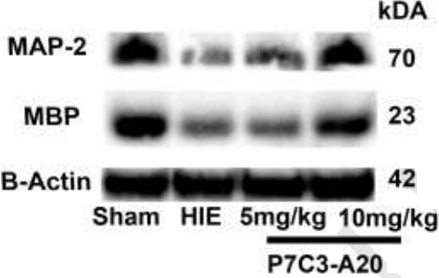
P7C3-A20 purchased from MedChemExpress. Usage Cited in: Neuroscience. 2020 Aug 10:441:197-208. [Abstract]
P7C3-A20 alleviates HI injury. MAP-2 and MBP protein levels 7 days after HI in sham, HIE, and HIE + P7C3-A20 5 and 10 mg/kg groups.
-
Biomed Pharmacother
Protective effects of the NAMPT activator P7C3-A20 on mouse neuronal injury in diabetic stroke: The role of intracellular NAMPT and SIRT1/FoxO3a signaling. [Abstract]2026 Jan:194:118963. PMID: 41496321 -
Biomed Pharmacother
Possible involvement of NAMPT in neuronal survival in cerebral ischemic injury under high-glucose conditions through the FoxO3a/LC3 pathway. [Abstract]2024 Jul:176:116778. PMID: 38788601 -
Oxid Med Cell Longev
P7C3-A20 Attenuates Microglial Inflammation and Brain Injury after ICH through Activating the NAD+/Sirt3 Pathway. [Abstract]2023 Feb 8:2023:7857760. PMID: 36819779


Solvent & Solubility
DMSO : ≥ 100 mg/mL (197.55 mM; Hygroscopic DMSO has a significant impact on the solubility of product, please use newly opened DMSO)
* "≥" means soluble, but saturation unknown.
Please refer to the solubility information to select the appropriate solvent. Once prepared, please aliquot and store the solution to prevent product inactivation from repeated freeze-thaw cycles.
Storage method and period of stock solution: -80°C, 2 years; -20°C, 1 year. When stored at -80°C, please use it within 2 years. When stored at -20°C, please use it within 1 year.
Please refer to the solubility information to select the appropriate solvent. Once prepared, please aliquot and store the solution to prevent product inactivation from repeated freeze-thaw cycles.
Storage method and period of stock solution: -80°C, 2 years; -20°C, 1 year. When stored at -80°C, please use it within 2 years. When stored at -20°C, please use it within 1 year.
Concentration (start) × Volume (start) = Concentration (final) × Volume (final)
Select the appropriate dissolution method based on your experimental animal and administration route.
- For the following dissolution methods, please ensure to first prepare a clear stock solution using an In Vitro approach and then sequentially add co-solvents:
- To ensure reliable experimental results, the clarified stock solution can be appropriately stored based on storage conditions. As for the working solution for In Vivo experiments, it is recommended to prepare freshly and use it on the same day.
- The percentages shown for the solvents indicate their volumetric ratio in the final prepared solution. If precipitation or phase separation occurs during preparation, heat and/or sonication can be used to aid dissolution.
Add each solvent one by one: 10% DMSO 40% PEG300 5% Tween-80 45% Saline
Solubility: ≥ 3.85 mg/mL (7.61 mM); Clear solution
This protocol yields a clear solution of ≥ 3.85 mg/mL (saturation unknown).
Taking 1 mL working solution as an example, add 100 μL DMSO stock solution (38.5 mg/mL) to 400 μL PEG300, and mix evenly; then add 50 μL Tween-80 and mix evenly; then add 450 μL Saline to adjust the volume to 1 mL.
Preparation of Saline: Dissolve 0.9 g sodium chloride in ddH₂O and dilute to 100 mL to obtain a clear Saline solution.
Please enter the basic information of animal experiments:
-
-
-
-
Recommended: Prepare an additional quantity of animals to account for potential losses during experiments.
Please enter your animal formula composition:
-
%DMSO +
Recommended: Keep the proportion of DMSO in working solution below 2% if your animal is weak.
-
%+
-
+%Tween-80 + +
-
%Saline +
The co-solvents required include: DMSO, . All of co-solvents are available by MedChemExpress (MCE). , Tween 80. All of co-solvents are available by MedChemExpress (MCE).
Working solution concentration: 0.22 mg/mL
Method for preparing stock solution: mg drug dissolved in μL DMSO. Stock solution concentration: mg/mL.
1. Take μL DMSO stock solution;
2. Add μL .
μL , mix evenly;
3. Then add μL Tween 80, mix evenly;
4. Then add μL
Please ensure that the stock solution in the first step is dissolved to a clear state, and add co-solvents in sequence. You can use ultrasonic heating (ultrasonic cleaner, recommended frequency 20-40 kHz), vortexing, etc. to assist dissolution.


Purity & Documentation
-
Data Sheet (278 KB)
-
SDS (396 KB)
- English - EN (396 KB)
- Français - FR (396 KB)
- Deutsch - DE (396 KB)
- Norwegian - NO (396 KB)
- Español - ES (396 KB)
- Swedish - SV (396 KB)
- Italian - IT (396 KB)
- Korean - KR (396 KB)
- Portuguese - PT (396 KB)
-
Handling Instructions (2659 KB)
References
[1]. Junjie Bai, et al. The Small Molecule P7C3-A20 Exerts Neuroprotective Effects in a Hypoxic-Ischemic Encephalopathy Model via Activation of PI3K/AKT/GSK3β Signaling. Neuroscience. 2020 Jun 3;S0306-4522(20)30353-5. [Content Brief]
[2]. Blaya MO et al. Neuroprotective efficacy of a proneurogenic compound after traumatic brain injury. J Neurotrauma. 2014 Mar 1;31(5):476-86. [Content Brief]
[3]. Walker AK et al. The P7C3 class of neuroprotective compounds exerts antidepressant efficacy in mice by increasinghippocampal neurogenesis. Mol Psychiatry. 2015 Apr;20(4):500-8. [Content Brief]


Complete Stock Solution Preparation Table
Please refer to the solubility information to select the appropriate solvent. Once prepared, please aliquot and store the solution to prevent product inactivation from repeated freeze-thaw cycles.
Storage method and period of stock solution: -80°C, 2 years; -20°C, 1 year. When stored at -80°C, please use it within 2 years. When stored at -20°C, please use it within 1 year.
| Optional Solvent | Concentration Solvent Mass | 1 mg | 5 mg | 10 mg | 25 mg |
|---|---|---|---|---|---|
| DMSO | 1 mM | 1.9755 mL | 9.8773 mL | 19.7546 mL | 49.3866 mL |
| 5 mM | 0.3951 mL | 1.9755 mL | 3.9509 mL | 9.8773 mL | |
| 10 mM | 0.1975 mL | 0.9877 mL | 1.9755 mL | 4.9387 mL | |
| 15 mM | 0.1317 mL | 0.6585 mL | 1.3170 mL | 3.2924 mL | |
| 20 mM | 0.0988 mL | 0.4939 mL | 0.9877 mL | 2.4693 mL | |
| 25 mM | 0.0790 mL | 0.3951 mL | 0.7902 mL | 1.9755 mL | |
| 30 mM | 0.0658 mL | 0.3292 mL | 0.6585 mL | 1.6462 mL | |
| 40 mM | 0.0494 mL | 0.2469 mL | 0.4939 mL | 1.2347 mL | |
| 50 mM | 0.0395 mL | 0.1975 mL | 0.3951 mL | 0.9877 mL | |
| 60 mM | 0.0329 mL | 0.1646 mL | 0.3292 mL | 0.8231 mL | |
| 80 mM | 0.0247 mL | 0.1235 mL | 0.2469 mL | 0.6173 mL | |
| 100 mM | 0.0198 mL | 0.0988 mL | 0.1975 mL | 0.4939 mL |


P7C3-A20 Related Classifications
HY-15978 Related Classifications
 Powered by Bioz