



Tanruprubart
Based on 6 publication(s) in Google Scholar
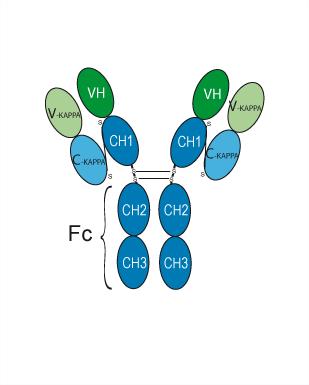
Tanruprubart (ANX005) is a C1q inhibitor and C1q depleter. Tanruprubart is a human antibody expressed in CHO cells, with huIgG1 heavy chains and huκ light chains, and its predicted molecular weight (MW) is 145 kDa. For the isotype control of Tanruprubart, refer to Human IgG4 kappa, Isotype Control (HY-P99003). The IC50 of Tanruprubart is 346 ng/mL for humans and 259 ng/mL for rats; its EC50 is 3.8 ng/mL for humans, 5.2 ng/mL for rats, and 9.9 ng/mL for mice. Tanruprubart is applicable to the research of Guillain-Barré syndrome and Alzheimer's disease.
For research use only. We do not sell to patients.
- Purity : 99.34%
- CAS No.: 2065212-40-8
- Molecular Weight:145.78 kDa
-
Storage:
Please store the product under the recommended conditions in the Certificate of Analysis.


To place orders, for customer services and technical support, please contact: MedChemExpress USA
Tel: 609-228-6898 E-mail: [email protected] [email protected]


-
 Biological Activity
-
Chemical Information
- Protocols
- Purity & Documentation
- References
-
 Help & FAQs


-
HY-P99965
CrovalimabAnti-C5 Recycling Antibody -
HY-127105
IptacopanFactor B Inhibitor -

HY-P99050
SutimlimabC1s Inhibitor -

HY-P99365
RavulizumabAnti-C5 Antibody -

HY-P9914
EculizumabComplement C5 Antibody -
HY-P99001
Human IgG1 kappa, Isotype ControlIgG1κ Isotype Control -

HY-P990025
EmpasiprubartAnti-complement C2 Antibody -
HY-P99376
NarsoplimabAnti-MASP-2 Antibody -
HY-P990091
RiliprubartActivated C1s Inhibitor -

HY-P990637
NGM-621Complement C3 Antibody
Publications Citing Use of MedChemExpress (MCE) Tanruprubart
More- J Adv Res. 2026 Feb 16:S2090-1232(26)00158-X. [Abstract]
- Neuron. 2025 Nov 18:S0896-6273(25)00803-7. [Abstract]
- Alzheimers Dement. 2025 Aug;21(8):e70331. [Abstract]
- J Neuroinflammation. 2025 Mar 7;22(1):69. [Abstract]
- Int J Mol Sci. 2026 Aug 20;27(16):7459.
- Int Immunopharmacol. 2025 Oct 10:163:115284. [Abstract]
 Customer Validation & Images

-
Cell Imaging/Staining

-
Bio/Physico-chemical Assay

-
In Vivo Efficacy Study

-
WB

-
WB


Biological Activity
Description
Isotype
Human lgG4 kappa
Recommend Isotype Controls
Species Reactivity
Human
IC50 & Target
C1q
In Vitro
Tanruprubart (ANX005) (Titered concentrations) binds with high, comparable affinity to serum-derived C1q from human, cynomolgus monkey, rhesus monkey, dog, and rat, has lower affinity for mouse C1q, and does not bind rabbit C1q[1].
Tanruprubart (Titered concentrations; 1 h) potently inhibits classical complement-mediated hemolysis in human, cynomolgus monkey, rhesus monkey, dog, and rat serum, with an average IC50 of ~350 ng/mL, and does not inhibit hemolysis in rabbit serum[1].
MedChemExpress (MCE) has not independently confirmed the accuracy of these methods. They are for reference only.
In Vivo
Tanruprubart (ANX005) (10-200 mg/kg; i.v.; single bolus dose; once weekly; 4 weeks) administered to cynomolgus monkeys (as single doses or weekly doses for 4 weeks) produces dose-dependent serum and CSF exposures, fully depletes free serum C1q and inhibits complement-mediated hemolysis at measurable reagent levels, fully occupies CSF C1q at higher doses, and shows no treatment-related toxicity at doses up to 200 mg/kg, resulting in a no observed adverse effect level (NOAEL) of 100 mg/kg[1].
MedChemExpress (MCE) has not independently confirmed the accuracy of these methods. They are for reference only.
-
Animal Model:Sprague Dawley rats (male and female, young adult, 8-9 weeks old)[1]
-
Dosage:10 mg/kg; 50 mg/kg; 100 mg/kg; 200 mg/kg
-
Administration:i.v.; once weekly; 4 weeks
-
Result:Depleted free C1q in rat serum at measurable reagent levels.\nShowed dose-proportional increases in serum Cmax; AUC increased greater than dose-proportionally between lower doses, and dose-proportionally between 100 and 200 mg/kg.\nIncreased mean CSF concentrations in a greater-than-dose-proportional manner, with CSF levels representing 0.1% to 0.2% of serum levels on days 38 and 50 of the GLP study.\nExhibited no treatment-related changes in clinical signs, body weight, food consumption, clinical pathology, gross pathology, organ weight, or histopathology at any dose tested.\nAchieved a no observed adverse effect level (NOAEL) of 200 mg/kg.
-
Animal Model:Cynomolgus monkeys (male and female, 2-4 years old)[1]
-
Dosage:15 mg/kg (single bolus); 100 mg/kg (single bolus); 10 mg/kg (weekly x4); 50 mg/kg (weekly x4); 100 mg/kg (weekly x4); 200 mg/kg (weekly x4)
-
Administration:i.v.; single bolus dose; once weekly; 4 weeks
-
Result:Depleted free C1q in monkey serum at measurable reagent levels, with free C1q returning to baseline only when reagent levels dropped below detection.\nInhibited ex vivo complement-mediated hemolysis completely at measurable reagent serum levels, with hemolysis activity returning to baseline when reagent levels declined.\nShowed dose-dependent increases in serum concentrations, with trough levels accumulating over weekly doses in the 50, 100, and 200 mg/kg groups (excluding animals with anti-drug antibody responses).\nIncreased mean CSF concentrations with dose, with CSF levels representing 0.04% to 0.11% of serum levels in the non-GLP study, and 0.02% to 0.13% of serum levels in the GLP study on day 29; these CSF levels fully occupied C1q in the CSF at 100 and 200 mg/kg doses on day 29.\nExhibited no treatment-related changes in clinical signs, body weight, food consumption, clinical pathology, gross pathology, organ weight, histopathology, ophthalmic findings, neurologic exams, vital signs, or electrocardiograms at any dose tested.\nAchieved a no observed adverse effect level (NOAEL) of 200 mg/kg.
Gene ID
Accession
Conjugated
Unconjugated
Reconsititution
The product can be reconstituted/diluted with sterile PBS or saline.
Format
-
IgG4-kappa
Application
ELISA, FACS, Functional assay
Verified Bioactivity
-
 Immobilized C1q Protein (HY-NP0194) can bind ANX005. The EC50 for this effect is 2.56 ng/mL.


Chemical Information
-
CAS No. 2065212-40-8
-
Appearance Liquid
-
Molecular Weight 145.78 kDa
-
Color Colorless to light yellow
-
Synonyms
ANX005
-
Shipping
Shipping with dry ice.
-
Formulation
Please refer to the lot-specific COA for specific buffer information.
-
Storage
Please store the product under the recommended conditions in the Certificate of Analysis.


Publications (6)
-
Journal Impact Factor
-
Most Recent
-
J Adv Res
Tocilizumab-loaded nanoparticles block IL-6R and reduce edema after intracerebral hemorrhage. [Abstract]2026 Feb 16:S2090-1232(26)00158-X. PMID: 41707962 -
Neuron
2025 Nov 18:S0896-6273(25)00803-7. PMID: 41260217 -
Alzheimers Dement
Gut-derived bacterial vesicles carrying lipopolysaccharide promote microglia-mediated synaptic pruning. [Abstract]2025 Aug;21(8):e70331. PMID: 40731189
Tanruprubart purchased from MedChemExpress. Usage Cited in: Alzheimers Dement. 2025 Aug;21(8):e70331. [Abstract]
The role of C1q in bEV‐induced synaptic pruning was further confirmed in vitro with a primary neuron and microglia cocultured system, where inhibiting C1q by ANX005 (Tanruprubart, 1 ng/mL) reversed the bEV‐induced reduction in PSD95 density.
Tanruprubart purchased from MedChemExpress. Usage Cited in: Alzheimers Dement. 2025 Aug;21(8):e70331. [Abstract]
The role of C1q in bEV-induced synaptic pruning was further confirmed in vitro with a primary neuron and microglia cocultured system, where inhibiting C1q by ANX005 (Tanruprubart, 1 ng/mL) reversed the bEV-induced reduction in PSD95 density.
-
J Neuroinflammation
Intravitreal delivery of NMO-IgG causes primary retinal damage in the absence of optic nerve injury. [Abstract]2025 Mar 7;22(1):69. PMID: 40055743 -
-
Int Immunopharmacol
Piezo1 participates in sevoflurane-induced developmental neurotoxicity via neuroinflammation and synaptic damage in the hippocampus. [Abstract]2025 Oct 10:163:115284. PMID: 40716188
Tanruprubart purchased from MedChemExpress. Usage Cited in: Int Immunopharmacol. 2025 Oct 10:163:115284. [Abstract]
We employed the C1q antagonist ANX005 (Tanruprubart, 20 mg/kg in 5% DMSO, 5 μL/g, ip) to Yoda1-treated sevoflurane-induced mice to examine synaptic and cognitive rescue.
Tanruprubart purchased from MedChemExpress. Usage Cited in: Int Immunopharmacol. 2025 Oct 10:163:115284. [Abstract]
We employed the C1q antagonist ANX005 (Tanruprubart, 20 mg/kg in 5% DMSO, 5 μL/g, ip) to Yoda1-treated sevoflurane-induced mice to examine synaptic and cognitive rescue. Representative Western blot bands and quantitative analysis of mouse hippocampal MAP2 protein.
Tanruprubart purchased from MedChemExpress. Usage Cited in: Int Immunopharmacol. 2025 Oct 10:163:115284. [Abstract]
We employed the C1q antagonist ANX005 (Tanruprubart, 20 mg/kg in 5% DMSO, 5 μL/g, ip) to Yoda1-treated sevoflurane-induced mice to examine synaptic and cognitive rescue. Representative Western blot bands and quantitative analysis of mouse hippocampal PSD95 protein.


Purity & Documentation
-
Data Sheet (265 KB)
-
SDS (251 KB)
- English - EN (251 KB)
- Français - FR (251 KB)
- Deutsch - DE (251 KB)
- Norwegian - NO (251 KB)
- Español - ES (251 KB)
- Swedish - SV (251 KB)
- Italian - IT (251 KB)
- Korean - KR (251 KB)
- Portuguese - PT (251 KB)
-
Inhibitory Antibodies User Guide (603 KB)
References

Calculators
Concentration (start) × Volume (start) = Concentration (final) × Volume (final)


Tanruprubart Related Classifications
HY-P990545 Related Classifications
 Powered by Bioz