



Molibresib besylate
Based on 24 publication(s) in Google Scholar
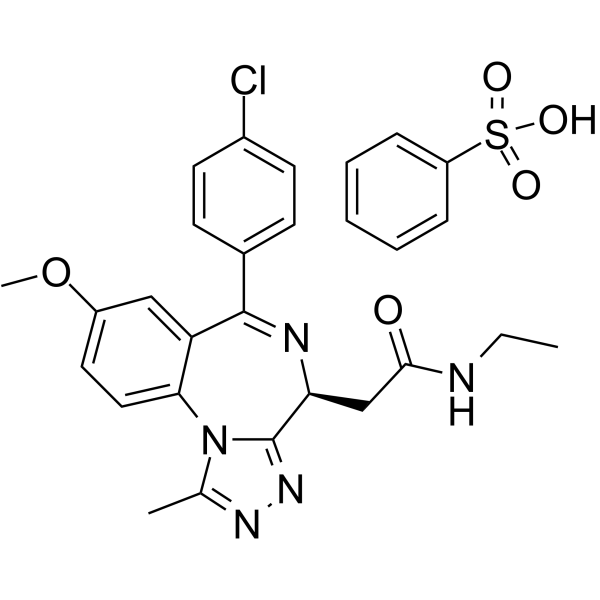
Molibresib besylate (GSK 525762C; I-BET 762 besylate) is an orally active pan-BET inhibitor that targets and binds to BRD2, BRD3, BRD4 and BRDT. By competitively occupying acetylated lysine binding sites, Molibresib besylate disrupts the interaction between BET proteins and chromatin, thereby effectively inhibiting MYC expression and target gene transcription. Molibresib besylate exhibits broad antiproliferative activity, which not only inhibits cancer cell growth and induces growth arrest, but also downregulates mitosis-related genes and upregulates the level of p-ERK1/2. When combined with MEK inhibitors, Molibresib besylate shows a significant synergistic effect, reduces tumor burden in mouse models of leukemia, modulates the immune microenvironment and prolongs survival. Molibresib besylate is widely applicable to research related to acute myeloid leukemia, multiple myeloma, triple-negative breast cancer, small-cell lung cancer and various advanced refractory solid tumors.
For research use only. We do not sell to patients.
- Purity : 97.04%
- CAS No.: 1895049-20-3
- Formula: C28H28ClN5O5S
- Molecular Weight:582.07
-
Storage:
4°C, sealed storage, away from moisture
* In solvent : -80°C, 6 months; -20°C, 1 month (sealed storage, away from moisture)

To place orders, for customer services and technical support, please contact: MedChemExpress USA
Tel: 609-228-6898 E-mail: [email protected] [email protected]


-
 Biological Activity
-
Chemical Information
-
Solvent & Solubility
- Protocols
- Purity & Documentation
- References
-
 Help & FAQs


Publications Citing Use of MedChemExpress (MCE) Molibresib besylate
More- Nat Med. 2017 Sep;23(9):1055-1062. [Abstract]
- Cell. 2021 Apr 15;184(8):2167-2182.e22. [Abstract]
- Cell Metab. 2025 Apr 1;37(4):903-919.e10. [Abstract]
- Nat Commun. 2024 Jul 2;15(1):5570. [Abstract]
- Sci Adv. 2021 Feb 19;7(8):eabe4038. [Abstract]
- Cancer Lett. 2020 Jan 1:468:48-58. [Abstract]
- J Exp Med. 2017 Aug 7;214(8):2349-2368. [Abstract]
- Proc Natl Acad Sci U S A. 2019 Feb 19;116(8):2961-2966. [Abstract]
- Blood Adv. 2022 Apr 12;6(7):2346-2360. [Abstract]
- Cell Syst. 2018 Apr 25;6(4):424-443.e7. [Abstract]
- J Med Chem. 2020 Jul 9;63(13):7186-7210. [Abstract]
- Atherosclerosis. 2016 Apr:247:48-57. [Abstract]
- Commun Biol. 2021 Jul 15;4(1):878. [Abstract]
- J Biol Chem. 2026 May 25:113185. [Abstract]
- Harvard University. 2026.
- bioRxiv. 2026 May 7.
- bioRxiv. 2026 Jan 9.
- bioRxiv. 2025 Sep 3:2025.08.30.673282. [Abstract]
- bioRxiv. 2025 May 4:2025.04.29.651320. [Abstract]
- SSRN. 2024 Apr 6.
- Patent. US20220016130A1.
- Elife. 2020 Dec 7:9:e61405. [Abstract]
- Patent. US20180263995A1.
- Oncotarget. 2016 Jun 21;7(25):38319-38332. [Abstract]
 Customer Validation & Images

-
Flow Cytometry
-
Flow Cytometry
-
RT-PCR

-
RT-PCR
-
Bio/Physico-chemical Assay


Biological Activity
Description
IC50 & Target
IC50: 32.5-42.5 nM (BET)[1]
In Vitro
Molibresib (besylate) (10-500 nM; 7 days, single agent; 0.05-1.5 μM; 7 days, in combination with trametinib) alone inhibits primary NrasG12D/+;Asxl1-/- AML cell proliferation in vitro, and in combination with trametinib exerts synergistic anti-proliferative effects on these cells[1].
Molibresib (besylate) (500 nM; 24-96 h) down-regulates MYC signatures and transiently down-regulates mitotic genes in RKO colorectal cancer cells, and combined treatment with trametinib results in sustained, robust down-regulation of mitotic, E2F, and apoptotic signatures that is greater than either single agent[2].
Molibresib (besylate) (500 nM; 1-6 days) induces transient G1 arrest in RKO colorectal cancer cells and modest G1 arrest in BxPC-3 pancreatic cancer cells, and combined treatment with trametinib results in sustained G1 arrest in RKO cells and cell death in BxPC-3 cells[2].
Molibresib (besylate) (100 nM to 1 μM; 1-6 days) up-regulates p-ERK1/2 levels in RPMI-8226 multiple myeloma, NCI-H510 small cell lung carcinoma, and NCI-H526 small cell lung carcinoma cells, and this up-regulation is reversed by co-treatment with MEK inhibitors[2].
Molibresib (besylate) (500 nM (RPMI-8226), 1 μM (NCI-H510); 96 h) up-regulates ERK activation-associated genes in RPMI-8226 multiple myeloma and NCI-H510 small cell lung carcinoma cells, and this up-regulation is reversed by co-treatment with MEK inhibitors[2].
MedChemExpress (MCE) has not independently confirmed the accuracy of these methods. They are for reference only. Further protocols information, click here.
-
Cell Line:RKO (BRAFmut, NF1mut CRC) cells, BxPC-3 (KRASmut pancreatic cancer) cells
-
Concentration:500 nM
-
Incubation Time:1 day (cell cycle analysis); 6 days (cell cycle analysis)
-
Result:Induced substantial G1 arrest in RKO cells at 1 day, which diminished by 6 days.
Induced modest G1 arrest in BxPC-3 cells at 6 days.
Resulted in sustained G1 arrest in RKO cells (with a greater proportion of cells in G1 at 6 days than at 1 day) when combined with trametinib.
Caused substantial sub-G1 accumulation (indicative of cell death) in BxPC-3 cells at 6 days when combined with trametinib.
-
Cell Line:RPMI-8226 (KRASmut MM) cells, NCI-H510 (NF1mut SCLC) cells, NCI-H526 (SCLC) cells
-
Concentration:250 nM, 500 nM, 1 μM (RPMI-8226); 100 nM, 1 μM (NCI-H510); 500 nM, 100 nM, 1 μM (NCI-H526)
-
Incubation Time:4 days (RPMI-8226); 3 days (NCI-H510); 1 day, 6 days, 3 days (NCI-H526)
-
Result:Increased p-ERK1/2 levels in RPMI-8226 cells after 4 days of single-agent treatment.
Increased p-ERK1/2 levels in NCI-H510 cells after 3 days of single-agent treatment.
Increased p-ERK1/2 levels in NCI-H526 cells after 1 and 6 days of single-agent treatment.
Reversed the Molibresib (besylate)-induced up-regulation of p-ERK1/2 when co-treated with MEK inhibitors (trametinib in RPMI-8226; PD0325901 in NCI-H510 and NCI-H526).
-
Cell Line:RPMI-8226 (KRASmut MM) cells, NCI-H510 (NF1mut SCLC) cells
-
Concentration:500 nM (RPMI-8226); 1 μM (NCI-H510)
-
Incubation Time:96 h
-
Result:Up-regulated ERK activation-associated genes (DUSP4, DUSP6, SPRED1, SPRED2, EGR1, ETV5, SPRY4, SPRY2) in RPMI-8226 cells with single-agent treatment.
Up-regulated ERK activation-associated genes (DUSP4, DUSP6, SPRED1, SPRED2, EGR1, ETV5, SPRY4, SPRY2) in NCI-H510 cells with single-agent treatment.
Down-regulated ERK activation-associated genes compared to Molibresib (besylate) monotherapy when co-treated with MEK inhibitors (trametinib in RPMI-8226; PD0325901 in NCI-H510).
In Vivo
Combination therapy with Molibresib besylate and Trametinib significantly prolongs survival in a human CMML xenograft mouse model harboring concurrent RAS and ASXL1 mutations[1].
Combination treatment with Molibresib besylate (15 mg/kg; p.o.; once daily) and Trametinib (1 mg/kg; p.o.; once daily) delays tumor growth in female NCr nu/nu mice inoculated with RKO colorectal cancer xenografts and MDA-MB-231 triple-negative breast cancer xenografts, respectively, and the combined effect is stronger than that of Molibresib besylate alone[2].
Combination treatment with Molibresib besylate (25 mg/kg; p.o.; once daily) and Trametinib (1 mg/kg; p.o.; once daily) delays tumor growth in female CB.17 SCID mice inoculated with RPMI-8226 multiple myeloma xenografts, and the combined effect is stronger than that of Molibresib besylate alone[2].
MedChemExpress (MCE) has not independently confirmed the accuracy of these methods. They are for reference only.
-
Animal Model:NCr nu/nu mice with Colorectal cancer (female, 10 or 11 weeks old, implanted with RKO cells for xenograft modeling)[2]
-
Dosage:15 mg/kg (in combination with trametinib 1 mg/kg)
-
Administration:p.o.; once daily
-
Result:Produced significantly greater tumor growth delay, with statistically significant difference in time to tumor endpoint.
-
Animal Model:NCr nu/nu mice with Triple-negative breast cancer (female, 10 or 11 weeks old, implanted with MDA-MB-231 cells for xenograft modeling)[2]
-
Dosage:15 mg/kg (in combination with trametinib 1 mg/kg)
-
Administration:p.o.; once daily
-
Result:Produced significantly greater tumor growth delay, with statistically significant difference in time to tumor endpoint.
-
Animal Model:CB.17 SCID mice with Multiple myeloma (female, 12 weeks old, implanted with RPMI-8226 cells for xenograft modeling)[2]
-
Dosage:25 mg/kg (in combination with trametinib 0.1 mg/kg)
-
Administration:p.o.; once daily
-
Result:Produced significantly greater tumor growth delay, with statistically significant difference in time to tumor endpoint.


Chemical Information
-
CAS No. 1895049-20-3
-
Appearance Solid
-
Molecular Weight 582.07
-
Formula C28H28ClN5O5S
-
Color White to off-white
-
SMILES
ClC1=CC=C(C2=N[C@@H](CC(NCC)=O)C3=NN=C(C)N3C4=CC=C(OC)C=C24)C=C1.O=S(C5=CC=CC=C5)(O)=O
-
Synonyms
GSK 525762C; I-BET 762 besylate
-
Shipping
Room temperature in continental US; may vary elsewhere.
-
Storage
4°C, sealed storage, away from moisture
* In solvent : -80°C, 6 months; -20°C, 1 month (sealed storage, away from moisture)


Publications (24)
-
Journal Impact Factor
-
Most Recent
-
Nat Med
Intrinsic BET inhibitor resistance in SPOP-mutated prostate cancer is mediated by BET protein stabilization and AKT-mTORC1 activation. [Abstract]2017 Sep;23(9):1055-1062. PMID: 28805822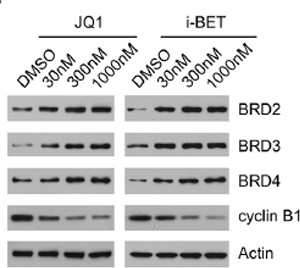
Molibresib besylate purchased from MedChemExpress. Usage Cited in: Nat Med. 2017 Sep;23(9):1055-1062. [Abstract]
Western blot of WCL of C4-2 cells treated with vehicle (DMSO) or different doses of JQ1 or i-BET for 24 h. Actin is used as a loading control.
-
Cell
2021 Apr 15;184(8):2167-2182.e22. PMID: 33811809 -
Cell Metab
2025 Apr 1;37(4):903-919.e10. PMID: 39933514 -
Nat Commun
2024 Jul 2;15(1):5570. PMID: 38956053
Molibresib besylate purchased from MedChemExpress. Usage Cited in: Nat Commun. 2024 Jul 2;15(1):5570. [Abstract]
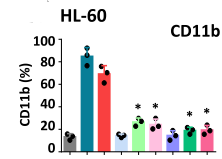
HL-60 cells were treated daily with 25% GI50 concentrations of CM-444, CM-1758, Molibresib, and JQ1, or CM-444 or CM-1758 in combination with Molibresib or JQ1, for 48 hours. The cell differentiation experiment was performed by detecting CD11b by flow cytometry.
Molibresib besylate purchased from MedChemExpress. Usage Cited in: Nat Commun. 2024 Jul 2;15(1):5570. [Abstract]
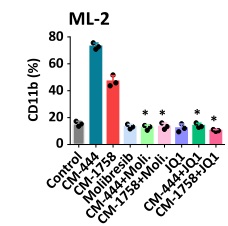
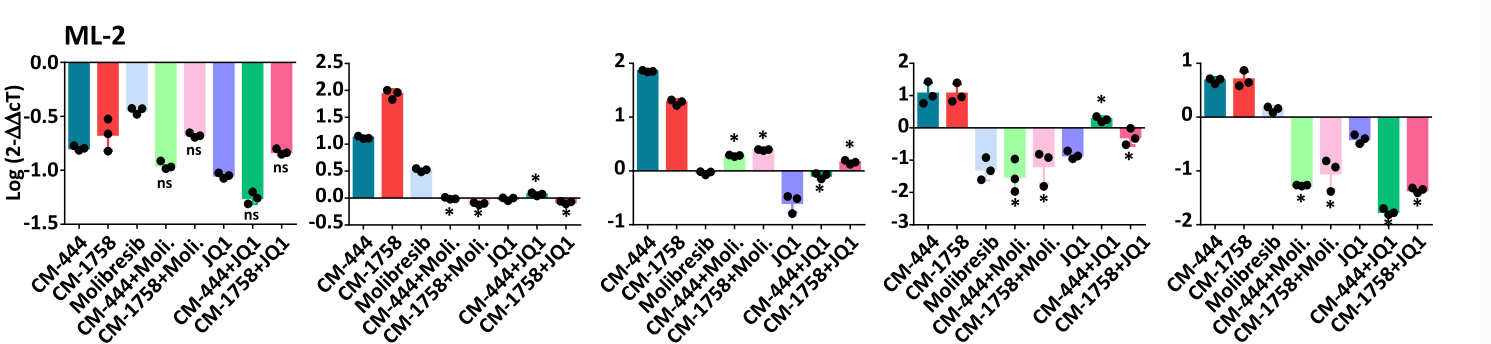
ML-2 cells were treated daily with 25% GI50 concentrations of CM-444, CM-1758, Molibresib, and JQ1, or CM-444 or CM-1758 in combination with Molibresib or JQ1, for 48 hours. The cell differentiation experiment was performed by detecting CD11b by flow cytometry.
Molibresib besylate purchased from MedChemExpress. Usage Cited in: Nat Commun. 2024 Jul 2;15(1):5570. [Abstract]
q-PCR results of GATA2, PU.1, SCL and CEBPA in HL-60 cells after daily treatment with 25% GI50 concentrations of CM-444, CM-1758, Molibresib, JQ1, and CM-444 or CM-1758 in combination with Molibresib or JQ1 for 48 hours.
Molibresib besylate purchased from MedChemExpress. Usage Cited in: Nat Commun. 2024 Jul 2;15(1):5570. [Abstract]
q-PCR results of GATA2, PU.1, SCL and CEBPA in ML-2 cells after daily treatment with 25% GI50 concentrations of CM-444, CM-1758, Molibresib, JQ1, and CM-444 or CM-1758 in combination with Molibresib or JQ1 for 48 hours.
-
Sci Adv
2021 Feb 19;7(8):eabe4038. PMID: 33608276
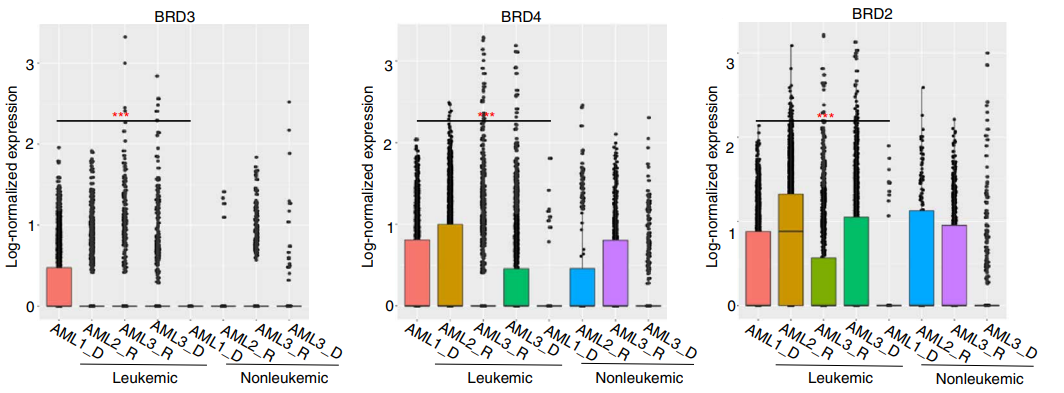
Molibresib besylate purchased from MedChemExpress. Usage Cited in: Sci Adv. 2021 Feb 19;7(8):eabe4038. [Abstract]
Comparison of expression levels of molibresib targets BRD2, BRD3 and BRD4 between leukemic and nonleukemic cells of AML1.
-
Cancer Lett
The combination of BET and PARP inhibitors is synergistic in models of cholangiocarcinoma. [Abstract]2020 Jan 1:468:48-58. PMID: 31605774 -
J Exp Med
Convergent roles of ATF3 and CSL in chromatin control of cancer-associated fibroblast activation. [Abstract]2017 Aug 7;214(8):2349-2368. PMID: 28684431 -
Proc Natl Acad Sci U S A
2019 Feb 19;116(8):2961-2966. PMID: 30718431 -
Blood Adv
Triple combination of BET plus PI3K and NF-κB inhibitors exhibit synergistic activity in adult T-cell leukemia/lymphoma. [Abstract]2022 Apr 12;6(7):2346-2360. PMID: 35030628 -
Cell Syst
A Library of Phosphoproteomic and Chromatin Signatures for Characterizing Cellular Responses to Drug Perturbations. [Abstract]2018 Apr 25;6(4):424-443.e7. PMID: 29655704 -
J Med Chem
Novel Pyrrolopyridone Bromodomain and Extra-Terminal Motif (BET) Inhibitors Effective in Endocrine-Resistant ER+ Breast Cancer with Acquired Resistance to Fulvestrant and Palbociclib. [Abstract]2020 Jul 9;63(13):7186-7210. PMID: 32453591 -
Atherosclerosis
RVX-208, a BET-inhibitor for treating atherosclerotic cardiovascular disease, raises ApoA-I/HDL and represses pathways that contribute to cardiovascular disease. [Abstract]2016 Apr:247:48-57. PMID: 26868508 -
Commun Biol
Three-dimensional CRISPR screening reveals epigenetic interaction with anti-angiogenic therapy. [Abstract]2021 Jul 15;4(1):878. PMID: 34267311 -
J Biol Chem
Low-dose EGFR inhibition unlocks ferroptosis susceptibility to sensitize chemotherapy in EGFR-high triple-negative breast cancer. [Abstract]2026 May 25:113185. PMID: 42190815 -
-
-
-
bioRxiv
2025 Sep 3:2025.08.30.673282. PMID: 40949948 -
bioRxiv
2025 May 4:2025.04.29.651320. PMID: 40654780 -
-
-
Elife
2020 Dec 7:9:e61405. PMID: 33284104 -
-
Oncotarget
BET bromodomain-mediated interaction between ERG and BRD4 promotes prostate cancer cell invasion. [Abstract]2016 Jun 21;7(25):38319-38332. PMID: 27223260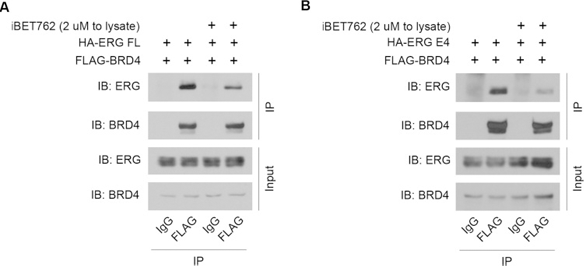
Molibresib besylate purchased from MedChemExpress. Usage Cited in: Oncotarget. 2016 Jun 21;7(25):38319-38332. [Abstract]
iBET762 partially disrupts the interaction between full-length ERG and BRD4 (A), and between T1-E4 ERG and BRD4 (B).


Solvent & Solubility
In Vitro:
DMSO : 25 mg/mL (42.95 mM; Need ultrasonic; Hygroscopic DMSO has a significant impact on the solubility of product, please use newly opened DMSO)
Please refer to the solubility information to select the appropriate solvent. Once prepared, please aliquot and store the solution to prevent product inactivation from repeated freeze-thaw cycles.
Storage method and period of stock solution: -80°C, 6 months; -20°C, 1 month (sealed storage, away from moisture). When stored at -80°C, please use it within 6 months. When stored at -20°C, please use it within 1 month.
Please refer to the solubility information to select the appropriate solvent. Once prepared, please aliquot and store the solution to prevent product inactivation from repeated freeze-thaw cycles.
Storage method and period of stock solution: -80°C, 6 months; -20°C, 1 month (sealed storage, away from moisture). When stored at -80°C, please use it within 6 months. When stored at -20°C, please use it within 1 month.
Concentration (start) × Volume (start) = Concentration (final) × Volume (final)
In Vivo:
Select the appropriate dissolution method based on your experimental animal and administration route.
- For the following dissolution methods, please ensure to first prepare a clear stock solution using an In Vitro approach and then sequentially add co-solvents:
- To ensure reliable experimental results, the clarified stock solution can be appropriately stored based on storage conditions. As for the working solution for In Vivo experiments, it is recommended to prepare freshly and use it on the same day.
- The percentages shown for the solvents indicate their volumetric ratio in the final prepared solution. If precipitation or phase separation occurs during preparation, heat and/or sonication can be used to aid dissolution.
Add each solvent one by one: 10% DMSO 40% PEG300 5% Tween-80 45% Saline
Solubility: ≥ 2.67 mg/mL (4.59 mM); Clear solution
This protocol yields a clear solution of ≥ 2.67 mg/mL (saturation unknown).
Taking 1 mL working solution as an example, add 100 μL DMSO stock solution (26.7 mg/mL) to 400 μL PEG300, and mix evenly; then add 50 μL Tween-80 and mix evenly; then add 450 μL Saline to adjust the volume to 1 mL.
Preparation of Saline: Dissolve 0.9 g sodium chloride in ddH₂O and dilute to 100 mL to obtain a clear Saline solution.
Add each solvent one by one: 10% DMSO 90% (20% SBE-β-CD in Saline)
Solubility: ≥ 2.67 mg/mL (4.59 mM); Clear solution
This protocol yields a clear solution of ≥ 2.67 mg/mL (saturation unknown).
Taking 1 mL working solution as an example, add 100 μL DMSO stock solution (26.7 mg/mL) to 900 μL 20% SBE-β-CD in Saline, and mix evenly.
Preparation of 20% SBE-β-CD in Saline (4°C, storage for one week): 2 g SBE-β-CD powder is dissolved in 10 mL Saline, completely dissolve until clear.
In Vivo Dissolution Calculator
Please enter the basic information of animal experiments:
-
-
-
-
Recommended: Prepare an additional quantity of animals to account for potential losses during experiments.
Please enter your animal formula composition:
-
%DMSO +
Recommended: Keep the proportion of DMSO in working solution below 2% if your animal is weak.
-
%+
-
+%Tween-80 + +
-
%Saline +
The co-solvents required include: DMSO, . All of co-solvents are available by MedChemExpress (MCE). , Tween 80. All of co-solvents are available by MedChemExpress (MCE).
Working solution concentration: 0.22 mg/mL
Method for preparing stock solution: mg drug dissolved in μL DMSO. Stock solution concentration: mg/mL. * In solvent : -80°C, 6 months; -20°C, 1 month (sealed storage, away from moisture)
1. Take μL DMSO stock solution;
2. Add μL .
μL , mix evenly;
3. Then add μL Tween 80, mix evenly;
4. Then add μL
Please ensure that the stock solution in the first step is dissolved to a clear state, and add co-solvents in sequence. You can use ultrasonic heating (ultrasonic cleaner, recommended frequency 20-40 kHz), vortexing, etc. to assist dissolution.

Protocols
-
RNA extraction experimental
By lysing cells, releasing RNA, and removing impurities such as proteins and DNA, high-purity RNA products are finally obtained. The commonly used traditional method is the guanidine isothiocyanate/phenol/chloroform method (Trizol), which is suitable for a variety of animal materials including animal tissues, microorganisms, cultured cells, etc., and most plant materials.
-
Protocol for Cell Counting and Cell Density Analysis
Cell counting and cell-density analysis estimate the number of cells in a known volume or field area. Manual hemocytometer counting uses a chamber of defined geometry to convert counted cells into cells/mL, while automated counters and image-analysis workflows detect cell objects from optical, brightfield, fluorescence, impedance, or digital-image features. Trypan blue viability counting is based on dye exclusion: viable cells with intact membranes exclude dye, while non-viable cells with compromised membranes stain blue. The readout is total cell density, viable-cell density, dead-cell density, and percent viability. Cell density can also be estimated from microscopy images by counting objects per image area, from flow cytometry using calibrated volume or reference particles, or from in situ microscopy in bioreactors after calibration against reference methods such as hemocytometer or flow cytometry.
-
Somatic Cell Culture
A method of simulating the in vivo environment in vitro to maintain the cell growth, differentation and main functions.
-
CCK-8/WST-8 Cell Proliferation Assay
The CCK-8/WST-8 assay is based on the reduction of the water-soluble tetrazolium salt WST-8 to a water-soluble formazan product by cellular dehydrogenases in metabolically active cells, where the generated formazan amount is proportional to the number of living cells and is quantified by measuring absorbance in the visible range, providing a colorimetric readout for cell viability and proliferation assessment. This class of tetrazolium-based assays improves upon earlier MTT-based systems by producing a water-soluble formazan, eliminating the need for organic solubilization steps and enabling direct spectrophotometric measurement in culture medium.
-
Cell Counting-Based Growth Curve Assay
Cell counting-based growth curve assays quantify cell proliferation by directly measuring changes in viable cell number over time using manual or automated counting methods such as hemocytometer-based counting or instrument-assisted cell enumeration, enabling construction of growth curves that reflect population expansion dynamics in response to culture conditions. A widely used approach is trypan blue exclusion with hemocytometer counting, where membrane-compromised (non-viable) cells take up the dye, allowing discrimination between viable and non-viable cells while simultaneously enabling total cell number quantification. Repeated sampling across time points allows estimation of proliferation rate, growth phases, and comparative growth kinetics between experimental conditions.
-
MTT Cell Proliferation Assay
The MTT assay is a colorimetric endpoint assay for estimating viable cell number, cell growth, cytotoxicity, or cell activation in cultured mammalian cells. Living cells reduce the yellow tetrazolium salt MTT into purple/blue formazan, while dead cells do not generate the same signal; the resulting color can be quantified with a multiwell spectrophotometer. MTT reduction is commonly interpreted as a readout of metabolic activity that often correlates with viable cell number, but it should not be treated as a direct cell-counting method unless the assay is optimized for the cell type and experimental condition. Studies show that MTT reduction can involve mitochondrial and non-mitochondrial reducing systems, and formazan may accumulate in intracellular lipid droplets rather than simply marking mitochondria.
-
Breast Cancer Modeling
Breast cancer is a heterogeneous cancer, and it has been distinguished into four subtypes: luminal A, luminal B, HER2-positive and basal-like. Molecular mutations, epigenetic alterations, hormone exposure and immune microenvironment are related to the progression of breast cancer.
-
Cell Viability Determination by MTT Colorimetric Assay
The following protocol uses the MTT colorimetric assay as a classic literature-established method for assessing cell viability/metabolic activity in cultured mammalian cells. MTT[3-(4,5-dimethylthiazol-2-yl)-2,5-diphenyltetrazolium bromide] is reduced by metabolically active cells to a colored formazan product; the amount of formazan is quantified spectrophotometrically and provides an indirect measure of metabolically active viable cells. Importantly, MTT reduction reflects cellular oxidoreductase/metabolic activity rather than an absolute direct count of living cells, so changes in cellular metabolism can alter the signal independently of cell number.


Purity & Documentation
-
Data Sheet (291 KB)
-
SDS (252 KB)
- English - EN (252 KB)
- Français - FR (252 KB)
- Deutsch - DE (252 KB)
- Norwegian - NO (252 KB)
- Español - ES (252 KB)
- Swedish - SV (252 KB)
- Italian - IT (252 KB)
- Korean - KR (252 KB)
- Portuguese - PT (252 KB)
-
Handling Instructions (2659 KB)
References
[1]. You X, et al. Asxl1 loss cooperates with oncogenic Nras in mice to reprogram the immune microenvironment and drive leukemic transformation. Blood. 2022;139(7):1066-1079. [Content Brief]
[2]. Wyce A, et al. MEK inhibitors overcome resistance to BET inhibition across a number of solid and hematologic cancers. Oncogenesis. 2018;7(4):35. Published 2018 Apr 20. [Content Brief]
[3]. Kulka LAM, et al. Impact of HDAC Inhibitors on Protein Quality Control Systems: Consequences for Precision Medicine in Malignant Disease. Front Cell Dev Biol. 2020;8:425. Published 2020 Jun 3. [Content Brief]


Complete Stock Solution Preparation Table
Please refer to the solubility information to select the appropriate solvent. Once prepared, please aliquot and store the solution to prevent product inactivation from repeated freeze-thaw cycles.
Storage method and period of stock solution: -80°C, 6 months; -20°C, 1 month (sealed storage, away from moisture). When stored at -80°C, please use it within 6 months. When stored at -20°C, please use it within 1 month.
| Optional Solvent | Concentration Solvent Mass | 1 mg | 5 mg | 10 mg | 25 mg |
|---|---|---|---|---|---|
| DMSO | 1 mM | 1.7180 mL | 8.5900 mL | 17.1801 mL | 42.9502 mL |
| 5 mM | 0.3436 mL | 1.7180 mL | 3.4360 mL | 8.5900 mL | |
| 10 mM | 0.1718 mL | 0.8590 mL | 1.7180 mL | 4.2950 mL | |
| 15 mM | 0.1145 mL | 0.5727 mL | 1.1453 mL | 2.8633 mL | |
| 20 mM | 0.0859 mL | 0.4295 mL | 0.8590 mL | 2.1475 mL | |
| 25 mM | 0.0687 mL | 0.3436 mL | 0.6872 mL | 1.7180 mL | |
| 30 mM | 0.0573 mL | 0.2863 mL | 0.5727 mL | 1.4317 mL | |
| 40 mM | 0.0430 mL | 0.2148 mL | 0.4295 mL | 1.0738 mL |


Molibresib besylate Related Classifications
HY-13032B Related Classifications
 Powered by Bioz