



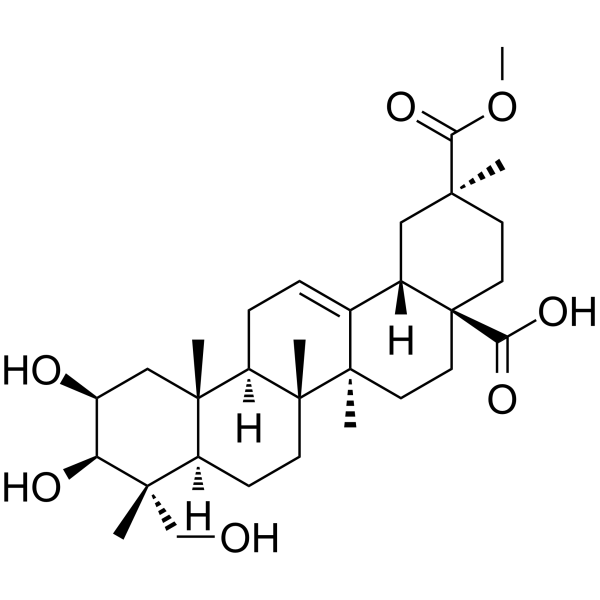
Phytolaccagenin

Based on 1 Customer Validation
Phytolaccagenin is a triterpenoid saponin aglycone, Antifungal agent, vasodilator, antihypertensive agent, and anti-inflammatory agent. Phytolaccagenin activates vascular and cardiac Muscarinic receptors, blocks cardiac β-adrenergic receptors, and inhibits voltage-dependent calcium channels in blood vessels. Phytolaccagenin inhibits the growth of Candida albicans and Cryptococcus neoformans. Phytolaccagenin induces vasodilation, produces negative inotropic and negative chronotropic effects, reduces mean arterial pressure, and inhibits LPS-induced inflammation. Phytolaccagenin exhibits enhanced antihypertensive effects in high salt-induced hypertensive rats. Phytolaccagenin can be used in the research of candidiasis, cryptococcosis, hypertension, and inflammation-related diseases.
For research use only. We do not sell to patients.
- Purity : 99.86%
- CAS No.: 1802-12-6
- Formula: C31H48O7
- Molecular Weight:532.71
-
Storage:
4°C, sealed storage, away from moisture and light
* In solvent : -80°C, 6 months; -20°C, 1 month (sealed storage, away from moisture and light)

To place orders, for customer services and technical support, please contact: MedChemExpress USA
Tel: 609-228-6898 E-mail: [email protected] [email protected]


-
 Biological Activity
-
Chemical Information
-
Solvent & Solubility
- Protocols
- Purity & Documentation
- References
-
 Help & FAQs




Biological Activity
Description
IC50 & Target
[2]|
β-adrenoceptor |
In Vitro
Phytolaccagenin inhibits phenylephrine (HY-B0769)- and high K+-induced contraction of isolated aortic rings from Sprague-Dawley rats[2].
Phytolaccagenin (10-100 μM; 30-45 min) inhibits voltage-dependent Ca2+ influx in aortic rings isolated from Sprague-Dawley rats, which is confirmed by the rightward shift of the CaCl2 concentration-response curve[2].
Phytolaccagenin produces negative inotropic and negative chronotropic effects on isolated spontaneously beating atrial strips from Sprague-Dawley rats, and these effects are partially mediated by cardiac muscarinic receptors and β-adrenergic receptors[2].
Phytolaccagenin (5-100 μM; 24 h) potently inhibits lipopolysaccharide (LPS)-induced nitric oxide production in RAW 264.7 macrophages, with an IC50 of 18.4 μM, and exhibits stronger activity than Esculentoside A (HY-N0632)[3].
Phytolaccagenin (60 min) shows no hemolytic activity against red blood cells of New Zealand rabbits, with an HD50 > 500 μM at the maximum concentration of 500 μM[3].
Phytolaccagenin (100 μM) reduces the viability of RAW 264.7 macrophages[3].
MedChemExpress (MCE) has not independently confirmed the accuracy of these methods. They are for reference only.
-
Cell Line:RAW 264.7 murine celiac macrophages
-
Concentration:100 μM
-
Incubation Time:A certain period of time
-
Result:Reduced RAW 264.7 macrophage growth by 39%.
Parmacokinetics
| Species | Dose | Route | C0 | T1/2 | AUC0-last | AUC0-∞ | MRT | Vz | CL |
|---|---|---|---|---|---|---|---|---|---|
| Rat[4] | 10 mg/kg | i.v. | 8277 ng/mL | 1.4 h | 5821 ng·h/mL | 5999 ng·h/mL | 0.9 h | 4.2 L/kg | 2.1 L/h/kg |
In Vivo
Phytolaccagenin (0.3-300 µg/kg; i.v.; single dose) produces a dose-dependent hypotensive effect in normotensive anesthetized SD rats, with a maximum 61% fall in MAP at 300 µg/kg i.v[2].
MedChemExpress (MCE) has not independently confirmed the accuracy of these methods. They are for reference only.
-
Animal Model:Sprague-Dawley (SD) (male, 180-250 g, high-salt diet-induced hypertension model)[2]
-
Dosage:0.3 µg/kg; 3 µg/kg; 30 µg/kg; 300 µg/kg
-
Administration:i.v.; single dose
-
Result:Caused a dose-dependent fall in MAP: 28.4% at 0.3 µg/kg, 50.8% at 3 µg/kg, 68.8% at 30 µg/kg, and 77.4% at 300 µg/kg.
Caused a dose-dependent fall in MAP in atropine-pretreated rats: 7% at 0.3 µg/kg, 27.33% at 3 µg/kg, 63.66% at 30 µg/kg, and 70% at 300 µg/kg.
Caused a dose-dependent fall in MAP in L-NAME-pretreated rats: 34% at 0.3 µg/kg, 51.66% at 3 µg/kg, 57.33% at 30 µg/kg, and 72.33% at 300 µg/kg.
Caused a dose-dependent fall in heart rate: 14.06% at 0.3 µg/kg, 22.53% at 3 µg/kg, 40.67% at 30 µg/kg, and 49.1% at 300 µg/kg.
-
Animal Model:Sprague-Dawley (SD) (male, 180-250 g)[2]
-
Dosage:0.3 µg/kg; 3 µg/kg; 30 µg/kg; 300 µg/kg
-
Administration:i.v.; single dose
-
Result:Caused a dose-dependent fall in MAP: 11% at 0.3 µg/kg, 31.8% at 3 µg/kg, 38.4% at 30 µg/kg, and 61% at 300 µg/kg.
Caused a dose-dependent fall in heart rate: 13.3% at 0.3 µg/kg, 23% at 3 µg/kg, 34.5% at 30 µg/kg, and 53.7% at 300 µg/kg.


Chemical Information
-
CAS No. 1802-12-6
-
Appearance Solid
-
Molecular Weight 532.71
-
Formula C31H48O7
-
Color White to off-white
-
SMILES
C[C@@]1(CO)[C@@H](O)[C@@H](O)C[C@]2(C)[C@@]3([H])CC=C4[C@]5([H])C[C@@](C)(C(OC)=O)CC[C@@](C(O)=O)5CC[C@](C)4[C@@](C)3CC[C@@]12[H]
-
Structure Classification
-
Initial Source
-
Shipping
Room temperature in continental US; may vary elsewhere.
-
Storage
4°C, sealed storage, away from moisture and light
* In solvent : -80°C, 6 months; -20°C, 1 month (sealed storage, away from moisture and light)


Solvent & Solubility
In Vitro:
DMSO : 50 mg/mL (93.86 mM; Need ultrasonic; Hygroscopic DMSO has a significant impact on the solubility of product, please use newly opened DMSO)
Please refer to the solubility information to select the appropriate solvent. Once prepared, please aliquot and store the solution to prevent product inactivation from repeated freeze-thaw cycles.
Storage method and period of stock solution: -80°C, 6 months; -20°C, 1 month (sealed storage, away from moisture and light). When stored at -80°C, please use it within 6 months. When stored at -20°C, please use it within 1 month.
Please refer to the solubility information to select the appropriate solvent. Once prepared, please aliquot and store the solution to prevent product inactivation from repeated freeze-thaw cycles.
Storage method and period of stock solution: -80°C, 6 months; -20°C, 1 month (sealed storage, away from moisture and light). When stored at -80°C, please use it within 6 months. When stored at -20°C, please use it within 1 month.
Concentration (start) × Volume (start) = Concentration (final) × Volume (final)
In Vivo:
Select the appropriate dissolution method based on your experimental animal and administration route.
- For the following dissolution methods, please ensure to first prepare a clear stock solution using an In Vitro approach and then sequentially add co-solvents:
- To ensure reliable experimental results, the clarified stock solution can be appropriately stored based on storage conditions. As for the working solution for In Vivo experiments, it is recommended to prepare freshly and use it on the same day.
- The percentages shown for the solvents indicate their volumetric ratio in the final prepared solution. If precipitation or phase separation occurs during preparation, heat and/or sonication can be used to aid dissolution.
Add each solvent one by one: 10% DMSO 40% PEG300 5% Tween-80 45% Saline
Solubility: 2.5 mg/mL (4.69 mM); Suspended solution; Need ultrasonic
This protocol yields a suspended solution of 2.5 mg/mL. Suspended solution can be used for oral and intraperitoneal injection.
Taking 1 mL working solution as an example, add 100 μL DMSO stock solution (25.0 mg/mL) to 400 μL PEG300, and mix evenly; then add 50 μL Tween-80 and mix evenly; then add 450 μL Saline to adjust the volume to 1 mL.
Preparation of Saline: Dissolve 0.9 g sodium chloride in ddH₂O and dilute to 100 mL to obtain a clear Saline solution.
In Vivo Dissolution Calculator
Please enter the basic information of animal experiments:
-
-
-
-
Recommended: Prepare an additional quantity of animals to account for potential losses during experiments.
Please enter your animal formula composition:
-
%DMSO +
Recommended: Keep the proportion of DMSO in working solution below 2% if your animal is weak.
-
%+
-
+%Tween-80 + +
-
%Saline +
The co-solvents required include: DMSO, . All of co-solvents are available by MedChemExpress (MCE). , Tween 80. All of co-solvents are available by MedChemExpress (MCE).
Working solution concentration: 0.22 mg/mL
Method for preparing stock solution: mg drug dissolved in μL DMSO. Stock solution concentration: mg/mL. * In solvent : -80°C, 6 months; -20°C, 1 month (sealed storage, away from moisture and light)
1. Take μL DMSO stock solution;
2. Add μL .
μL , mix evenly;
3. Then add μL Tween 80, mix evenly;
4. Then add μL
Please ensure that the stock solution in the first step is dissolved to a clear state, and add co-solvents in sequence. You can use ultrasonic heating (ultrasonic cleaner, recommended frequency 20-40 kHz), vortexing, etc. to assist dissolution.


Purity & Documentation
-
Data Sheet (284 KB)
-
SDS (392 KB)
- English - EN (392 KB)
- Français - FR (392 KB)
- Deutsch - DE (392 KB)
- Norwegian - NO (392 KB)
- Español - ES (392 KB)
- Swedish - SV (392 KB)
- Italian - IT (392 KB)
- Korean - KR (392 KB)
- Portuguese - PT (392 KB)
-
Handling Instructions (2659 KB)
References
[1]. Di Liberto M, et al. Antifungal activity of saponin-rich extracts of Phytolacca dioica and of the sapogenins obtained through hydrolysis. Natural product communications. 2010 Jul;5(7):1013-8. [Content Brief]
[2]. Ul Haq I, et al. Antihypertensive effect and the underlying mechanisms of action of phytolaccagenin in rat models. Clinical and experimental hypertension (New York, N.Y. : 1993). 2022 Aug 18;44(6):557-566. [Content Brief]
[3]. Gong W, et al. Synthesis of novel derivatives of esculentoside A and its aglycone phytolaccagenin, and evaluation of their haemolytic activity and inhibition of lipopolysaccharide-induced nitric oxide production. Chemistry & biodiversity. 2011 Oct;8(10):1833-52. [Content Brief]
[4]. Wei F, et al. Development and validation of a HPLC-MS/MS method for the determination of phytolaccagenin in rat plasma and application to a pharmacokinetic study. Journal of pharmaceutical and biomedical analysis. 2015 Mar 25;107:82-8. [Content Brief]


Complete Stock Solution Preparation Table
Please refer to the solubility information to select the appropriate solvent. Once prepared, please aliquot and store the solution to prevent product inactivation from repeated freeze-thaw cycles.
Storage method and period of stock solution: -80°C, 6 months; -20°C, 1 month (sealed storage, away from moisture and light). When stored at -80°C, please use it within 6 months. When stored at -20°C, please use it within 1 month.
| Optional Solvent | Concentration Solvent Mass | 1 mg | 5 mg | 10 mg | 25 mg |
|---|---|---|---|---|---|
| DMSO | 1 mM | 1.8772 mL | 9.3860 mL | 18.7719 mL | 46.9298 mL |
| 5 mM | 0.3754 mL | 1.8772 mL | 3.7544 mL | 9.3860 mL | |
| 10 mM | 0.1877 mL | 0.9386 mL | 1.8772 mL | 4.6930 mL | |
| 15 mM | 0.1251 mL | 0.6257 mL | 1.2515 mL | 3.1287 mL | |
| 20 mM | 0.0939 mL | 0.4693 mL | 0.9386 mL | 2.3465 mL | |
| 25 mM | 0.0751 mL | 0.3754 mL | 0.7509 mL | 1.8772 mL | |
| 30 mM | 0.0626 mL | 0.3129 mL | 0.6257 mL | 1.5643 mL | |
| 40 mM | 0.0469 mL | 0.2346 mL | 0.4693 mL | 1.1732 mL | |
| 50 mM | 0.0375 mL | 0.1877 mL | 0.3754 mL | 0.9386 mL | |
| 60 mM | 0.0313 mL | 0.1564 mL | 0.3129 mL | 0.7822 mL | |
| 80 mM | 0.0235 mL | 0.1173 mL | 0.2346 mL | 0.5866 mL |


Phytolaccagenin Related Classifications
HY-N1433 Related Classifications
 Powered by Bioz
Keywords
- Phytolaccagenin
- 1802-12-6
- Fungal
- mAChR
- Adrenergic Receptor
- Calcium Channel
- muscarinic receptors
- New Zealand rabbit erythrocytes
- Cryptococcus neoformans
- Candida albicans
- high salt-induced hypertensive rats
- RAW 264.7 macrophages
- β-adrenergic receptors
- Sprague-Dawley rat aortic rings
- voltage-dependent calcium channels
- nitric oxide pathways
- Inhibitor
- inhibitor
- inhibit