



Activin A Protein, Human (Biotinylated, HEK293, Avi)
Based on 1 publication(s) in Google Scholar
The INHBA protein plays a key role in regulating pituitary function by regulating follicle-stimulating hormone secretion together with activin. Its broad effects span a variety of physiological processes, including hormone secretion, germ cell development, erythrocyte differentiation, insulin secretion, nerve cell survival, embryonic development, and bone growth, depending on unique subunit composition. Activin A Protein, Human (Biotinylated, HEK293, Avi) is the recombinant human-derived Activin A protein, expressed by HEK293, with C-Avi labeled tag.
- Species: Human
- Source: HEK293
-
Storage:Stored at -20°C for 2 years from date of receipt. After reconstitution, it is stable at 4°C for 1 week or -20°C for longer (with carrier protein). It is recommended to freeze aliquots at -20°C or -80°C for extended storage.


To place orders, for customer services and technical support, please contact: MedChemExpress USA
Tel: 609-228-6898 E-mail: [email protected] [email protected]


-
 Biological Activity
-
Technical Parameters
-
Product Properties
- Documentation
- Help & FAQs




Biological Activity
Description
The INHBA protein plays a key role in regulating pituitary function by regulating follicle-stimulating hormone secretion together with activin. Its broad effects span a variety of physiological processes, including hormone secretion, germ cell development, erythrocyte differentiation, insulin secretion, nerve cell survival, embryonic development, and bone growth, depending on unique subunit composition. Activin A Protein, Human (Biotinylated, HEK293, Avi) is the recombinant human-derived Activin A protein, expressed by HEK293, with C-Avi labeled tag.
Background
INHBA protein assumes a pivotal role in the intricate regulation of pituitary gland function, contributing to the opposing dynamics of inhibiting and activating follitropin secretion alongside activins. The expansive influence of inhibins and activins, with INHBA as a central player, spans a spectrum of physiological processes, including hypothalamic and pituitary hormone secretion, gonadal hormone secretion, germ cell development and maturation, erythroid differentiation, insulin secretion, nerve cell survival, embryonic axial development, and bone growth, contingent upon their unique subunit compositions. Notably, inhibins, such as Inhibin A and Inhibin B, emerge as counterparts opposing the functions of activins. Structurally, INHBA exists in a dimeric form, intricately linked by one or more disulfide bonds, representing a homodimer of beta-A subunits. The diversity of activins, encompassing Activin A, Activin B, and Activin AB, further emphasizes their specific subunit compositions, influencing interactions with regulatory proteins like FST and FSTL3. This intricate interplay underscores INHBA's central role in orchestrating a finely tuned regulatory network governing diverse physiological functions.
Verified Bioactivity
Immobilized Human/Cynomolgus Activin RIIB/ACVR2B, His Tag at 1 μg/mL (100 μL/well) on the plate. Dose response curve for Biotinylated Human/Mouse/Rat Activin A, Avi Tag with the EC50 of ≤3.6 ng/mL determined by ELISA.
MCE Validation Data
-
Purity - SDS-PAGE
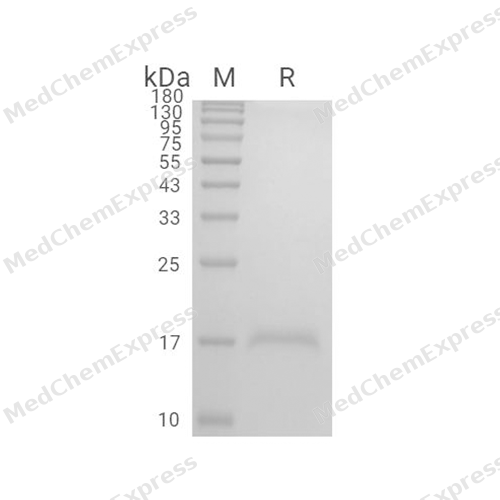
Purity - SDS-PAGE
-
Bioactivity - ELISA
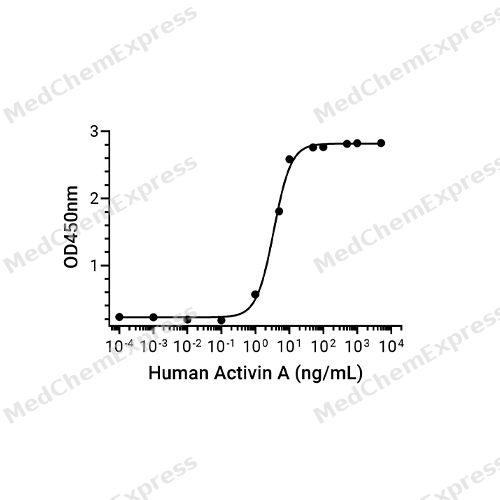
Bioactivity - ELISA


Publications (1)
-
Journal Impact Factor
-
Most Recent
-
Sci Transl Med
Real-time in vivo analysis of murine β cells reveals autophagic flux defects before onset of autoimmune diabetes. [Abstract]2026 May 20;18(850):eadj4902. PMID: 42160447


Technical Parameters
-
Species Human
-
Source HEK293
-
Tag C-Avi
-
Accession
P08476 (G311-S426)
-
Gene ID3624
-
Molecular Construction
-
N-term
-
Activin A (G311-S426)
Accession # P08476 -
Avi
-
C-term
-
-
Protein Length
Full Length of Mature Protein
-
Conjugation
Biotin
-
Conjugate Method
The single lysine residue in Avitag is biotinylated through an enzymatic reaction.
-
Synonyms
INHBA; Follicle-Stimulating Hormone-Releasing Protein; Inhibin Subunit Beta A; Erythroid Differentiation Factor; Inhibin Beta A Chain; Inhibin Beta A Subunit; Activin Beta-A Chain; FSH-Releasing Protein; Inhibin, Beta A (Activin A, Activin AB Alpha Polype
-
AA Sequence
GLECDGKVNICCKKQFFVSFKDIGWNDWIIAPSGYHANYCEGECPSHIAGTSGSSLSFHSTVINHYRMRGHSPFANLKSCCVPTKLRPMSMLYYDDGQNIIKKDIQNMIVEECGCS
-
Predicted Molecular Mass
14.8 kDa
-
Molecular Weight
Approximately 15-18 kDa under reduced (R) conditions, 23-30 kDa under non reducing (N) conditions, based on SDS-PAGE.
-
Structure/Form
Homodimer
-
Purity
≥ 95%, as determined by reducing SDS-PAGE.


Product Properties
Lyophilized powder
Lyophilized from a 0.22 μm filtered solution of 4 mM HCl, 8% trehalose.
<1 EU/μg, determined by LAL method.
It is not recommended to reconstitute to a concentration less than 100 μg/mL in ddH2O . For long term storage it is recommended to add a carrier protein (0.1% BSA, 5% HSA, 10% FBS or 5% Trehalose).
Stored at -20°C for 2 years from date of receipt. After reconstitution, it is stable at 4°C for 1 week or -20°C for longer (with carrier protein). It is recommended to freeze aliquots at -20°C or -80°C for extended storage.
Room temperature in continental US; may vary elsewhere.


Documentation
-
Data Sheet (236 KB)
-
SDS (252 KB)
- English - EN (252 KB)
- Français - FR (252 KB)
- Deutsch - DE (252 KB)
- Norwegian - NO (252 KB)
- Español - ES (252 KB)
- Swedish - SV (252 KB)
- Italian - IT (252 KB)
- Korean - KR (252 KB)
- Portuguese - PT (252 KB)
-
Handling Instructions (2659 KB)

Calculators
Concentration (start) × Volume (start) = Concentration (final) × Volume (final)


 Powered by Bioz

