



Apolipoprotein E/APOE4 Protein, Human (HEK293, His)

Based on 1 Customer Validation
Apolipoprotein E/APOE4 Protein, Human (HEK293, His) is the recombinant human-derived Apolipoprotein E/APOE4 protein, expressed by HEK293, with N-His labeled tag.
- Species: Human
- Source: HEK293
-
Storage:Stored at -20°C for 2 years from date of receipt. After reconstitution, it is stable at 4°C for 1 week or -20°C for longer (with carrier protein). It is recommended to freeze aliquots at -20°C or -80°C for extended storage.


To place orders, for customer services and technical support, please contact: MedChemExpress USA
Tel: 609-228-6898 E-mail: [email protected] [email protected]


-
 Biological Activity
-
Technical Parameters
-
Product Properties
- Documentation
- Help & FAQs




Biological Activity
Description
Apolipoprotein E/APOE4 Protein, Human (HEK293, His) is the recombinant human-derived Apolipoprotein E/APOE4 protein, expressed by HEK293, with N-His labeled tag.
Background
Apolipoprotein E (APOE) is a lipid-associated protein that primarily facilitates lipoprotein-mediated lipid transport between organs through plasma and interstitial fluids. As a core component of plasma lipoproteins, APOE participates in their production, conversion, and clearance. This amphipathic molecule interacts with both lipoprotein core lipids and the aqueous plasma environment, binding to chylomicrons, chylomicron remnants, VLDL, and IDL while showing preferential affinity for HDL. APOE engages with cellular receptors including LDLR, LRP1/LRP2/LRP8, and VLDLR to mediate cellular uptake of APOE-containing lipoprotein particles. Its heparin-binding activity enables interaction with cell-surface heparan sulfate proteoglycans, facilitating lipoprotein capture and receptor-mediated endocytosis. A key function involves hepatic clearance of chylomicrons, VLDL, and HDL. APOE contributes to VLDL biosynthesis in the liver and subsequent peripheral tissue uptake for triglyceride delivery and energy storage. It maintains systemic lipid homeostasis by coordinating inter-tissue lipid distribution and participates in reverse cholesterol transport via HDL biogenesis (with ABCA1) and hepatic HDL uptake. In the central nervous system, APOE regulates lipid transport, neuronal survival, and sprouting. The protein also modulates innate/adaptive immune responses (by similar) through interactions with LILRB4 and may influence transcription via a cholesterol-independent mechanism activating MAP3K12 and non-canonical MAPK signaling to enhance AP-1-mediated APP expression.
MCE Validation Data
-
Purity - SDS-PAGE
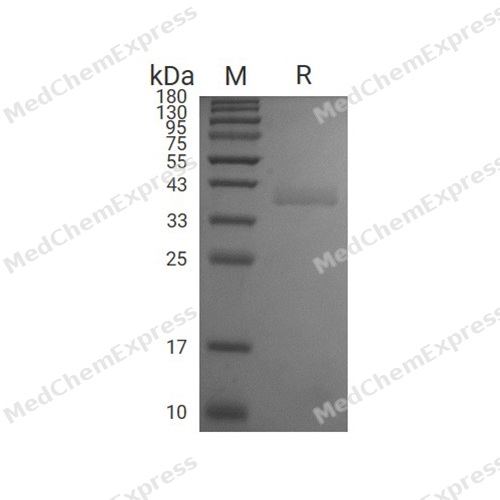
Purity - SDS-PAGE


Technical Parameters
-
Species Human
-
Source HEK293
-
Tag N-8*His
-
Accession
AAB59397.1 (K19-H317)
-
Molecular Construction
-
N-term
-
8*His
-
APOE4 (K19-H317)
Accession # AAB59397.1 -
C-term
-
-
Protein Length
Full Length of Mature Protein
-
Synonyms
APOE; Apolipoprotein E3; Prev. AD2; APO-E; Alzheimer Disease 2 (APOE*E4-Associated, Late Onset); ApoE4; Apolipoprotein E Isoform 4; Apo-E; Apolipoprotein E Isoform 5; LPG; Apolipoprotein E Isoform 2; Apolipoprotein E; LDLCQ5
-
AA Sequence
KVEQAVETEPEPELRQQTEWQSGQRWELALGRFWDYLRWVQTLSEQVQEELLSSQVTQELRALMDETMKELKAYKSELEEQLTPVAEETRARLSKELQAAQARLGADMEDVRGRLVQYRGEVQAMLGQSTEELRVRLASHLRKLRKRLLRDADDLQKRLAVYQAGAREGAERGLSAIRERLGPLVEQGRVRAATVGSLAGQPLQERAQAWGERLRARMEEMGSRTRDRLDEVKEQVAEVRAKLEEQAQQIRLQAEAFQARLKSWFEPLVEDMQRQWAGLVEKVQAAVGTSAAPVPSDNH
-
Molecular Weight
Approximately 35-40 kDa, based on SDS-PAGE under reducing conditions, due to the glycosylation.
-
Glycosylation
Yes
-
Purity
≥ 95%, as determined by reducing SDS-PAGE.


Product Properties
Lyophilized powder
1.Lyophilized from a 0.22 μm filtered solution of PBS, 2mM DTT, pH 7.4, 8% trehalose.
2.Lyophilized from a 0.22 μm filtered solution of PBS, pH 7.4, 8% trehalose.
Please refer to the lot-specific COA for specific buffer information.
<1 EU/μg, determined by LAL method.
It is not recommended to reconstitute to a concentration less than 100 μg/mL in ddH2O.
Stored at -20°C for 2 years from date of receipt. After reconstitution, it is stable at 4°C for 1 week or -20°C for longer (with carrier protein). It is recommended to freeze aliquots at -20°C or -80°C for extended storage.
Room temperature in continental US; may vary elsewhere.


Documentation
-
Data Sheet (237 KB)
-
SDS (252 KB)
- English - EN (252 KB)
- Français - FR (252 KB)
- Deutsch - DE (252 KB)
- Norwegian - NO (252 KB)
- Español - ES (252 KB)
- Swedish - SV (252 KB)
- Italian - IT (252 KB)
- Korean - KR (252 KB)
- Portuguese - PT (252 KB)
-
Handling Instructions (2659 KB)

Calculators
Concentration (start) × Volume (start) = Concentration (final) × Volume (final)


 Powered by Bioz

