



Apolipoprotein E/APOE3 Protein, Human (HEK293, His)
Based on 2 publication(s) in Google Scholar
Apolipoprotein E/ApoE3 is an apolipoprotein isoform that mediates lipid transport and plays a crucial role in lipid homeostasis in both plasma and the central nervous system by binding to LDL receptors (LDLR), LDL receptor-related proteins (LRP1, LRP2, LRP8), Very Low-Density Lipoprotein Receptor (VLDLR), and Heparin. The Apolipoprotein E/ApoE3 Protein, Human (HEK293, His) is a recombinant protein with a His tag at the N-terminus, consisting of 299 amino acids (K19-H317), and is expressed in HEK293 cells.
- Species: Human
- Source: HEK293
-
Storage:Stored at -20°C for 2 years from date of receipt. After reconstitution, it is stable at 4°C for 1 week or -20°C for longer (with carrier protein). It is recommended to freeze aliquots at -20°C or -80°C for extended storage.


To place orders, for customer services and technical support, please contact: MedChemExpress USA
Tel: 609-228-6898 E-mail: [email protected] [email protected]


-
 Biological Activity
-
Technical Parameters
-
Product Properties
- Documentation
- References
- Help & FAQs


-

HY-P700853
Apolipoprotein E/APOE4 Protein, Human (HEK293, His) -
HY-P701094
Apolipoprotein E/APOE2 Protein, Human (R154S, R176C, HEK293, C-His) -
HY-P7532
Apolipoprotein E/APOE Protein, Mouse (HEK293, His) -
HY-P70499
Osteopontin/OPN Protein, Human (HEK293, His) -

HY-P1050A
COG 133 TFA -
HY-P70836
GPNMB/Osteoactivin Protein, Human (HEK293, His) -
HY-P70015
B18R Protein, Vaccinia virus (HEK293, His)


Biological Activity
Description
Apolipoprotein E/ApoE3 is an apolipoprotein isoform that mediates lipid transport and plays a crucial role in lipid homeostasis in both plasma and the central nervous system by binding to LDL receptors (LDLR), LDL receptor-related proteins (LRP1, LRP2, LRP8), Very Low-Density Lipoprotein Receptor (VLDLR), and Heparin. The Apolipoprotein E/ApoE3 Protein, Human (HEK293, His) is a recombinant protein with a His tag at the N-terminus, consisting of 299 amino acids (K19-H317), and is expressed in HEK293 cells[1].
Background
Apolipoprotein E/APOE3 is an amphiphilic molecule that interacts with both the lipid core of lipoprotein particles and the aqueous environment of plasma[3]. Apolipoprotein E/APOE3 regulates plasma and central nervous system lipid metabolism by binding to LDL receptor (LDLR), LDL receptor-related proteins (LRP1, LRP2, LRP8), and Very Low-Density Lipoprotein Receptor (VLDLR) as well as heparin (Heparin)[9][10][12]. Apolipoprotein E/APOE3 first promotes HDL (high-density lipoprotein) synthesis by interacting with ABCA1 and then transports HDL from peripheral tissues to the liver, thereby clearing cholesterol from it. Apolipoprotein E/APOE3 plays an important role in regulating cholesterol homeostasis[11]. Apolipoprotein E/APOE can bind to the immune cell receptor LILRB4 to modulate immune responses[13]. Apolipoprotein E/APOE3 can activate MAP3K12 and atypical MAPK signaling pathways to enhance AP-1-mediated APP transcription[14].
In Vitro
Apolipoprotein E/ApoE3 (Human) (3 μM, 24 hours) provides a certain degree of protection against the inflammatory response induced by β-Amyloid (1-42) (HY-P1388) in neonatal rat astrocytes (NRA)[5]. Apolipoprotein E/ApoE3 (Human) (10 μg/mL, 48 hours) enhances Aβ synthesis in neurons derived from mouse embryonic fibroblasts (MEF)[5].
In Vivo
Apolipoprotein E/ApoE3 (Human) enhances diet-induced hypercholesterolemia and atherosclerosis in transgenic C57BL/6J mice with the hAPOE3 allele-targeted replacement of the Apolipoprotein E gene[6]. Apolipoprotein E/ApoE3 (Human) releases cholesterol extracellularly in astrocytes of hApoE3 transgenic mice by producing high-density lipoprotein (HDL)-like particles[8].
Verified Bioactivity
Measured in a cell proliferation assay using SH-SY5Y cells.The ED50 for this effect is 10-25 ng/mL.
MCE Validation Data
-
Purity - SDS-PAGE
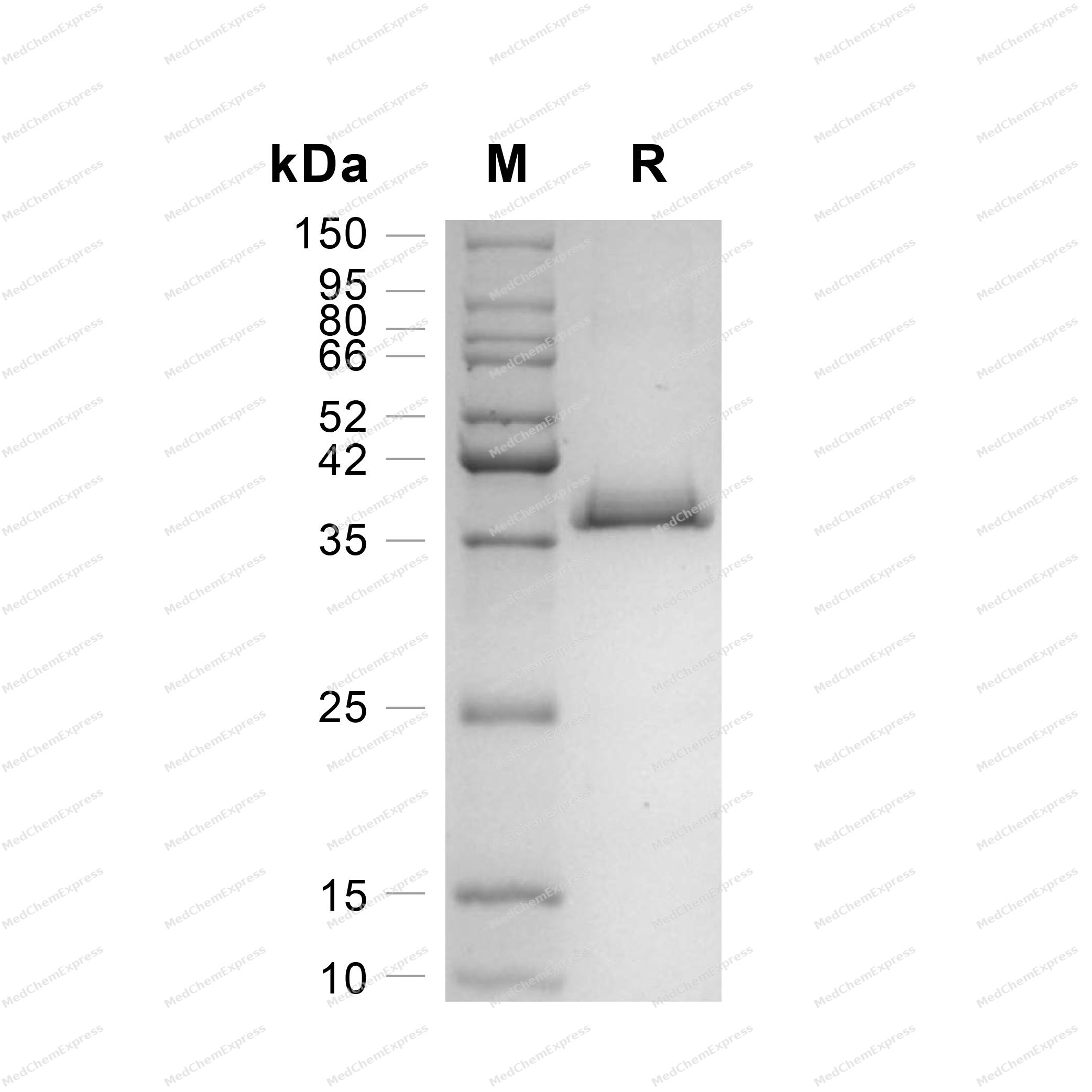
Purity - SDS-PAGE
-
Bioactivity - Cell-Based Assay
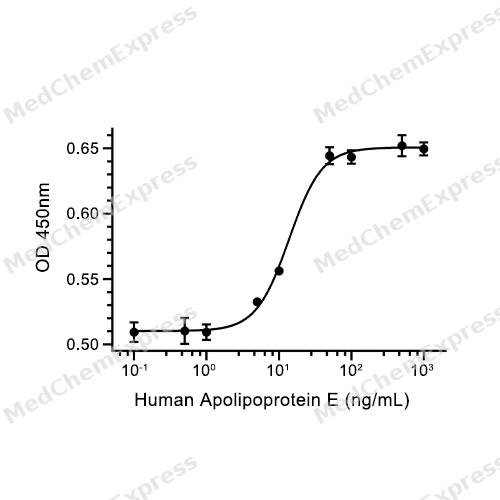
Bioactivity - Cell-Based Assay


Publications (2)
-
Journal Impact Factor
-
Most Recent
-
Cell Death Dis
Tumor-derived apolipoprotein E confers resistance to temozolomide in pancreatic neuroendocrine tumors. [Abstract]2025 Dec 13. PMID: 41390817 -
Int J Pharm
Recombinant ApoE3 corona plus sucrose vitrification endows mRNA-LNPs with Freeze-Thaw and -80 °C stability. [Abstract]2025 Nov 30:685:126281. PMID: 41101606


Technical Parameters
-
Species Human
-
Source HEK293
-
Tag C-6*His
-
Accession
P02649 (K19-H317)
-
Molecular Construction
-
N-term
-
APOE (K19-H317)
Accession # P02649 -
6*His
-
C-term
-
-
Protein Length
Full Length of Mature Protein
-
Synonyms
APOE; Apolipoprotein E3; Prev. AD2; APO-E; Alzheimer Disease 2 (APOE*E4-Associated, Late Onset); ApoE4; Apolipoprotein E Isoform 4; Apo-E; Apolipoprotein E Isoform 5; LPG; Apolipoprotein E Isoform 2; Apolipoprotein E; LDLCQ5
-
AA Sequence
KVEQAVETEPEPELRQQTEWQSGQRWELALGRFWDYLRWVQTLSEQVQEELLSSQVTQELRALMDETMKELKAYKSELEEQLTPVAEETRARLSKELQAAQARLGADMEDVCGRLVQYRGEVQAMLGQSTEELRVRLASHLRKLRKRLLRDADDLQKRLAVYQAGAREGAERGLSAIRERLGPLVEQGRVRAATVGSLAGQPLQERAQAWGERLRARMEEMGSRTRDRLDEVKEQVAEVRAKLEEQAQQIRLQAEAFQARLKSWFEPLVEDMQRQWAGLVEKVQAAVGTSAAPVPSDNH
-
Molecular Weight
Approximately 36-40 kDa, based on SDS-PAGE under reducing conditions.
-
Glycosylation
Yes
-
Purity
≥ 95%, as determined by reducing SDS-PAGE.


Product Properties
Lyophilized powder
1.Lyophilized from a 0.22 μm filtered solution of 20 mM Tris-HCl, 5% Trehalose,5% Mannitol, 0.02% Tween80, pH 8.0.
2.Lyophilized from a 0.22 μm filtered solution of 20 mM PB, 150 mM NaCl, pH 7.4.
3.Lyophilized from a 0.22 μm filtered solution of PBS, pH 7.4, 8% trehalose.
Please refer to the lot-specific COA for specific buffer information.
Note: For SPR assay, please replace the buffer. Primary amine components (e.g., Tris, imidazole) can affect protein-coupled chips.
<1 EU/μg, determined by LAL method.
It is not recommended to reconstitute to a concentration less than 100 μg/mL in ddH2O.
Stored at -20°C for 2 years from date of receipt. After reconstitution, it is stable at 4°C for 1 week or -20°C for longer (with carrier protein). It is recommended to freeze aliquots at -20°C or -80°C for extended storage.
Room temperature in continental US; may vary elsewhere.


Documentation
-
Data Sheet (266 KB)
-
SDS (252 KB)
- English - EN (252 KB)
- Français - FR (252 KB)
- Deutsch - DE (252 KB)
- Norwegian - NO (252 KB)
- Español - ES (252 KB)
- Swedish - SV (252 KB)
- Italian - IT (252 KB)
- Korean - KR (252 KB)
- Portuguese - PT (252 KB)
-
Handling Instructions (2659 KB)


References
[1]. Gong JS, et al. Apolipoprotein E (ApoE) isoform-dependent lipid release from astrocytes prepared from humanApoE3 and ApoE4 knock-in mice. J Biol Chem. 2002 Aug 16;277(33):29919-26. [Content Brief]
[2]. Gong JS, et al. Novel action of apolipoprotein E (ApoE): ApoE isoform specifically inhibits lipid-particle-mediated cholesterol release from neurons. Mol Neurodegener. 2007 May 15;2:9. [Content Brief]
[3]. Hatters DM, et al. Apolipoprotein E structure: insights into function. Trends Biochem Sci. 2006 Aug;31(8):445-54. [Content Brief]
[4]. Wetterau JR, et al. Human apolipoprotein E3 in aqueous solution. I. Evidence for two structural domains. J Biol Chem. [Content Brief]
[5]. Dorey E, et al. Apolipoprotein E Isoforms Differentially Regulate Alzheimer's Disease and Amyloid-β-Induced Inflammatory Response in vivo and in vitro. J Alzheimers Dis. 2017;57(4):1265-1279. [Content Brief]
[6]. Sullivan PM, et al. Targeted replacement of the mouse apolipoprotein E gene with the common human APOE3 allele enhances diet-induced hypercholesterolemia and atherosclerosis. J Biol Chem. [Content Brief]
[7]. Huang Y W A, et al. ApoE2, ApoE3, and ApoE4 differentially stimulate APP transcription and Aβ secretion[J]. Cell, 2017, 168(3): 427-441. e21. [Content Brief]
[8]. Gong J S, et al. Apolipoprotein E (ApoE) isoform-dependent lipid release from astrocytes prepared from human ApoE3 and ApoE4 knock-in mice[J]. Journal of Biological Chemistry, 2002, 277(33): 29919-29926. [Content Brief]
[9]. Sehayek E, et al. Mechanisms of inhibition by apolipoprotein C of apolipoprotein E-dependent cellular metabolism of human triglyceride-rich lipoproteins through the low density lipoprotein receptor pathway. [Content Brief]
[10]. Kowal RC, et al. Low density lipoprotein receptor-related protein mediates uptake of cholesteryl esters derived from apoprotein E-enriched lipoproteins. Proc Natl Acad Sci U S A. 1989 Aug;86(15):5810-4. [Content Brief]
[11]. Ji ZS, et al. Heparan sulfate proteoglycans participate in hepatic lipaseand apolipoprotein E-mediated binding and uptake of plasma lipoproteins, including high density lipoproteins. J Biol Chem. [Content Brief]
[12]. Fagan AM, et al. Apolipoprotein E-containing high density lipoprotein promotes neurite outgrowth and is a ligand for the low density lipoprotein receptor-related protein. J Biol Chem. 1996 Nov 22;271(47):30121-5. [Content Brief]
[13]. Deng M, et al. LILRB4 signalling in leukaemia cells mediates T cell suppression and tumour infiltration. Nature. 2018 Oct;562(7728):605-609. [Content Brief]
[14]. Huang YA, et al. ApoE2, ApoE3, and ApoE4 Differentially Stimulate APP Transcription and Aβ Secretion. Cell. 2017 Jan 26;168(3):427-441.e21. [Content Brief]

Calculators
Concentration (start) × Volume (start) = Concentration (final) × Volume (final)


 Powered by Bioz

