



Apolipoprotein E/APOE Protein, Mouse (HEK293, His)
Based on 1 publication(s) in Google Scholar
Apolipoprotein E/APOE is a key molecule linking lipid metabolism and neurological function. Apolipoprotein E/APOE gene polymorphisms are closely associated with diseases such as Alzheimer’s disease and atherosclerosis by influencing protein structure and function. Apolipoprotein E/APOE Protein, Mouse (HEK293, His) is a recombinant APOE protein expressed in HEK293 cells, with a C-6*His tag.
- Species: Mouse
- Source: HEK293
-
Storage:Stored at -20°C for 2 years from date of receipt. After reconstitution, it is stable at 4°C for 1 week or -20°C for longer (with carrier protein). It is recommended to freeze aliquots at -20°C or -80°C for extended storage.


To place orders, for customer services and technical support, please contact: MedChemExpress USA
Tel: 609-228-6898 E-mail: [email protected] [email protected]


-
 Biological Activity
-
Technical Parameters
-
Product Properties
- Documentation
- References
- Help & FAQs


-

HY-P7531
Apolipoprotein E/APOE3 Protein, Human (HEK293, His) -
HY-P73484
Vitronectin Protein, Mouse (HEK293, His) -
HY-15772
Osimertinib -
HY-P78247
Complement C3 Protein, Mouse (HEK293, His) -
HY-P700853
Apolipoprotein E/APOE4 Protein, Human (HEK293, His) -
HY-P7080
IL-4 Protein, Mouse (CHO) -
HY-P71461
GFP Protein, Aequorea victoria (His) -
HY-148026
Sonrotoclax -

HY-NP0204
MSA Protein -
HY-P7534A
Apolipoprotein H/APOH Protein, Mouse (HEK293, His) -
HY-P7526
Apolipoprotein A-I/APOA1 Protein, Human -

HY-K0301
Cell Counting Kit-8


Biological Activity
Description
Apolipoprotein E/APOE is a key molecule linking lipid metabolism and neurological function. Apolipoprotein E/APOE gene polymorphisms are closely associated with diseases such as Alzheimer’s disease and atherosclerosis by influencing protein structure and function. Apolipoprotein E/APOE Protein, Mouse (HEK293, His) is a recombinant APOE protein expressed in HEK293 cells, with a C-6*His tag[1][2][3].
Background
Apolipoprotein E/APOE is a member of the soluble apolipoprotein family, primarily synthesized in the liver and brain. Liver-derived Apolipoprotein E/APOE participates in peripheral lipid metabolism, while brain-derived Apolipoprotein E/APOE, produced by astrocytes, is involved in neuronal repair and synaptic plasticity. Apolipoprotein E/APOE plays a critical role in lipid transport within both plasma and the central nervous system by interacting with the low-density lipoprotein receptor family. The three common Apolipoprotein E/APOE isoforms (APOE2, APOE3, APOE4), differing in amino acids at positions 112 and 158, have distinct effects on the risk of diseases such as atherosclerosis and Alzheimer’s disease. Due to domain interactions and lower stability, APOE4 is a major genetic risk factor for Alzheimer’s disease, while APOE2 is associated with type III hyperlipoproteinemia due to weak receptor binding[1][2][3].
Verified Bioactivity
1.Measured in a cell proliferation assay using SH-SY5Y Human neuroblastoma cells. The ED50 this effect is 15-50 ng/mL.
2.Mouse TREM-2 immobilized on CM5 Chip can bind Mouse APOE with an affinity constant of 3.595 nM as determined in a SPR assay.
3.Immobilized Recombinant Mouse ApoE (C-6His) at 2 μg/ml (100 μl/well) can bind Recombinant Human TREM2 (C-Fc). The ED50 of Recombinant Human TREM2 (C-Fc) is 8.05-34.77 ng/ml.
MCE Validation Data
-
Purity - SDS-PAGE
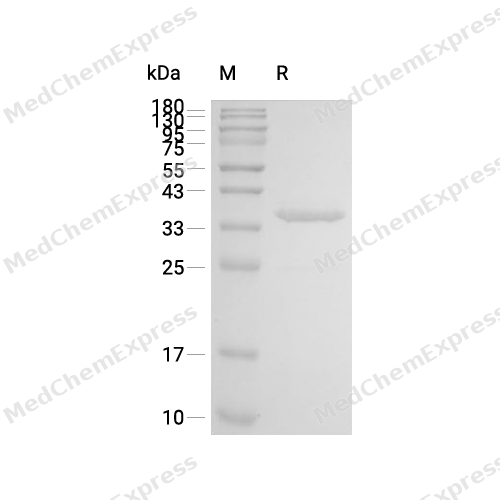
Purity - SDS-PAGE
-
Bioactivity - Cell-Based Assay
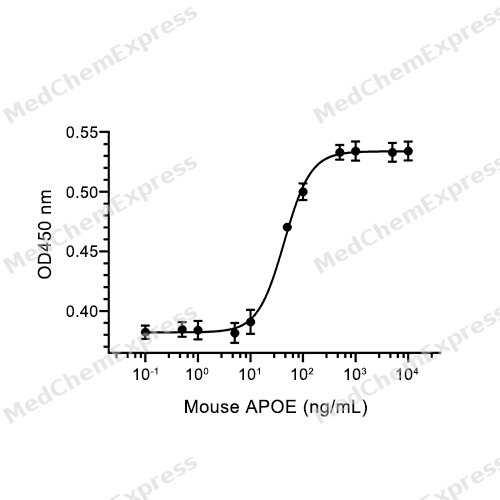
Bioactivity - Cell-Based Assay


Publications (1)
-
Journal Impact Factor
-
Most Recent
-
Cancer Res
Pancreatic Neuroendocrine Tumors Secrete Apolipoprotein E to Induce Tip Endothelial Cells That Remodel the Tumor-Stroma Ratio and Promote Cancer Progression. [Abstract]2025 Aug 1;85(15):2805-2819. PMID: 40623046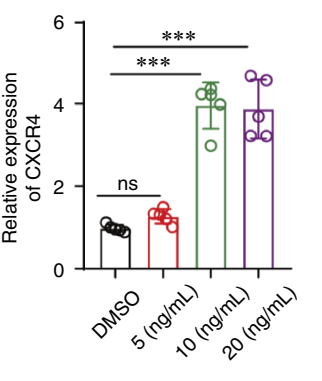
Apolipoprotein E/APOE Protein, Mouse (HEK293, His) purchased from MedChemExpress. Usage Cited in: Cancer Res. 2025 Aug 1;85(15):2805-2819. [Abstract]
Different concentrations of Apolipoprotein E/APOE Protein caused changes in CXCR4 expression levels in TipECs in mice after 48 hours.
Apolipoprotein E/APOE Protein, Mouse (HEK293, His) purchased from MedChemExpress. Usage Cited in: Cancer Res. 2025 Aug 1;85(15):2805-2819. [Abstract]
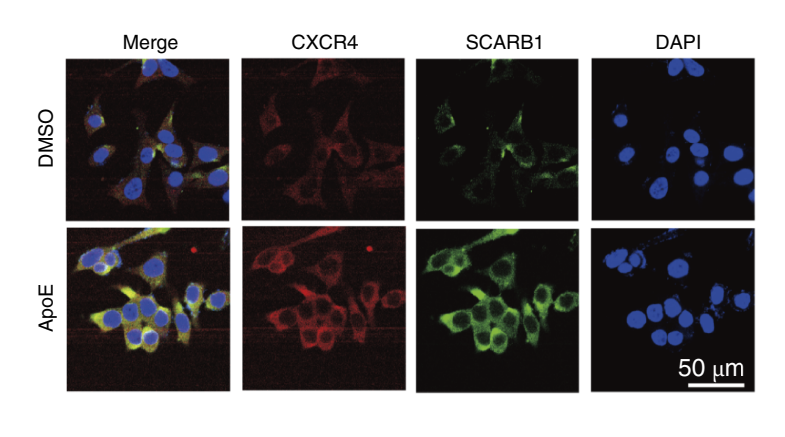
Immunofluorescence staining showed that Apolipoprotein E/APOE Protein, Mouse (10 ng/mL) induced increased expression of CXCR4 and SCARB1 in HUVECs after 48 hours.
Apolipoprotein E/APOE Protein, Mouse (HEK293, His) purchased from MedChemExpress. Usage Cited in: Cancer Res. 2025 Aug 1;85(15):2805-2819. [Abstract]
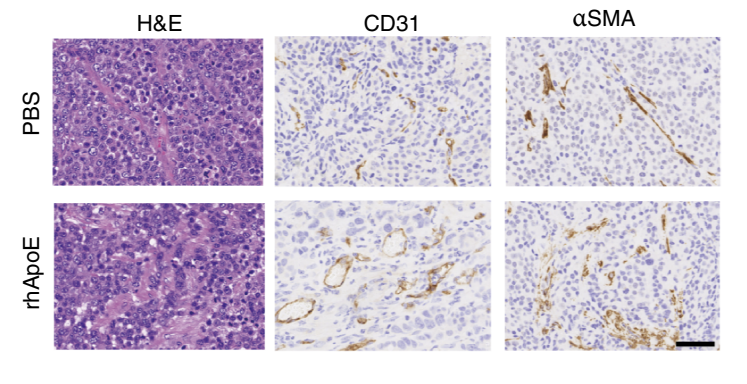
Apolipoprotein E/APOE Protein, Mouse (10 μg) or an equal volume of PBS was administered via gastric instillation, and IHC staining was used to visualize the number of tumor stromal cells.
Apolipoprotein E/APOE Protein, Mouse (HEK293, His) purchased from MedChemExpress. Usage Cited in: Cancer Res. 2025 Aug 1;85(15):2805-2819. [Abstract]
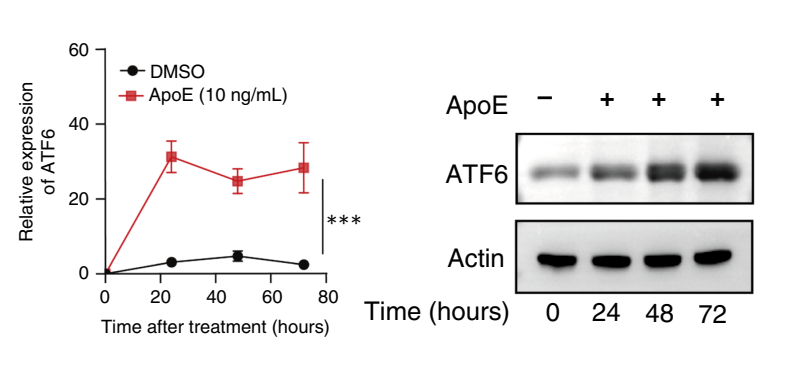
Effects of Apolipoprotein E/APOE Protein, Mouse (10 ng/mL) on transcription factor activity at different time points.


Technical Parameters
-
Species Mouse
-
Source HEK293
-
Tag C-6*His
-
Accession
P08226 (E19-Q311)
-
Molecular Construction
-
N-term
-
APOE (E19-Q311)
Accession # P08226 -
6*His
-
C-term
-
-
Protein Length
Full Length of Mature Protein
-
Synonyms
APOE; Apolipoprotein E3; Prev. AD2; APO-E; Alzheimer Disease 2 (APOE*E4-Associated, Late Onset); ApoE4; Apolipoprotein E Isoform 4; Apo-E; Apolipoprotein E Isoform 5; LPG; Apolipoprotein E Isoform 2; Apolipoprotein E; LDLCQ5
-
AA Sequence
EGEPEVTDQLEWQSNQPWEQALNRFWDYLRWVQTLSDQVQEELQSSQVTQELTALMEDTMTEVKAYKKELEEQLGPVAEETRARLGKEVQAAQARLGADMEDLRNRLGQYRNEVHTMLGQSTEEIRARLSTHLRKMRKRLMRDAEDLQKRLAVYKAGAREGAERGVSAIRERLGPLVEQGRQRTANLGAGAAQPLRDRAQAFGDRIRGRLEEVGNQARDRLEEVREHMEEVRSKMEEQTQQIRLQAEIFQARLKGWFEPIVEDMHRQWANLMEKIQASVATNPIITPVAQENQ
-
Molecular Weight
Approximately 30-40 kDa, based on SDS-PAGE under reducing conditions.
-
Purity
≥ 90%, as determined by reducing SDS-PAGE.


Product Properties
Lyophilized powder
1.Lyophilized from a 0.22 μm filtered solution of 20 mM PB, 150 mM NaCl, pH 7.4.
2.Lyophilized from a 0.22 μm filtered solution of PBS, pH 7.4.
3.Lyophilized from a 0.22 μm filtered solution of PBS, pH 7.4, 8% trehalose.
Please refer to the lot-specific COA for specific buffer information.
<1 EU/μg, determined by LAL method.
It is not recommended to reconstitute to a concentration less than 100 μg/mL in ddH2O. For long term storage it is recommended to add a carrier protein (0.1% BSA, 5% HSA, 10% FBS or 5% Trehalose).
Stored at -20°C for 2 years from date of receipt. After reconstitution, it is stable at 4°C for 1 week or -20°C for longer (with carrier protein). It is recommended to freeze aliquots at -20°C or -80°C for extended storage.
Room temperature in continental US; may vary elsewhere.


Documentation
-
Data Sheet (264 KB)
-
SDS (252 KB)
- English - EN (252 KB)
- Français - FR (252 KB)
- Deutsch - DE (252 KB)
- Norwegian - NO (252 KB)
- Español - ES (252 KB)
- Swedish - SV (252 KB)
- Italian - IT (252 KB)
- Korean - KR (252 KB)
- Portuguese - PT (252 KB)
-
Handling Instructions (2659 KB)


References
[1]. Gong JS, et al. Novel action of apolipoprotein E (ApoE): ApoE isoform specifically inhibits lipid-particle-mediated cholesterol release from neurons. Mol Neurodegener. 2007 May 15;2:9. [Content Brief]
[3]. Eichner JE, et al. Apolipoprotein E polymorphism and cardiovascular disease: a HuGE review. Am J Epidemiol. 2002 Mar 15;155(6):487-95. [Content Brief]

Calculators
Concentration (start) × Volume (start) = Concentration (final) × Volume (final)


 Powered by Bioz

