



ARMET/MANF Protein, Human (His)
Based on 2 publication(s) in Google Scholar
ARMET/MANF proteins critically support the survival of dopaminergic neurons in the ventral midbrain and contribute to neuronal homeostasis. It modulates GABAergic transmission and enhances inhibitory postsynaptic currents in substantia nigra dopaminergic neurons. ARMET/MANF Protein, Human (His) is the recombinant human-derived ARMET/MANF protein, expressed by E. coli , with N-6*His labeled tag.
- Species: Human
- Source: E. coli
-
Storage:Stored at -20°C for 2 years from date of receipt. After reconstitution, it is stable at 4°C for 1 week or -20°C for longer (with carrier protein). It is recommended to freeze aliquots at -20°C or -80°C for extended storage.


To place orders, for customer services and technical support, please contact: MedChemExpress USA
Tel: 609-228-6898 E-mail: [email protected] [email protected]


-
 Biological Activity
-
Technical Parameters
-
Product Properties
- Documentation
- Help & FAQs




Biological Activity
Description
ARMET/MANF proteins critically support the survival of dopaminergic neurons in the ventral midbrain and contribute to neuronal homeostasis. It modulates GABAergic transmission and enhances inhibitory postsynaptic currents in substantia nigra dopaminergic neurons. ARMET/MANF Protein, Human (His) is the recombinant human-derived ARMET/MANF protein, expressed by E. coli , with N-6*His labeled tag.
Background
ARMET/MANF protein selectively promotes the survival of dopaminergic neurons in the ventral mid-brain, thereby playing a crucial role in neuronal homeostasis. It modulates GABAergic transmission to dopaminergic neurons in the substantia nigra, enhancing both spontaneous and evoked GABAergic inhibitory postsynaptic currents, indicating its involvement in neurotransmission regulation (By similarity). Additionally, ARMET/MANF inhibits cell proliferation and protects against endoplasmic reticulum (ER) stress-induced cell death, demonstrating its multifaceted role in cellular processess. Under normal conditions, the protein is retained in the ER/sarcoplasmic reticulum (SR) through its association with the endoplasmic reticulum chaperone protein HSPA5. However, in response to ER stress and hypoxia, ARMET/MANF is upregulated and secreted by the ER/SR, leading to its binding to 3-O-sulfogalactosylceramide, a lipid sulfatide in the outer cell membrane of target cells. This interaction facilitates cellular uptake through endocytosis and is crucial for ARMET/MANF's role in alleviating ER stress and mitigating cell toxicity under hypoxic and ER stress conditions. The protein also interacts directly with HSPA5 and is part of a complex involving CRELD2, MANF, MATN3, and PDIA4, further underscoring its involvement in cellular regulatory networks (By similarity).
Verified Bioactivity
Measured in a cell proliferation assay using rat C6 cells.The ED50 for this effect is ≤1.05 μg/mL.
MCE Validation Data
-
Purity - SDS-PAGE
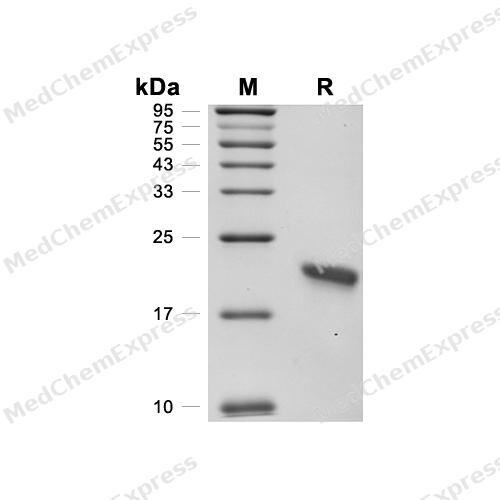
Purity - SDS-PAGE
-
Bioactivity - Cell-Based Assay
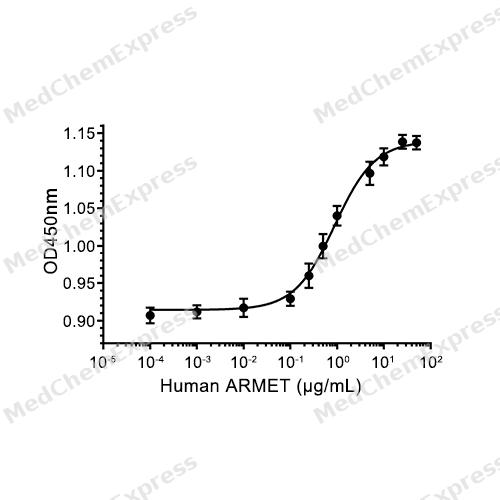
Bioactivity - Cell-Based Assay


Publications (2)
-
Journal Impact Factor
-
Most Recent
-
Neural Plast
Activation of the PERK/MANF/STAT3 Pathway in Astrocytes Promotes Synaptic Remodeling and Neurological Recovery in the Acute Phase After Stroke in Mice. [Abstract]2025 Aug 28:2025:6776608. PMID: 40919080 -
Biochem Biophys Rep
Identification and validation of the pivotal role of MANF gene in pancreatic β-cell aging using bioinformatics. [Abstract]2025 Jul 8:43:102106. PMID: 40688493


Technical Parameters
-
Species Human
-
Source E. coli
-
Tag N-6*His
-
Accession
P55145 (L25-L182)
-
Molecular Construction
-
N-term
-
6*His
-
ARMET (L25-L182)
Accession # P55145 -
C-term
-
-
Protein Length
Full Length of Mature Protein
-
Synonyms
MANF; Arginine-Rich, Mutated In Early Stage Tumors; Prev. ARMET; Protein ARMET; ARP; DDDS; Mesencephalic Astrocyte-Derived Neurotrophic Factor; Mesencephalic Astrocyte Derived Neurotrophic Factor; Arginine-Rich Protein
-
AA Sequence
LRPGDCEVCISYLGRFYQDLKDRDVTFSPATIENELIKFCREARGKENRLCYYIGATDDAATKIINEVSKPLAHHIPVEKICEKLKKKDSQICELKYDKQIDLSTVDLKKLRVKELKKILDDWGETCKGCAEKSDYIRKINELMPKYAPKAASARTDL
-
Predicted Molecular Mass
18.2 kDa
-
Molecular Weight
Approximately 20 kDa, based on SDS-PAGE under reducing conditions.
-
Purity
≥ 95%, as determined by reducing SDS-PAGE.


Product Properties
Lyophilized powder.
Lyophilized from a 0.22 μm filtered solution of 50 mM Tris-HCl, 300 mM NaCl, pH 8.0.
Note: For SPR assay, please replace the buffer. Primary amine components (e.g., Tris, imidazole) can affect protein-coupled chips.
<1 EU/μg, determined by LAL method.
It is not recommended to reconstitute to a concentration less than 100 μg/mL in ddH2O. For long term storage it is recommended to add a carrier protein (0.1% BSA, 5% HSA, 10% FBS or 5% Trehalose).
Stored at -20°C for 2 years from date of receipt. After reconstitution, it is stable at 4°C for 1 week or -20°C for longer (with carrier protein). It is recommended to freeze aliquots at -20°C or -80°C for extended storage.
Room temperature in continental US; may vary elsewhere.


Documentation
-
Data Sheet (236 KB)
-
SDS (252 KB)
- English - EN (252 KB)
- Français - FR (252 KB)
- Deutsch - DE (252 KB)
- Norwegian - NO (252 KB)
- Español - ES (252 KB)
- Swedish - SV (252 KB)
- Italian - IT (252 KB)
- Korean - KR (252 KB)
- Portuguese - PT (252 KB)
-
Handling Instructions (2659 KB)

Calculators
Concentration (start) × Volume (start) = Concentration (final) × Volume (final)


 Powered by Bioz

