



ART3 Protein, Human (HEK293, His)

Based on 1 Customer Validation
ART3 is a member of the mono-ADP-ribosyltransferase family genes which is involved in cell division, DNA-repair and the regulation of the inflammatory response. The temporary and restricted expression of ART3 in spermatocytes might be linked to cell division processes underlying the formation of spermatocytes and the regulation of spermatogenesis. Moreover, it induces TNBC cell growth and invasion by activating Akt and ERK. ART3 Protein, Human (HEK293, His) is the recombinant human-derived ART3 protein, expressed by HEK293 , with C-His labeled tag.
- Species: Human
- Source: HEK293
-
Storage:Stored at -20°C for 2 years from date of receipt. After reconstitution, it is stable at 4°C for 1 week or -20°C for longer (with carrier protein). It is recommended to freeze aliquots at -20°C or -80°C for extended storage.


To place orders, for customer services and technical support, please contact: MedChemExpress USA
Tel: 609-228-6898 E-mail: [email protected] [email protected]


-
 Biological Activity
-
Technical Parameters
-
Product Properties
- Documentation
- Help & FAQs




Biological Activity
Description
ART3 is a member of the mono-ADP-ribosyltransferase family genes which is involved in cell division, DNA-repair and the regulation of the inflammatory response. The temporary and restricted expression of ART3 in spermatocytes might be linked to cell division processes underlying the formation of spermatocytes and the regulation of spermatogenesis. Moreover, it induces TNBC cell growth and invasion by activating Akt and ERK. ART3 Protein, Human (HEK293, His) is the recombinant human-derived ART3 protein, expressed by HEK293 , with C-His labeled tag.
Background
ART3 is a member of the mono-ADP-ribosyltransferase family genes which is involved in cell division, DNA-repair and the regulation of the inflammatory response. ART3 mRNA can be detected in unstimulated monocytes, alveolar epithelial cells, spermatocytes in testes, macrophages, T lymphocytes and other cell types. The expression of ART3 is associated with physiological and pathological functions, including spermatogenesis and damage to the number of cardiomyocytes. The temporary and restricted expression of ART3 in spermatocytes might be linked to cell division processes underlying the formation of spermatocytes and the regulation of spermatogenesis. And ART3 protein is significantly overexpressed in human TNBC tumors tissue and cell lines through. Overexpression of ART3 in MDA-MB-231 breast cancer cells increased cell proliferation, invasion, and survival in vitro and growth of xenograft tumors by activating Akt and ERK. Moreover, ART3 may play important roles in central nervous system (CNS) pathophysiology after traumatic brain injury (TBI)[1][2].
Verified Bioactivity
Measured in a cell proliferation assay using MDA-MB-231 cells. The ED50 for this effect is typically 1.039 μg/mL, corresponding to a specific activity is 962.464 units/mg.
MCE Validation Data
-
Purity - SDS-PAGE
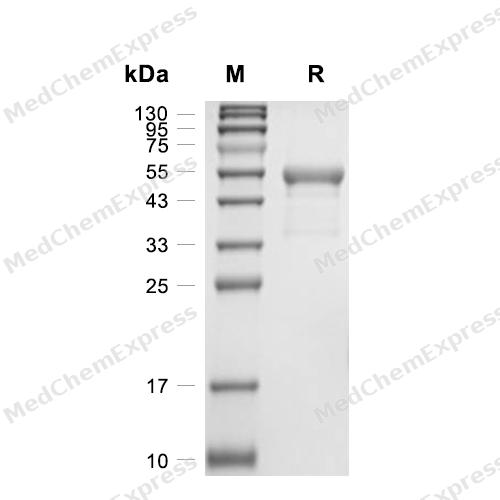
Purity - SDS-PAGE

Assay Procedure
Materials
Cell line used for assay: MDA-MB-231
Cell culture medium: DMEM +10% FBS+1% P/S (DMEM complete medium)
Penicillin-Streptomycin (100×), Sterile (HY-K1006)
Cell Counting Kit-8 (CCK8 solution, HY-K0301)
ART3 Protein, Human (HEK293, His) (HY-P74409)
Procedure
1. Seed cells at a density of 3000 cells/well in a 96-well plate, with a total volume of 100 μL/well. (Do not seed cells in the outermost ring of the 96-well plate; instead, add an equal volume of PBS solution.)
2. Add 100 μL of DMEM complete mediumcontaining different concentrations of ART3 protein to the 96-well plate, achieving final concentrations of ART3 protein in each well of 0, 0.001, 0.005, 0.01, 0.05, 0.1, 0.5, 1, 2.5, 5, 10, 25, 50 μg/mL.
3. Incubate the cells in a 37°C incubator with 5% CO2 for 72 hours.
4. After the incubation period, add 10 μL of CCK-8 solution to each well under light-protected conditions and incubate in a 37°C incubator with 5% CO2 for 2 hours.
5. Measure the OD value at 450 nm using a microplate reader.
6. Using GraphPad Prism software, plot a curve with the OD value as the vertical axis and the protein concentration as the horizontal axis, and calculate the ED50 value.


Technical Parameters
-
Species Human
-
Source HEK293
-
Tag C-6*His
-
Accession
AAH08397 (E27-S362)
-
Molecular Construction
-
N-term
-
ART3 (E27-S362)
Accession # AAH08397 -
His
-
C-term
-
-
Protein Length
Full Length of Ecto-ADP-ribosyltransferase 3 Chain
-
Synonyms
ART3; Ecto-ADP-Ribosyltransferase 3; ADP-Ribosyltransferase 3 (Inactive); Mono-ADP-Ribosyltransferase; ARTC3; NAD(P)(+)--Arginine ADP-Ribosyltransferase; ADP-Ribosyltransferase C2 And C3 Toxin-Like 3; Mono(ADP-Ribosyl)Transferase; NAD(P)(+)--Arginine ADP-
-
AA Sequence
EVLDMADNAFDDEYLKCTDRMEIKYVPQLLKEEKASHQQLDTVWENAKAKWAARKTQIFLPMNFKDNHGIALMAYISEAQEQTPFYHLFSEAVKMAGQSREDYIYGFQFKAFHFYLTRALQLLRKPCEASSKTVVYRTSQGTSFTFGGLNQARFGHFTLAYSAKPQAANDQLTVLSIYTCLGVDIENFLDKESERITLIPLNEVFQVSQEGAGNNLILQSINKTCSHYECAFLGGLKTENCIENLEYFQPIYVYNPGEKNQKLEDHSEKNWKLEDHGEKNQKLEDHGVKILEPTQIPGMKIPEPFPLPEDKSQGNINNPTPGPVPVPGPKSHPSAS
-
Molecular Weight
Approximately 49 kDa, based on SDS-PAGE under reducing conditions.
-
Glycosylation
Yes
-
Purity
≥ 90%, as determined by reducing SDS-PAGE.


Product Properties
Lyophilized powder.
Lyophilized from a 0.22 μm filtered solution of PBS, pH 7.4.
<1 EU/μg, determined by LAL method.
It is not recommended to reconstitute to a concentration less than 100 μg/mL in ddH2O. For long term storage it is recommended to add a carrier protein (0.1% BSA, 5% HSA, 10% FBS or 5% Trehalose).
Stored at -20°C for 2 years from date of receipt. After reconstitution, it is stable at 4°C for 1 week or -20°C for longer (with carrier protein). It is recommended to freeze aliquots at -20°C or -80°C for extended storage.
Room temperature in continental US; may vary elsewhere.


Documentation
-
Data Sheet (238 KB)
-
SDS (251 KB)
- English - EN (251 KB)
- Français - FR (251 KB)
- Deutsch - DE (251 KB)
- Norwegian - NO (251 KB)
- Español - ES (251 KB)
- Swedish - SV (251 KB)
- Italian - IT (251 KB)
- Korean - KR (251 KB)
- Portuguese - PT (251 KB)
-
Handling Instructions (2659 KB)

Calculators
Concentration (start) × Volume (start) = Concentration (final) × Volume (final)


 Powered by Bioz

