



ENPP-5 Protein, Human (HEK293, His)

Based on 1 Customer Validation
ENPP-5, also known as ectonucleotide pyrophosphatase/phosphodiesterase 5, has the ability to hydrolyze nicotinamide adenine dinucleotide (NAD) but does not have lysophospholipase D activity, indicating its inability to hydrolyze Nucleotide diphosphates and triphosphates. This enzymatic activity suggests that ENPP-5 may play a role in regulating NAD levels and possibly affecting cellular processes involved in NAD metabolism. ENPP-5 Protein, Human (HEK293, His) is the recombinant human-derived ENPP-5 protein, expressed by HEK293 , with C-His labeled tag.
- Species: Human
- Source: HEK293
-
Storage:Stored at -20°C for 2 years from date of receipt. After reconstitution, it is stable at 4°C for 1 week or -20°C for longer (with carrier protein). It is recommended to freeze aliquots at -20°C or -80°C for extended storage.


To place orders, for customer services and technical support, please contact: MedChemExpress USA
Tel: 609-228-6898 E-mail: [email protected] [email protected]


-
 Biological Activity
-
Technical Parameters
-
Product Properties
- Documentation
- Help & FAQs




Biological Activity
Description
ENPP-5, also known as ectonucleotide pyrophosphatase/phosphodiesterase 5, has the ability to hydrolyze nicotinamide adenine dinucleotide (NAD) but does not have lysophospholipase D activity, indicating its inability to hydrolyze Nucleotide diphosphates and triphosphates. This enzymatic activity suggests that ENPP-5 may play a role in regulating NAD levels and possibly affecting cellular processes involved in NAD metabolism. ENPP-5 Protein, Human (HEK293, His) is the recombinant human-derived ENPP-5 protein, expressed by HEK293 , with C-His labeled tag.
Background
ENPP-5, also known as ectonucleotide pyrophosphatase/phosphodiesterase 5, demonstrates the capacity to hydrolyze nicotinamide adenine dinucleotide (NAD) but does not possess lysophospholipase D activity, indicating its inability to hydrolyze nucleotide di- and triphosphates. This enzymatic activity suggests that ENPP-5 may play a role in modulating NAD levels and potentially influencing cellular processes involving NAD metabolism. Furthermore, the enzyme's presence in neuronal cells suggests that it may contribute to neuronal cell communication through its enzymatic properties. Further research is needed to fully understand the specific functions and regulatory mechanisms of ENPP-5, as well as its potential implications in neuronal signaling and cellular homeostasis.
Verified Bioactivity
Measured by its ability to cleave 2 mM O-(4-Nitrophenylphosphoryl) choline that at room temperature for 30 minutes. The specific activity is 303.591 pmol/min/μg.
MCE Validation Data
-
Purity - SDS-PAGE
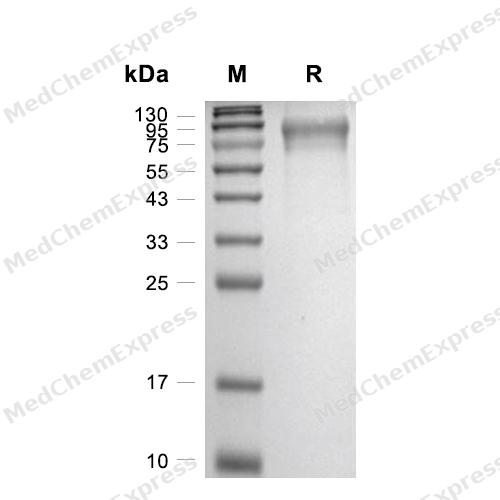
Purity - SDS-PAGE


Technical Parameters
-
Species Human
-
Source HEK293
-
Tag C-10*His
-
Accession
Q9UJA9 (P25-G429)
-
Molecular Construction
-
N-term
-
ENPP-5 (P25-G429)
Accession # Q9UJA9 -
His
-
C-term
-
-
Protein Length
Partial
-
Synonyms
ENPP5; E-NPP 5; Ectonucleotide Pyrophosphatase/Phosphodiesterase Family Member 5; NPP-5; Ectonucleotide Pyrophosphatase/Phosphodiesterase 5 (Putative); NPP5
-
AA Sequence
PDQQKVLLVSFDGFRWDYLYKVPTPHFHYIMKYGVHVKQVTNVFITKTYPNHYTLVTGLFAENHGIVANDMFDPIRNKSFSLDHMNIYDSKFWEEATPIWITNQRAGHTSGAAMWPGTDVKIHKRFPTHYMPYNESVSFEDRVAKIIEWFTSKEPINLGLLYWEDPDDMGHHLGPDSPLMGPVISDIDKKLGYLIQMLKKAKLWNTLNLIITSDHGMTQCSEERLIELDQYLDKDHYTLIDQSPVAAILPKEGKFDEVYEALTHAHPNLTVYKKEDVPERWHYKYNSRIQPIIAVADEGWHILQNKSDDFLLGNHGYDNALADMHPIFLAHGPAFRKNFSKEAMNSTDLYPLLCHLLNITAMPHNGSFWNVQDLLNSAMPRVVPYTQSTILLPGSVKPAEYDQEG
-
Molecular Weight
Approximately 81 kDa, based on SDS-PAGE under reducing conditions.
-
Glycosylation
Yes
-
Purity
≥ 95%, as determined by reducing SDS-PAGE.


Product Properties
Lyophilized powder.
Lyophilized from a 0.22 μm filtered solution of PBS, pH 7.4.
<1 EU/μg, determined by LAL method.
It is not recommended to reconstitute to a concentration less than 100 μg/mL in ddH2O. For long term storage it is recommended to add a carrier protein (0.1% BSA, 5% HSA, 10% FBS or 5% Trehalose).
Stored at -20°C for 2 years from date of receipt. After reconstitution, it is stable at 4°C for 1 week or -20°C for longer (with carrier protein). It is recommended to freeze aliquots at -20°C or -80°C for extended storage.
Room temperature in continental US; may vary elsewhere.


Documentation
-
Data Sheet (238 KB)
-
SDS (251 KB)
- English - EN (251 KB)
- Français - FR (251 KB)
- Deutsch - DE (251 KB)
- Norwegian - NO (251 KB)
- Español - ES (251 KB)
- Swedish - SV (251 KB)
- Italian - IT (251 KB)
- Korean - KR (251 KB)
- Portuguese - PT (251 KB)
-
Handling Instructions (2659 KB)

Calculators
Concentration (start) × Volume (start) = Concentration (final) × Volume (final)


 Powered by Bioz

