



FCRN-B2M Heterodimer Protein, Human (HEK293, C-His)
Based on 1 publication(s) in Google Scholar
FCGRT is an IgG Fc receptor. Fc receptor expression is up-regulated by pro-inflammatory cytokines TNF and down-regulated by IFN-γ. FCGRT plays a role in regulating IgG and serum albumin conversion. Overexpression of FCGRT is also associated with poor prognosis of tumors. FCRN-B2M Heterodimer Protein, Human (HEK293, C-His) is a recombinant protein dimer complex containing human-derived FCRN-B2M protein, expressed by HEK293 , with C-6*His labeled tag.
- Species: Human
- Source: HEK293
-
Storage:Stored at -20°C for 2 years from date of receipt. After reconstitution, it is stable at 4°C for 1 week or -20°C for longer (with carrier protein). It is recommended to freeze aliquots at -20°C or -80°C for extended storage.


To place orders, for customer services and technical support, please contact: MedChemExpress USA
Tel: 609-228-6898 E-mail: [email protected] [email protected]


-
 Biological Activity
-
Technical Parameters
-
Product Properties
- Documentation
- Help & FAQs




Biological Activity
Description
FCGRT is an IgG Fc receptor. Fc receptor expression is up-regulated by pro-inflammatory cytokines TNF and down-regulated by IFN-γ. FCGRT plays a role in regulating IgG and serum albumin conversion. Overexpression of FCGRT is also associated with poor prognosis of tumors. FCRN-B2M Heterodimer Protein, Human (HEK293, C-His) is a recombinant protein dimer complex containing human-derived FCRN-B2M protein, expressed by HEK293 , with C-6*His labeled tag.
Background
IgG receptor FcRn large subunit p51 is an IgG Fc receptor with a molecular structure similar to MHC Class I and also binds to β-2 microglobulin. In rodents, FcRn was originally thought to be a receptor that trantranks maternal immunoglobulin G (IgG) from mother to newborn offspring via breast milk and is therefore known as a neonatal Fc receptor. FcRn has also been shown to play a role in regulating IgG and serum albumin conversion, and neonatal Fc receptor expression is up-regulated by pro-inflammatory cytokines TNF and down-regulated by IFN-γ. In the acidic endosomes of endothelial and hematopoietic cells, monomer IgG binds to FcRn, circulates IgG to the cell surface, where it is released into the circulation, regulating, in addition to IgG, homeostasis of the circulating protein albumin /ALB. The up-regulated expression of FCGRT in bladder cancer may serve as a key neutrophil gene associated with poor prognosis. FCGRT overexpression was also associated with decreased PD-L1 expression and decreased tumor mutation load (TMB) level[1][2][3][4][5][6].
Verified Bioactivity
Measured by its binding ability in a functional ELISA. When Recombinant Human FCRN-B2M is immobilized at 2 µg/mL (100 µL/well)can bind Biotinylated Human IgG (HY-P73903). The ED50 for this effect is <2.5 μg/mL.
MCE Validation Data
-
Purity - SDS-PAGE
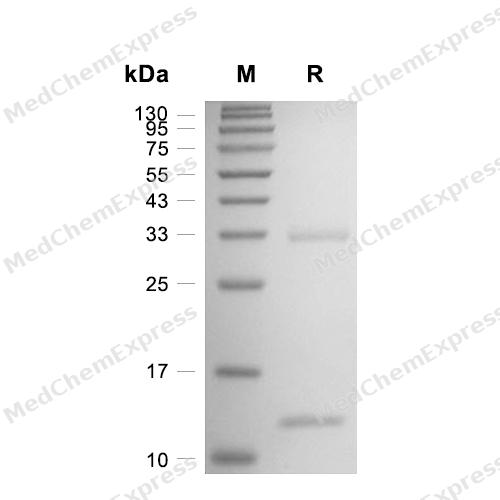
Purity - SDS-PAGE
-
Bioactivity - ELISA
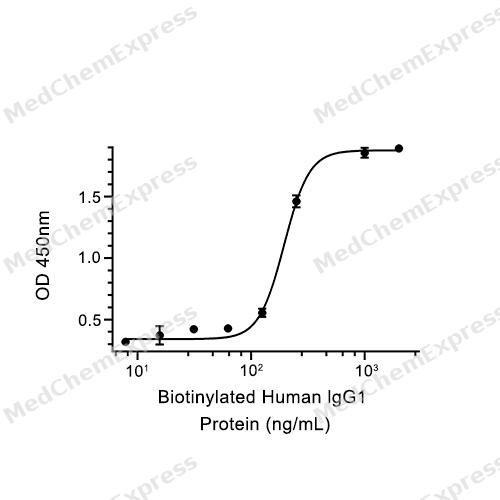
Bioactivity - ELISA


Publications (1)
-
Journal Impact Factor
-
Most Recent
-
Nat Commun
A potent broad-spectrum neutralizing antibody targeting a conserved region of the prefusion RSV F protein. [Abstract]2024 Nov 21;15(1):10085. PMID: 39572535


Technical Parameters
-
Species Human
-
Source HEK293
-
Tag C-6*His
-
Accession
AAF72596 (A24-S297)&P61769 (I21-M119)
-
Synonyms
FCGRT; Major Histocompatibility Complex Class I-Like Fc Receptor; Fc Gamma Receptor And Transporter; Neonatal Crystallizable Fc Receptor FcRn Splice Variant 6; Neonatal Fc Receptor; Neonatal Crystallizable Fc Receptor FcRn Splice Variant 5; FcRn; Neonatal Fragment Crystallizable Fc Receptor FcRn; IgG Fc Fragment Receptor Transporter Alpha Chain; Immunoglobulin Receptor, Intestinal, Heavy Chain; IgG Receptor FcRn Large Subunit P51; Neonatal Fc-Receptor For Ig; FcgammaRn; FCRN Alpha-Chain; Heavy Chain Of The Major Histocompatibility Complex Class I-Like Fc Receptor; FcRn Alpha Chain; Transmembrane Alpha Chain Of The Neonatal Receptor; Alpha-Chain; Fc Fragment Of IgG, Receptor, Transporter, Alpha; FCRN; Fc Fragment Of IgG Receptor And Transporter; B2M; Beta 2-Microglobulin; Beta-2-Microglobulin; Beta-2-Microglobin; Beta Chain Of MHC Class I Molecules; AMYLD6; Beta 2-Microglobulin Protein; MHC1D4; Human Nkt Tcr Alpha Chain; IMD43; Human Nkt Tcr Beta Chain
-
AA Sequence
A1:
AESHLSLLYHLTAVSSPAPGTPAFWVSGWLGPQQYLSYNSLRGEAEPCGAWVWENQVSWYWEKETTDLRIKEKLFLEAFKALGGKGPYTLQGLLGCELGPDNTSVPTAKFALNGEEFMNFDLKQGTWGGDWPEALAISQRWQQQDKAANKELTFLLFSCPHRLREHLERGRGNLEWKEPPSMRLKARPSSPGFSVLTCSAFSFYPPELQLRFLRNGLAAGTGQGDFGPNSDGSFHASSSLTVKSGDEHHYCCIVQHAGLAQPLRVELESPAKSS
A2:
IQRTPKIQVYSRHPAENGKSNFLNCYVSGFHPSDIEVDLLKNGERIEKVEHSDLSFSKDWSFYLLYYTEFTPTEKDEYACRVNHVTLSQPKIVKWDRDM -
Molecular Weight
Approximately 37 kDa & 13 kDa, based on SDS-PAGE under reducing conditions.
-
Glycosylation
Yes
-
Purity
≥ 95%, as determined by reducing SDS-PAGE.


Product Properties
Lyophilized powder
1.Lyophilized from a 0.22 μm filtered solution of 50 mM HEPES, 150 mM NaCl, pH 7.4.
2.Lyophilized from a 0.22 μm filtered solution of 10 mM HEPES, 100 mM KCl, 50% Glycerol, pH 7.4.
3.Lyophilized from a 0.22 μm filtered solution of PBS, pH 7.4.
4.Lyophilized from a 0.22 μm filtered solution of PBS, pH 7.4, 8% trehalose.
Please refer to the lot-specific COA for specific buffer information.
<1 EU/μg, determined by LAL method.
It is not recommended to reconstitute to a concentration less than 100 μg/mL in ddH2O. For long term storage it is recommended to add a carrier protein (0.1% BSA, 5% HSA, 10% FBS or 5% Trehalose).
Stored at -20°C for 2 years from date of receipt. After reconstitution, it is stable at 4°C for 1 week or -20°C for longer (with carrier protein). It is recommended to freeze aliquots at -20°C or -80°C for extended storage.
Room temperature in continental US; may vary elsewhere.


Documentation
-
Data Sheet (239 KB)
-
SDS (252 KB)
- English - EN (252 KB)
- Français - FR (252 KB)
- Deutsch - DE (252 KB)
- Norwegian - NO (252 KB)
- Español - ES (252 KB)
- Swedish - SV (252 KB)
- Italian - IT (252 KB)
- Korean - KR (252 KB)
- Portuguese - PT (252 KB)
-
Handling Instructions (2659 KB)

Calculators
Concentration (start) × Volume (start) = Concentration (final) × Volume (final)


 Powered by Bioz

