



Frizzled-7 Protein, Human (CHO, hFc)

Based on 1 Customer Validation
GIP Protein is a protein involved in the regulation of glucose homeostasis and insulin secretion. It plays a crucial role in modulating pancreatic beta-cell function and glucose metabolism. Dysregulation of GIP Protein has been associated with various diseases, including type 2 diabetes and obesity. Targeting GIP Protein may offer potential therapeutic interventions in these conditions by improving glucose regulation and insulin sensitivity. Frizzled-7 Protein, Human (CHO, hFc) is the recombinant human-derived Frizzled-7 protein, expressed by CHO , with C-hFc labeled tag.
- Species: Human
- Source: CHO
-
Storage:Stored at -20°C for 2 years from date of receipt. After reconstitution, it is stable at 4°C for 1 week or -20°C for longer (with carrier protein). It is recommended to freeze aliquots at -20°C or -80°C for extended storage.


To place orders, for customer services and technical support, please contact: MedChemExpress USA
Tel: 609-228-6898 E-mail: [email protected] [email protected]


-
 Biological Activity
-
Technical Parameters
-
Product Properties
- Documentation
- Help & FAQs




Biological Activity
Description
GIP Protein is a protein involved in the regulation of glucose homeostasis and insulin secretion. It plays a crucial role in modulating pancreatic beta-cell function and glucose metabolism. Dysregulation of GIP Protein has been associated with various diseases, including type 2 diabetes and obesity. Targeting GIP Protein may offer potential therapeutic interventions in these conditions by improving glucose regulation and insulin sensitivity. Frizzled-7 Protein, Human (CHO, hFc) is the recombinant human-derived Frizzled-7 protein, expressed by CHO , with C-hFc labeled tag.
Background
The Frizzled-7 (FZD7) Protein, a member of the 'frizzled' gene family, encodes a 7-transmembrane domain receptor for Wnt signaling proteins. The FZD7 protein structure includes an N-terminal signal sequence, a cysteine-rich extracellular domain with 10 cysteine residues characteristic of Fz family members, 7 putative transmembrane domains, and an intracellular C-terminal tail featuring a PDZ domain-binding motif. The expression of the FZD7 gene is implicated in potentially downregulating APC function and enhancing beta-catenin-mediated signals, particularly observed in poorly differentiated human esophageal carcinomas. This highlights FZD7's role in modulating critical cellular signaling pathways, particularly in the context of cancer progression.
Verified Bioactivity
Measured by its binding ability in a functional ELISA. Immobilized Human Frizzled-7, at 0.1μg/mL (100 μL/well) can bind Biotinylated Wnt-5a. The ED50 for this effect is 257.8 ng/mL.
MCE Validation Data
-
Purity - SDS-PAGE
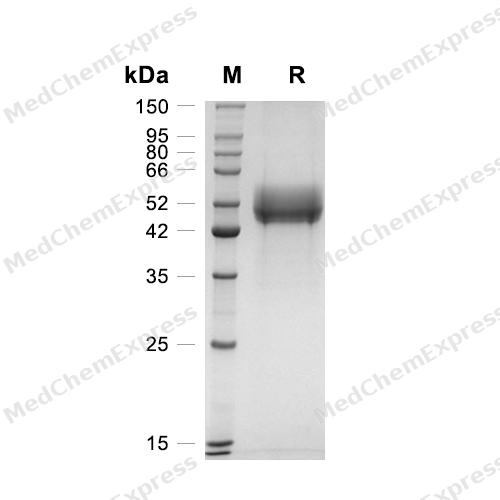
Purity - SDS-PAGE
-
Bioactivity - ELISA
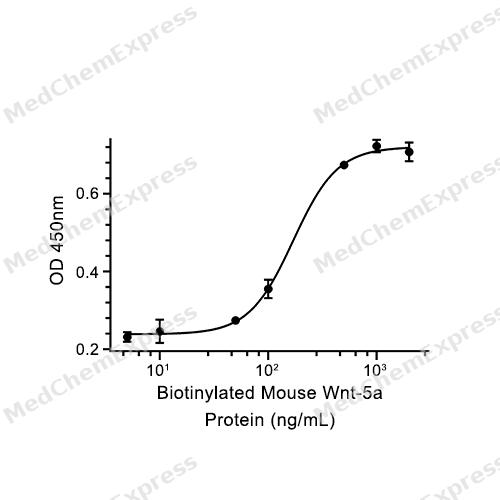
Bioactivity - ELISA


Technical Parameters
-
Species Human
-
Source CHO
-
Tag C-hFc
-
Accession
O75084/NP_003498 (Q33-L185)
-
Molecular Construction
-
N-term
-
Frizzled-7 (Q33-L185)
Accession # NP_003498 -
hFc
-
C-term
-
-
Protein Length
Partial Extracellular Domain
-
Synonyms
FZD7; Fz-7; Frizzled Class Receptor 7; HFz7; FzE3; Frizzled, Drosophila, Homolog Of, 7; Frizzled-7; Frizzled (Drosophila) Homolog 7; Frizzled 7, Seven Transmembrane Spanning Receptor; Frizzled Homolog 7 (Drosophila); Frizzled Family Receptor 7; Frizzled H
-
AA Sequence
QPYHGEKGISVPDHGFCQPISIPLCTDIAYNQTILPNLLGHTNQEDAGLEVHQFYPLVKVQCSPELRFFLCSMYAPVCTVLDQAIPPCRSLCERARQGCEALMNKFGFQWPERLRCENFPVHGAGEICVGQNTSDGSGGPGGGPTAYPTAPYL
-
Molecular Weight
Approximately 55-66 kDa, based on SDS-PAGE under reducing conditions.
-
Glycosylation
Yes
-
Purity
≥ 95%, as determined by reducing SDS-PAGE.


Product Properties
Lyophilized powder.
Lyophilized from a 0.22 μm filtered solution of 20 mM PB, 150 mM NaCl, pH 7.4.
<1 EU/μg, determined by LAL method.
It is not recommended to reconstitute to a concentration less than 200 μg/mL in ddH2O. For long term storage it is recommended to add a carrier protein (0.1% BSA, 5% HSA, 10% FBS or 5% Trehalose).
Stored at -20°C for 2 years from date of receipt. After reconstitution, it is stable at 4°C for 1 week or -20°C for longer (with carrier protein). It is recommended to freeze aliquots at -20°C or -80°C for extended storage.
Room temperature in continental US; may vary elsewhere.


Documentation
-
Data Sheet (236 KB)
-
SDS (252 KB)
- English - EN (252 KB)
- Français - FR (252 KB)
- Deutsch - DE (252 KB)
- Norwegian - NO (252 KB)
- Español - ES (252 KB)
- Swedish - SV (252 KB)
- Italian - IT (252 KB)
- Korean - KR (252 KB)
- Portuguese - PT (252 KB)
-
Handling Instructions (2659 KB)

Calculators
Concentration (start) × Volume (start) = Concentration (final) × Volume (final)


 Powered by Bioz

