



GAS6 Protein, Human (HEK293, His)
Based on 1 Customer Validation
The GAS6 protein is a ligand for AXL, TYRO3 and MER receptors and affects a variety of cellular processes.GAS6/AXL signaling promotes endothelial cell survival, aids cytokine signaling in natural killer cell development, supports liver regeneration, affects gonadotropin-releasing hormone neuron survival and migration, modulates platelet activation, and regulates thrombotic responses.GAS6 Protein, Human (HEK293, His) is the recombinant human-derived GAS6 protein, expressed by HEK293 , with C-6*His labeled tag.
- Species: Human
- Source: HEK293
-
Storage:Stored at -20°C for 2 years from date of receipt. After reconstitution, it is stable at 4°C for 1 week or -20°C for longer (with carrier protein). It is recommended to freeze aliquots at -20°C or -80°C for extended storage.


To place orders, for customer services and technical support, please contact: MedChemExpress USA
Tel: 609-228-6898 E-mail: [email protected] [email protected]


-
 Biological Activity
-
Technical Parameters
-
Product Properties
- Documentation
- Help & FAQs




Biological Activity
Description
The GAS6 protein is a ligand for AXL, TYRO3 and MER receptors and affects a variety of cellular processes.GAS6/AXL signaling promotes endothelial cell survival, aids cytokine signaling in natural killer cell development, supports liver regeneration, affects gonadotropin-releasing hormone neuron survival and migration, modulates platelet activation, and regulates thrombotic responses.GAS6 Protein, Human (HEK293, His) is the recombinant human-derived GAS6 protein, expressed by HEK293 , with C-6*His labeled tag.
Background
GAS6, a ligand for tyrosine-protein kinase receptors AXL, TYRO3, and MER, is implicated in diverse cellular processes including cell growth, survival, adhesion, and migration. GAS6/AXL signaling contributes to endothelial cell survival under acidic conditions by preventing apoptosis, facilitates optimal cytokine signaling during human natural killer cell development, plays a role in hepatic regeneration, influences gonadotropin-releasing hormone neuron survival and migration, regulates platelet activation, and modulates thrombotic responses. Additionally, in microbial infections, GAS6 can act as a bridge between virus envelope phosphatidylserine and the TAM receptor tyrosine kinase Axl, facilitating viral entry through apoptotic mimicry. This unique function extends to its involvement in the entry processes of diverse viruses, including Dengue, Vaccinia, ebolavirus, and marburgvirus, highlighting the multifaceted roles of GAS6 in cellular and infectious contexts.
Verified Bioactivity
Measured by its ability to down regulate the expression of Axl in DU145 human prostate carcinoma cells. The ED50 for this effect is 15-50 ng/mL.
MCE Validation Data
-
Purity - SDS-PAGE
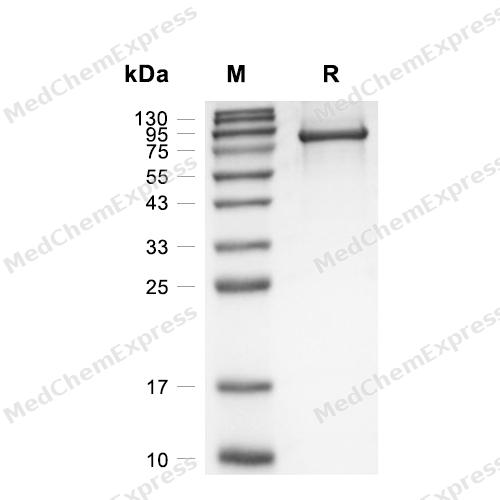
Purity - SDS-PAGE
-
Bioactivity - Cell-Based Assay
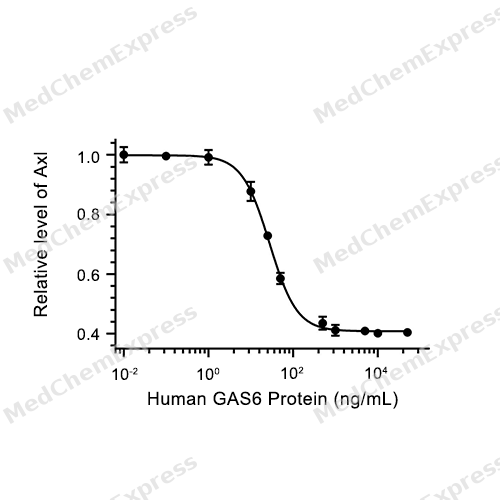
Bioactivity - Cell-Based Assay


Technical Parameters
-
Species Human
-
Source HEK293
-
Tag C-6*His
-
Accession
Q14393-2 (A31-A678)
-
Gene ID2621
-
Molecular Construction
-
N-term
-
GAS6 (A31-A678)
Accession # Q14393 -
6*His
-
C-term
-
-
Protein Length
Full Length of Isoform-2
-
Synonyms
GAS6; AXSF; Prev. AXLLG; DKFZp666G247; AXL Receptor Tyrosine Kinase Ligand; FLJ34709; Growth Arrest-Specific Protein 6; GAS-6; Growth Arrest Specific 6; AXL Stimulatory Factor
-
AA Sequence
ALLPAREATQFLRPRQRRAFQVFEEAKQGHLERECVEELCSREEAREVFENDPETDYFYPRYLDCINKYGSPYTKNSGFATCVQNLPDQCTPNPCDRKGTQACQDLMGNFFCLCKAGWGGRLCDKDVNECSQENGGCLQICHNKPGSFHCSCHSGFELSSDGRTCQDIDECADSEACGEARCKNLPGSYSCLCDEGFAYSSQEKACRDVDECLQGRCEQVCVNSPGSYTCHCDGRGGLKLSQDMDTCEDILPCVPFSVAKSVKSLYLGRMFSGTPVIRLRFKRLQPTRLVAEFDFRTFDPEGILLFAGGHQDSTWIVLALRAGRLELQLRYNGVGRVTSSGPVINHGMWQTISVEELARNLVIKVNRDAVMKIAVAGDLFQPERGLYHLNLTVGGIPFHEKDLVQPINPRLDGCMRSWNWLNGEDTTIQETVKVNTRMQCFSVTERGSFYPGSGFAFYSLDYMRTPLDVGTESTWEVEVVAHIRPAADTGVLFALWAPDLRAVPLSVALVDYHSTKKLKKQLVVLAVEHTALALMEIKVCDGQEHVVTVSLRDGEATLEVDGTRGQSEVSAAQLQERLAVLERHLRSPVLTFAGGLPDVPVTSAPVTAFYRGCMTLEVNRRLLDLDEAAYKHSDITAHSCPPVEPAAA
-
Predicted Molecular Mass
71.9 kDa
-
Molecular Weight
Approximately 75-95 kDa, based on SDS-PAGE under reducing conditions.
-
Glycosylation
Yes
-
Purity
≥ 95%, as determined by reducing SDS-PAGE.


Product Properties
Lyophilized powder
Lyophilized from a 0.22 μm filtered solution of PBS, pH 7.4, 8% trehalose.
<1 EU/μg, determined by LAL method.
It is not recommended to reconstitute to a concentration less than 100 μg/mL in ddH2O.
Stored at -20°C for 2 years from date of receipt. After reconstitution, it is stable at 4°C for 1 week or -20°C for longer (with carrier protein). It is recommended to freeze aliquots at -20°C or -80°C for extended storage.
Room temperature in continental US; may vary elsewhere.


Documentation
-
Data Sheet (240 KB)
-
SDS (252 KB)
- English - EN (252 KB)
- Français - FR (252 KB)
- Deutsch - DE (252 KB)
- Norwegian - NO (252 KB)
- Español - ES (252 KB)
- Swedish - SV (252 KB)
- Italian - IT (252 KB)
- Korean - KR (252 KB)
- Portuguese - PT (252 KB)
-
Handling Instructions (2659 KB)

Calculators
Concentration (start) × Volume (start) = Concentration (final) × Volume (final)


 Powered by Bioz

