



GITR Protein, Mouse (HEK293, His)

Based on 1 Customer Validation
GITR (TNFRSF18) is a member of the TNFR superfamily. GITR promotes T cell activation and proliferation and increases resistance to tumors and viral infections, and exacerbates autoimmune diseases and inflammation processes. GITR Protein, Mouse (HEK293, His) is a recombinant protein with a C-terminal His label and is produced in HEK293 cells.
- Species: Mouse
- Source: HEK293
-
Storage:Stored at -20°C for 2 years from date of receipt. After reconstitution, it is stable at 4°C for 1 week or -20°C for longer (with carrier protein). It is recommended to freeze aliquots at -20°C or -80°C for extended storage.


To place orders, for customer services and technical support, please contact: MedChemExpress USA
Tel: 609-228-6898 E-mail: [email protected] [email protected]


-
 Biological Activity
-
Technical Parameters
-
Product Properties
- Documentation
- References
- Help & FAQs




Biological Activity
Description
GITR (TNFRSF18) is a member of the TNFR superfamily. GITR promotes T cell activation and proliferation and increases resistance to tumors and viral infections, and exacerbates autoimmune diseases and inflammation processes[1]. GITR Protein, Mouse (HEK293, His) is a recombinant protein with a C-terminal His label and is produced in HEK293 cells.
Background
GITR is expressed on regulatory T cells (Tregs) and some activated immune cells, including effector T lymphocytes, nature killer (NK) cells, and neutrophils[1].
The amino acid sequence of human GITR protein has low homology for mouse GITR protein.
GITR does not have any enzymatic activity and signaling is propagated via recruiting TRAF-family members, specifically TRAF1, TRAF2 and TRAF5, to the GITR-signaling complex. The signaling is then mediated through NF-kB and MAPK pathways. GITR does not have any enzymatic activity and signaling is propagated via recruiting TRAF-family members, specifically TRAF1, TRAF2 and TRAF5, to the GITR-signaling complex. The signaling is then mediated through NF-kB and MAPK pathways, protecting T cells from TCR activation-induced cell death[2].
GITR (Glucocorticoid-induced TNFR-related protein, also known as TNFRSF18) is a type I transmembrane protein. GITR stimulates the proliferation of effector T-lymphocytes and partially reverses the immunosuppressive function of CD4+CD25+ Tregs[1]. GITR is activated by its ligand GITRL (TNFSF18). GITR induces NOS in murine macrophage in a time and dose-dependent manner[3]. GITR inhibits Multiple Myeloma (MM) cell proliferation in vitro and in vivo and induces apoptosis[4].
In Vitro
GITR (mouse; .1, .1, .2, .5 µg/mL; -46 h) increases the generation of nitric oxide in a dose and time-dependent manner in mouse macrophage RAW 264.7 cells[3].
In Vivo
GITR overexpressing cells are injected into SCID-bg mice via tail, showing a significant reduction of growth of MM cells in mice after 4 weeks in bone marrow tissues[4].
Verified Bioactivity
Measured by its binding ability in a functional ELISA. Immobilized Mouse GITR at 2 μg/mL (100 μL/well) can bind Biotinylated Human GITR Ligand. The ED50 for this effect is 16.44 ng/mL.
MCE Validation Data
-
Purity - SDS-PAGE
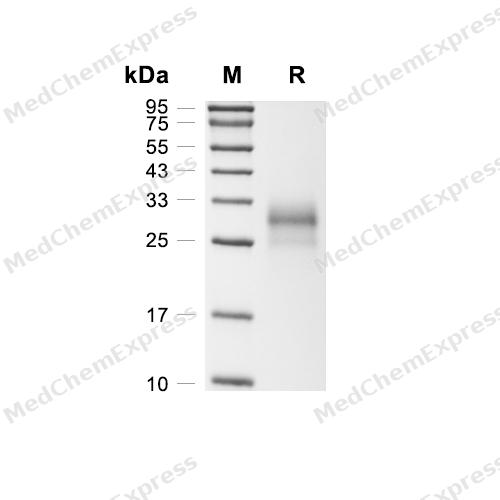
Purity - SDS-PAGE
-
Bioactivity - ELISA
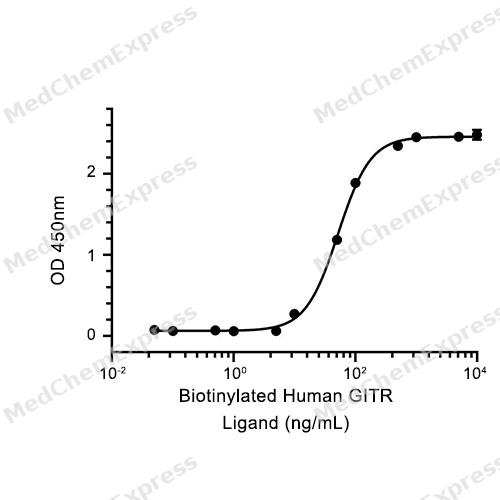
Bioactivity - ELISA


Technical Parameters
-
Species Mouse
-
Source HEK293
-
Tag C-6*His
-
Accession
O35714-1/NP_033426.1 (S22-Q150)
-
Molecular Construction
-
N-term
-
GITR?Protein, Mouse (HEK293, His) (S22-Q150)
Accession # O35714-1/NP_033426.1 -
His
-
C-term
-
-
Protein Length
Extracellular Domain
-
Synonyms
TNFRSF18; Glucocorticoid-Induced TNFR-Related Protein; TNF Receptor Superfamily Member 18; Activation-Inducible TNFR Family Receptor; AITR; Tumor Necrosis Factor Receptor Superfamily Member 18 Isoform 4; GITR; TNF Receptor Superfamily Activation-Inducible
-
AA Sequence
SVVEEPGCGPGKVQNGSGNNTRCCSLYAPGKEDCPKERCICVTPEYHCGDPQCKICKHYPCQPGQRVESQGDIVFGFRCVACAMGTFSAGRDGHCRLWTNCSQFGFLTMFPGNKTHNAVCIPEPLPTEQ
-
Predicted Molecular Mass
14 kDa
-
Molecular Weight
Approximately 28-33 kDa, based on SDS-PAGE under reducing conditions, due to the glycosylation.
-
Glycosylation
Yes
-
Purity
≥ 95%, as determined by reducing SDS-PAGE.


Product Properties
Lyophilized powder.
Lyophilized from a 0.22 μm filtered solution of PBS, pH 7.4.
<1 EU/μg, determined by LAL method.
It is not recommended to reconstitute to a concentration less than 100 μg/mL in ddH2O. For long term storage it is recommended to add a carrier protein (0.1% BSA, 5% HSA, 10% FBS or 5% Trehalose).
Stored at -20°C for 2 years from date of receipt. After reconstitution, it is stable at 4°C for 1 week or -20°C for longer (with carrier protein). It is recommended to freeze aliquots at -20°C or -80°C for extended storage.
Room temperature in continental US; may vary elsewhere.


Documentation
-
Data Sheet (264 KB)
-
SDS (251 KB)
- English - EN (251 KB)
- Français - FR (251 KB)
- Deutsch - DE (251 KB)
- Norwegian - NO (251 KB)
- Español - ES (251 KB)
- Swedish - SV (251 KB)
- Italian - IT (251 KB)
- Korean - KR (251 KB)
- Portuguese - PT (251 KB)
-
Handling Instructions (2659 KB)


References
[1]. Tian J, et al. The Role of GITR/GITRL Interaction in Autoimmune Diseases. Front Immunol. 2020 Oct 9;11:588682. [Content Brief]
[2]. Krausz LT, et al. GITR-GITRL system, a novel player in shock and inflammation. ScientificWorldJournal. 2007 May 1;7:533-66. [Content Brief]
[3]. Shin HH, et al. Recombinant glucocorticoid induced tumor necrosis factor receptor (rGITR) induces NOS in murine macrophage. FEBS Lett. 2002 Mar 13;514(2-3):275-80. [Content Brief]
[4]. Liu Y, et al. Novel tumor suppressor function of glucocorticoid-induced TNF receptor GITR in multiple myeloma. PLoS One. 2013 Jun 13;8(6):e66982. [Content Brief]

Calculators
Concentration (start) × Volume (start) = Concentration (final) × Volume (final)


 Powered by Bioz

