



HSPA8/HSC70 Protein, Human (His)
Based on 3 publication(s) in Google Scholar
HSPA8/HSC70 is a molecular chaperone that protects the proteome and aids in peptide folding, transport, chaperone-mediated autophagy, and protein complex regulation. It is central to quality control, ensuring correct folding and targeting misfolded proteins for degradation through ATP-dependent cycles. HSPA8/HSC70 Protein, Human (His) is the recombinant human-derived HSPA8/HSC70 protein, expressed by E. coli , with N-6*His labeled tag.
- Species: Human
- Source: E. coli
-
Storage:Stored at -20°C for 2 years from date of receipt. After reconstitution, it is stable at 4°C for 1 week or -20°C for longer (with carrier protein). It is recommended to freeze aliquots at -20°C or -80°C for extended storage.


To place orders, for customer services and technical support, please contact: MedChemExpress USA
Tel: 609-228-6898 E-mail: [email protected] [email protected]


-
 Biological Activity
-
Technical Parameters
-
Product Properties
- Documentation
- Help & FAQs




Biological Activity
Description
HSPA8/HSC70 is a molecular chaperone that protects the proteome and aids in peptide folding, transport, chaperone-mediated autophagy, and protein complex regulation. It is central to quality control, ensuring correct folding and targeting misfolded proteins for degradation through ATP-dependent cycles. HSPA8/HSC70 Protein, Human (His) is the recombinant human-derived HSPA8/HSC70 protein, expressed by E. coli , with N-6*His labeled tag.
Background
HSPA8/HSC70, a molecular chaperone, is intricately involved in diverse cellular processes, including proteome protection from stress, facilitation of polypeptide folding and transport, chaperone-mediated autophagy, activation of misfolded protein proteolysis, and modulation of protein complex formation and dissociation. Central to the protein quality control system, it ensures correct protein folding, refolding of misfolded proteins, and regulates protein targeting for subsequent degradation. This function is orchestrated through cycles of ATP binding, ATP hydrolysis, and ADP release, facilitated by co-chaperones. The nucleotide-bound state of HSP70 regulates its affinity for polypeptides, with ATP-bound form having low substrate affinity, and a conformational change upon ATP hydrolysis increasing the affinity for substrates. Co-chaperones, including J-domain co-chaperones (HSP40s), nucleotide exchange factors (NEFs) such as BAG1/2/3, and TPR domain chaperones like HOPX and STUB1, play specific roles in modulating HSP70 activity. Beyond its fundamental role in mitochondrial import, HSPA8/HSC70 also acts as a repressor of transcriptional activation, participates in the spliceosome assembly, and plays a role in selective protein degradation processes, including chaperone-mediated autophagy and ER-associated degradation. Additionally, it interacts with the VGF-derived peptide TLQP-21, indicating its involvement in diverse cellular pathways.
Verified Bioactivity
1.HSC70 has ATPase activity at the time of manufacture of 13.173 µM phosphate liberated/h/µg protein in a 200µL reaction at 37°C in the presence of 10 µL of 4 mM ATP using a Malachite Green assay.
2.Measured by its ability to catalyze 25 µM ATP substrate at room temperature for 10 minutes. The specific activity is 7.016 μM/h/μg.
MCE Validation Data
-
Purity - SDS-PAGE
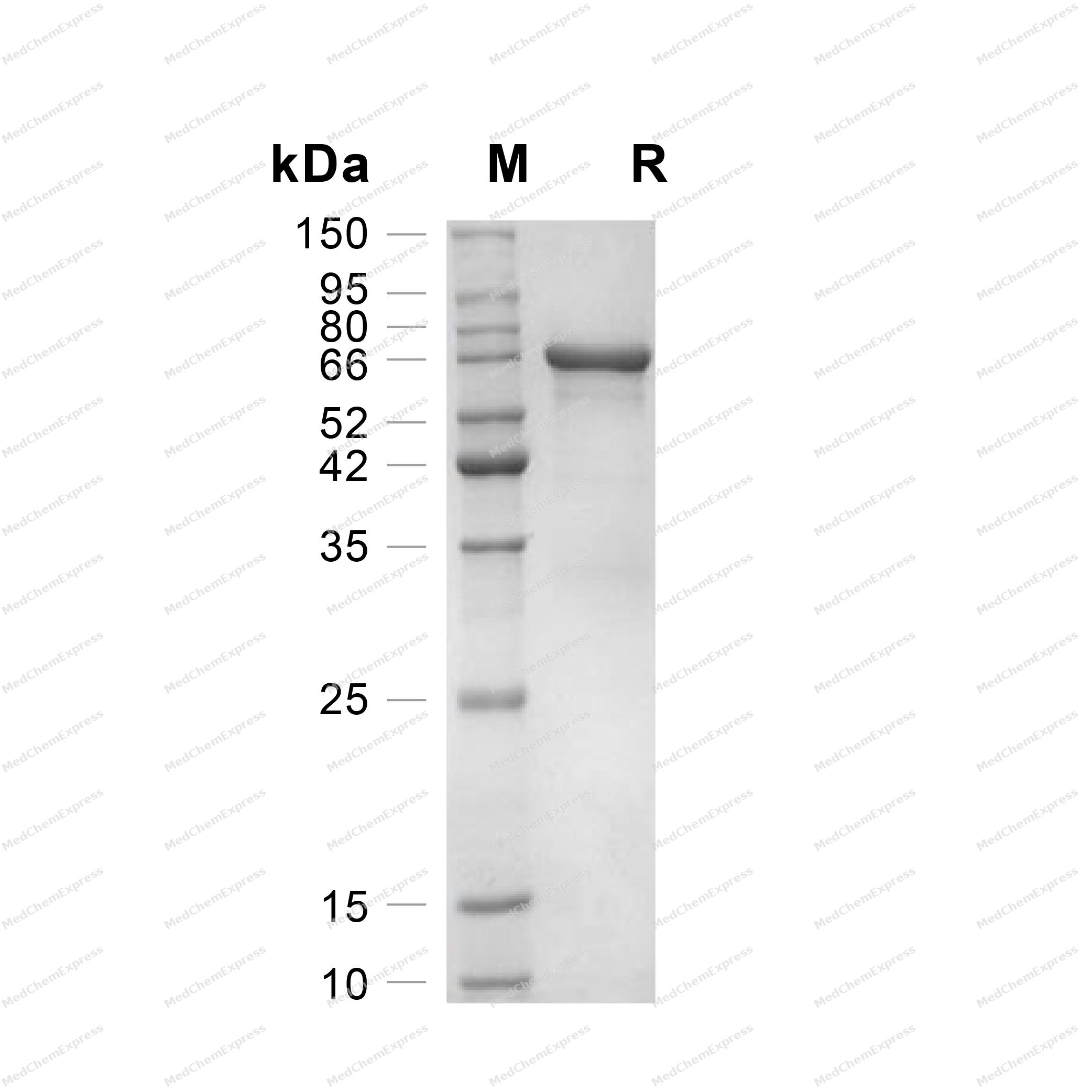
Purity - SDS-PAGE

Assay Procedure
Materials
Target Protein: HSPA8/HSC70 Protein, Human (His) (HY-P73915A)
Kinase-LumiTM Enhanced Chemiluminescent Kinase Activity Assay Kit
Procedure
1. Take out the reagents from the Kinase-LumiTM Enhanced Chemiluminescent Kinase Activity Assay Kit and equilibrate to room temperature.
2. Preparation of standard: Prepare ATP standard solution with ddH2O to the concentrations of 0, 0.195, 0.39, 0.78, 1.5625, 3.125, 6.25, 12.5, 25, 50 μM. Add 50 μL per well to a 96?well plate.
3. Dissolve the protein with ddH2O to 1000 μg/mL, then dilute to 200 μg/mL.
Test group: 25 μL of 200 μg/mL HSPA8 protein + 25 μL of 50 μM ATP.
Blank group: 25 μL ddH2O + 25 μL of 50 μM ATP.
Add the mixtures into the 96?well plate after preparation.
4. Add 50 μL of Kinase-LumiTM Enhanced Chemiluminescent Kinase Detection Reagent to each well, mix well, and incubate at room temperature for 10 minutes.
5. Detect the chemiluminescence signal under Luminescence mode with a microplate reader.
6. Calculate specific activity:
Specific Activity (μM/μg/h) = | Adjusted [ATP]* (μM) |
| amount of enzyme (μg) x Time (h) |
*Adjusted for Blank Control


Publications (3)
-
Journal Impact Factor
-
Most Recent
-
Mol Neurodegener
In vivo profiling of astrocyte secretome reveals brain-region specific regulatory networks in a mouse model of amyloid pathology. [Abstract]2026 May 23. PMID: 42177534 -
Adv Sci (Weinh)
Targeting the HSPA8-CMA-ATP6V1A Axis Triggers Lysosomal Hyperacidification and Catastrophic Vacuolation in Prostate Cancer. [Abstract]2026 Jun 19:e76165. PMID: 42318659 -


Technical Parameters
-
Species Human
-
Source E. coli
-
Tag N-6*His
-
Accession
P11142-1 (M1-D646)
-
Gene ID3312
-
Molecular Construction
-
N-term
-
6*His
-
HSPA8 (M1-D646)
Accession # P11142-1 -
C-term
-
-
Protein Length
Full Length of Isoform-1
-
Synonyms
HSPA8; Epididymis Secretory Sperm Binding Protein Li 72p; Prev. HSPA10; Constitutive Heat Shock Protein 70; HSC70; Epididymis Luminal Protein 33; HSP73; Heat Shock Cognate Protein 54; Heat Shock Cognate 71 KDa Protein; Heat Shock 70kd Protein 10; HSC71; H
-
AA Sequence
MSKGPAVGIDLGTTYSCVGVFQHGKVEIIANDQGNRTTPSYVAFTDTERLIGDAAKNQVAMNPTNTVFDAKRLIGRRFDDAVVQSDMKHWPFMVVNDAGRPKVQVEYKGETKSFYPEEVSSMVLTKMKEIAEAYLGKTVTNAVVTVPAYFNDSQRQATKDAGTIAGLNVLRIINEPTAAAIAYGLDKKVGAERNVLIFDLGGGTFDVSILTIEDGIFEVKSTAGDTHLGGEDFDNRMVNHFIAEFKRKHKKDISENKRAVRRLRTACERAKRTLSSSTQASIEIDSLYEGIDFYTSITRARFEELNADLFRGTLDPVEKALRDAKLDKSQIHDIVLVGGSTRIPKIQKLLQDFFNGKELNKSINPDEAVAYGAAVQAAILSGDKSENVQDLLLLDVTPLSLGIETAGGVMTVLIKRNTTIPTKQTQTFTTYSDNQPGVLIQVYEGERAMTKDNNLLGKFELTGIPPAPRGVPQIEVTFDIDANGILNVSAVDKSTGKENKITITNDKGRLSKEDIERMVQEAEKYKAEDEKQRDKVSSKNSLESYAFNMKATVEDEKLQGKINDEDKQKILDKCNEIINWLDKNQTAEKEEFEHQQKELEKVCNPIITKLYQSAGGMPGGMPGGFPGGGAPPSGGASSGPTIEEVD
-
Predicted Molecular Mass
71.7 kDa
-
Molecular Weight
Approximately 64 kDa, based on SDS-PAGE under reducing conditions.
-
Purity
≥ 95%, as determined by reducing SDS-PAGE.


Product Properties
Lyophilized powder
Lyophilized from a 0.2 μm filtered solution of 20 mM PB, 150 mM NaCl, pH 7.4 or PBS, pH 7.4, 8% trehalose.
<1 EU/μg, determined by LAL method.
It is not recommended to reconstitute to a concentration less than 100 μg/mL in ddH2O. For long term storage it is recommended to add a carrier protein (0.1% BSA, 5% HSA, 10% FBS or 5% Trehalose).
Stored at -20°C for 2 years from date of receipt. After reconstitution, it is stable at 4°C for 1 week or -20°C for longer (with carrier protein). It is recommended to freeze aliquots at -20°C or -80°C for extended storage.
Room temperature in continental US; may vary elsewhere.


Documentation
-
Data Sheet (240 KB)
-
SDS (251 KB)
- English - EN (251 KB)
- Français - FR (251 KB)
- Deutsch - DE (251 KB)
- Norwegian - NO (251 KB)
- Español - ES (251 KB)
- Swedish - SV (251 KB)
- Italian - IT (251 KB)
- Korean - KR (251 KB)
- Portuguese - PT (251 KB)
-
Handling Instructions (2659 KB)

Calculators
Concentration (start) × Volume (start) = Concentration (final) × Volume (final)


 Powered by Bioz

