



HVEM/TNFRSF14 Protein, Human (HEK293, His)

Based on 1 Customer Validation
HVEM (herpes virus entry mediator, TNFRSF14, CD270) is a member of the tumor necrosis factor receptor superfamily (TNFRSF). HVEM is a bidirectional molecular switch that transduces positive and negative signals. HVEM can deliver proinflammatory and survival signals when engaged by BTLA or LIGHT, stimulating lymphocyte proliferation, activation, and inducing inflammatory reactions. While, HVEM binds to CD160 and BTLA, inhibiting T- and B-lymphocyte activation and proliferation. HVEM/TNFRSF14 Protein, Human (HEK293, His) is a recombinant protein with a C-Terminal His label, It is produced in HEK293 cells.
- Species: Human
- Source: HEK293
-
Storage:Stored at -20°C for 2 years from date of receipt. After reconstitution, it is stable at 4°C for 1 week or -20°C for longer (with carrier protein). It is recommended to freeze aliquots at -20°C or -80°C for extended storage.


To place orders, for customer services and technical support, please contact: MedChemExpress USA
Tel: 609-228-6898 E-mail: [email protected] [email protected]


-
 Biological Activity
-
Technical Parameters
-
Product Properties
- Documentation
- References
- Help & FAQs




Biological Activity
Description
HVEM (herpes virus entry mediator, TNFRSF14, CD270) is a member of the tumor necrosis factor receptor superfamily (TNFRSF). HVEM is a bidirectional molecular switch that transduces positive and negative signals. HVEM can deliver proinflammatory and survival signals when engaged by BTLA or LIGHT, stimulating lymphocyte proliferation, activation, and inducing inflammatory reactions. While, HVEM binds to CD160 and BTLA, inhibiting T- and B-lymphocyte activation and proliferation[2][3]. HVEM/TNFRSF14 Protein, Human (HEK293, His) is a recombinant protein with a C-Terminal His label, It is produced in HEK293 cells.
Background
HVEM is widely expressed in a range of hematopoietic cells, including B cells, T cells, NK cells, monocytes and immature dendritic cells, and several non-hematopoietic cells and tissues, including the liver, kidney and lung[1].
The amino acid sequence of human HVEM protein has low homology for mouse HVEM protein.
HVEM is known as the “molecular switch” models of activation and inhibition. HVEM provides an inhibitory or activating signal and bi-directionally regulates host immune function. HVEM binds to LIGHT or LIGHT-α exerts a positive stimulatory effect, stimulating lymphocyte proliferation, activation, and inducing inflammatory reactions; thus, providing a second stimulatory signal for T cell activation. Besides, the Binding of HVEM to BTLA and CD160 exerts an adverse regulatory effect, promoting signal transduction through the ERK1/2 and PI3K (phosphatidylinositol 3-kinase)–AKT (protein kinase B (PKB)) pathways, leading to the production of IFNγ, inhibiting T- and B-lymphocyte activation and proliferation and binding of HVEM to HSV-gD, which can promote HSV infection in target cells[2][3].
HVEM is considered to be a molecular switch for immune responses, HVEM induces DCs to produce IL-10 and shows protection against experimental autoimmune myocarditis (EAM) caused by myosin[4].
Verified Bioactivity
Measured by its ability to inhibit TNF-beta -mediated cytotoxicity using L 929 mouse fibroblast cells. The ED50 for this effect is 4.180 μg/mL in the presence of 50 pg/mL of Recombinant Human TNF-beta, corresponding to a specific activity is 239.2344 units/mg.
MCE Validation Data
-
Bioactivity - Cell-Based Assay
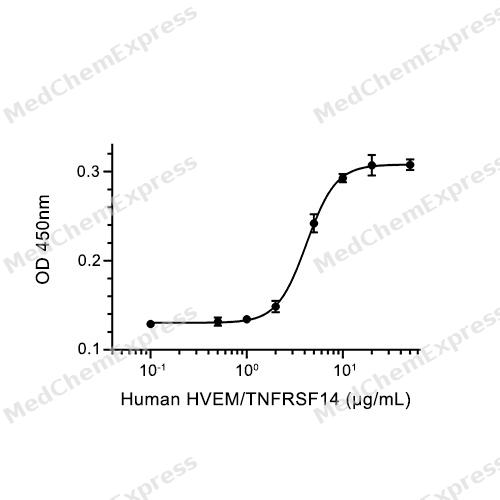
Bioactivity - Cell-Based Assay


Technical Parameters
-
Species Human
-
Source HEK293
-
Tag C-6*His
-
Accession
Q92956-1 (L39-V202)
-
Protein Length
Extracellular Domain
-
Synonyms
TNFRSF14; Herpes Virus Entry Mediator A; TNF Receptor Superfamily Member 14; Tumor Necrosis Factor Receptor Superfamily, Member 14; HVEM; Tumor Necrosis Factor Receptor-Like Gene2; HVEA; Tumor Necrosis Factor Receptor-Like 2; TR2; Herpesvirus Entry Mediator A; LIGHTR; Herpesvirus Entry Mediator; CD270; CD40-Like Protein; ATAR; CD270 Antigen; Tumor Necrosis Factor Receptor Superfamily, Member 14 (Herpesvirus Entry Mediator); HveA; Tumor Necrosis Factor Receptor Superfamily Member 14
-
AA Sequence
LPSCKEDEYPVGSECCPKCSPGYRVKEACGELTGTVCEPCPPGTYIAHLNGLSKCLQCQMCDPAMGLRASRNCSRTENAVCGCSPGHFCIVQDGDHCAACRAYATSSPGQRVQKGGTESQDTLCQNCPPGTFSPNGTLEECQHQTKCSWLVTKAGAGTSSSHWV
-
Predicted Molecular Mass
18.4 kDa
-
Molecular Weight
Approximately 22-45 kDa, based on SDS-PAGE under reducing conditions, due to the glycosylation.
-
Glycosylation
Yes
-
Purity
≥ 95%, as determined by reducing SDS-PAGE.


Product Properties
Lyophilized powder.
Lyophilized from a 0.22 μm filtered solution of PBS, pH 7.4.
<1 EU/μg, determined by LAL method.
It is not recommended to reconstitute to a concentration less than 100 μg/mL in ddH2O. For long term storage it is recommended to add a carrier protein (0.1% BSA, 5% HSA, 10% FBS or 5% Trehalose).
Stored at -20°C for 2 years from date of receipt. After reconstitution, it is stable at 4°C for 1 week or -20°C for longer (with carrier protein). It is recommended to freeze aliquots at -20°C or -80°C for extended storage.
Room temperature in continental US;may vary elsewhere.


Documentation
-
Data Sheet (264 KB)
-
SDS (251 KB)
- English - EN (251 KB)
- Français - FR (251 KB)
- Deutsch - DE (251 KB)
- Norwegian - NO (251 KB)
- Español - ES (251 KB)
- Swedish - SV (251 KB)
- Italian - IT (251 KB)
- Korean - KR (251 KB)
- Portuguese - PT (251 KB)
-
Handling Instructions (2659 KB)


References
[1]. Ma B, et al. High expression of HVEM is associated with improved prognosis in intrahepatic cholangiocarcinoma. Oncol Lett. 2021 Jan;21(1):69. [Content Brief]
[2]. Yu X, et al. BTLA/HVEM Signaling: Milestones in Research and Role in Chronic Hepatitis B Virus Infection. Front Immunol. 2019 Mar 29;10:617. [Content Brief]
[3]. Rodriguez-Barbosa JI, et al. HVEM, a cosignaling molecular switch, and its interactions with BTLA, CD160 and LIGHT. Cell Mol Immunol. 2019 Jul;16(7):679-682. [Content Brief]
[4]. Cai G, et al. Amelioration of myocarditis by HVEM-overexpressing dendritic cells through induction of IL-10-producing cells. Cardiovasc Res. 2009 Dec 1;84(3):425-33. [Content Brief]

Calculators
Concentration (start) × Volume (start) = Concentration (final) × Volume (final)


 Powered by Bioz

