



IL-19 Protein, Mouse
Based on 2 publication(s) in Google Scholar
IL-19 Protein, Mouse is a member of the Interleukin-10 family. The biological functions and clinical implications of Interleukin-19 is still undefined.
- Species: Mouse
- Source: E. coli
-
Storage:Stored at -20°C for 2 years from date of receipt. After reconstitution, it is stable at 4°C for 1 week or -20°C for longer (with carrier protein). It is recommended to freeze aliquots at -20°C or -80°C for extended storage.


To place orders, for customer services and technical support, please contact: MedChemExpress USA
Tel: 609-228-6898 E-mail: [email protected] [email protected]


-
 Biological Activity
-
Technical Parameters
-
Product Properties
- Documentation
- References
- Help & FAQs




Biological Activity
Description
IL-19 Protein, Mouse is a member of the Interleukin-10 family. The biological functions and clinical implications of Interleukin-19 is still undefined.
Background
IL-19 shares 21% amino acid identity with IL-10. The exon/intron structure of IL-19 is similar to that of the human IL-10 gene, comprising five exons and four introns within the coding region of the IL-19 cDNA. IL-19 does not bind or signal through the canonical IL-10 receptor complex[1]. IL-19 functions through a receptor complex composed of IL-20Ra and IL20Rb that is also utilized by IL-20 and IL-24. IL19 has been shown to enhance the production of Th2 cytokines in Tcells and to be elevated in asthma patients. Furthermore, it induces IL-6, IL-8 and IL-10 expression in monocytes. Additionally, it has been implicated in a range of diseases and disorders, including aging, Type-I diabetes, endotoxic shock, periodontal disease, vascular disease and rheumatoid arthritis[2].
Verified Bioactivity
The ED50 is <50 ng/mL as measured by MCF-7 cells, corresponding to a specific activity of >2.0 × 10⁴ units/mg.
MCE Validation Data
-
Purity - SDS-PAGE
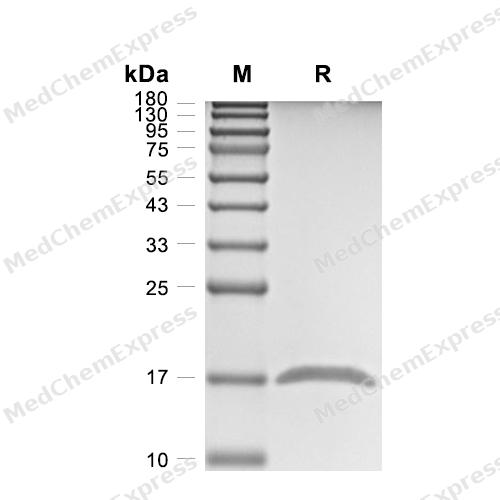
Purity - SDS-PAGE
-
Bioactivity - Cell-Based Assay
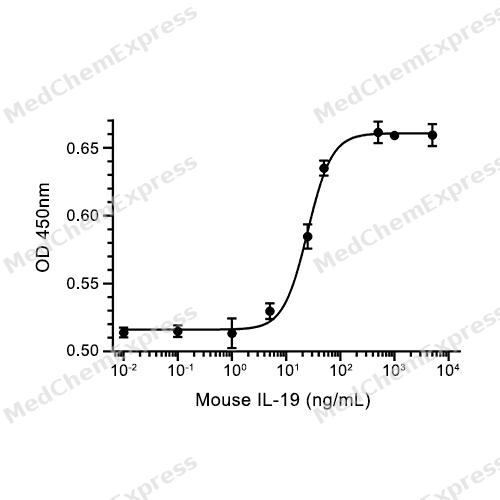
Bioactivity - Cell-Based Assay


Publications (2)
-
Journal Impact Factor
-
Most Recent
-
Virulence
The dual pathogenic role of IL-24 in sepsis: Coupling bacterial dissemination with inflammatory amplification as a therapeutic target. [Abstract]2026 Dec;17(1):2673266. PMID: 42228927 -


Technical Parameters
-
Species Mouse
-
Source E. coli
-
Tag Tag Free
-
Accession
Q8CJ70 (L25-A176)
-
Molecular Construction
-
N-term
-
IL-19 (L25-A176)
Accession # Q8CJ70 -
C-term
-
-
Protein Length
Full Length of Mature Protein
-
Synonyms
IL19; IL-19; Interleukin 19; MDA1; ZMDA1; Melanoma Differentiation Associated Protein-Like Protein; NG.1; Interleukin-19; IL-10C; Melanoma Differentiation-Associated Protein-Like Protein
-
AA Sequence
LRRCLISVDMRLIEKSFHEIKRAMQTKDTFKNVTILSLENLRSIKPGDVCCMTNNLLTFYRDRVFQDHQERSLEVLRRISSIANSFLCVQKSLERCQVHRQCNCSQEATNATRIIHDNYNQLEVSSAALKSLGELNILLAWIDRNHLETPAA
-
Molecular Weight
Approximately 18 kDa, based on SDS-PAGE under reducing conditions.
-
Purity
≥ 95%, as determined by reducing SDS-PAGE.


Product Properties
Lyophilized powder.
1.Lyophilized from a 0.22 μm filtered solution of 50 mM acetic acid.
2.Lyophilized from a 0.22 μm filtered solution of PBS, pH 7.4, 8% trehalose.
Please refer to the lot-specific COA for specific buffer information.
<0.2 EU/μg, determined by LAL method.
Reconstitute the lyophilized powder up to 50 μg/mL in 50 mM acetic acid. For long term storage it is recommended to add a carrier protein (0.1% BSA, 5% HSA, 10% FBS or 5% Trehalose).
Stored at -20°C for 2 years from date of receipt. After reconstitution, it is stable at 4°C for 1 week or -20°C for longer (with carrier protein). It is recommended to freeze aliquots at -20°C or -80°C for extended storage.
Room temperature in continental US; may vary elsewhere.


Documentation
-
Data Sheet (263 KB)
-
SDS (252 KB)
- English - EN (252 KB)
- Français - FR (252 KB)
- Deutsch - DE (252 KB)
- Norwegian - NO (252 KB)
- Español - ES (252 KB)
- Swedish - SV (252 KB)
- Italian - IT (252 KB)
- Korean - KR (252 KB)
- Portuguese - PT (252 KB)
-
Handling Instructions (2659 KB)


References
[1]. IL-19 shares 21% amino acid identity with IL-10. The exon/intron structure of IL-19 is similar to that of the human IL-10 gene, comprising five exons and four introns within the coding region of the IL-19 cDNA. IL-19 does not bind or signal through the canonical IL-10 receptor complex[1]. IL-19 functions through a receptor complex composed of IL-20Ra and IL20Rb that is also utilized by IL-20 and IL-24. IL19 has been shown to enhance the production of Th2 cytokines in Tcells and to be elevated in asthma patients. Furthermore, it induces IL-6, IL-8 and IL-10 expression in monocytes. Additionally, it has been implicated in a range of diseases and disorders, including aging, Type-I diabetes, endotoxic shock, periodontal disease, vascular disease and rheumatoid arthritis[2]. [Content Brief]
[2]. Gallagher G, et al. Interleukin-19: multiple roles in immune regulation and disease. Cytokine Growth Factor Rev. 2010 Oct;21(5):345-52. [Content Brief]

Calculators
Concentration (start) × Volume (start) = Concentration (final) × Volume (final)


 Powered by Bioz

