



IL-27 Protein, Human (CHO, His)
Based on 1 Customer Validation
IL-27 (Interleukin-27) is a heterodimeric cytokine of the IL-12 family, composed of two subunits, EBI3 (Epstein-Barr-virus-induced molecule 3) and p28. IL-27 enhances the development, proliferation, and cytotoxic activity of CD8+ T cells, thereby indirectly promoting anti-tumor immunity[ 2]. IL-27 Protein, Human (CHO, His) is a recombinant protein with a His label that consists of two subunits, EBI3 (IL27B) (229 amino acids (M1-K229)) and IL27A (214 amino acids (F29-P243)), is produced by CHO cells.
- Species: Human
- Source: CHO
-
Storage:Stored at -20°C for 2 years from date of receipt. After reconstitution, it is stable at 4°C for 1 week or -20°C for longer (with carrier protein). It is recommended to freeze aliquots at -20°C or -80°C for extended storage.


To place orders, for customer services and technical support, please contact: MedChemExpress USA
Tel: 609-228-6898 E-mail: [email protected] [email protected]


-
 Biological Activity
-
Technical Parameters
-
Product Properties
- Documentation
- References
- Help & FAQs




Biological Activity
Description
IL-27 (Interleukin-27) is a heterodimeric cytokine of the IL-12 family, composed of two subunits, EBI3 (Epstein-Barr-virus-induced molecule 3) and p28[1]. IL-27 enhances the development, proliferation, and cytotoxic activity of CD8+ T cells, thereby indirectly promoting anti-tumor immunity[ 2]. IL-27 Protein, Human (CHO, His) is a recombinant protein with a His label that consists of two subunits, EBI3 (IL27B) (229 amino acids (M1-K229)) and IL27A (214 amino acids (F29-P243)), is produced by CHO cells.
Background
IL-27 is mainly produced by cells of myeloid origin such as monocytes, macrophages, dendritic cells, and microglial cells, in response to stimuli acting through Toll-like receptors or TNF-R-family members[3].
The amino acid sequence of human IL-27 protein has low homology for mouse IL-27 protein.
IL-27 acts through a heterodimer receptor consisting of IL-27Rα (WSX1) and gp130 chains, activates the JAK/STAT signaling pathway, which mainly involves STAT1 and STAT3 phosphorylation. STAT3 activation by IL-27 induces the expression of SOCS3, which inhibits further IL-27 signaling in a negative feedback loop, through inhibition of JAK activity[3].
IL-27 plays multiple roles in proinflammatory and anti-inflammatory immune responses. IL-27 enhances NF-κB/AP-1 activity and increases IL-12p40, TNF-α, and IL-6 production, increases TLR4 and TLR5 expression[5]. IL-27 exerts inhibitory effects upon hPMSC adherence and proliferation, and promotes migration of hPMSCs. Besides, IL-27 can upregulate PDL1 expression and enhance the regulatory effects of hPMSCs on Th1 and Th2 cell differentiations and IL-10 secretion from CD4+T cells[6]. IL-27 induces the proliferation and differentiation in hematopoietic stem cells[7]. IL-27 increases IL-10 levels and the expression of p-STAT1, p-STAT3[8]. IL-27 promotes the development and differentiation of CD4+IL-10+ T cells[9].
In Vitro
IL-27 (human) (5 ng/mL; 24 h) enhances LPS-induced IL-12p4, TNF-α, and IL-6 production in THP-1 and PMA-THP-1 cells[5].
IL-27 (human) (5 ng/mL; 16 h) increases TLR4 and TLR5 expression in monocytes and macrophages[5].
IL-27 (human) (2, 3 ng/mL; 6, 12, 24 h) significantly inhibits cell proliferation, adherence and promotes migration in hPMSCs, increases IL-1 secretion from CD4+T cells, and upregulates PDL1 expression via the JAK/STAT1 pathway[6].
IL-27 (human) (.1, 1, 1, 1 ng/mL; 9 days) enhances proliferation and differentiation of human CD34+ cells[7].
Verified Bioactivity
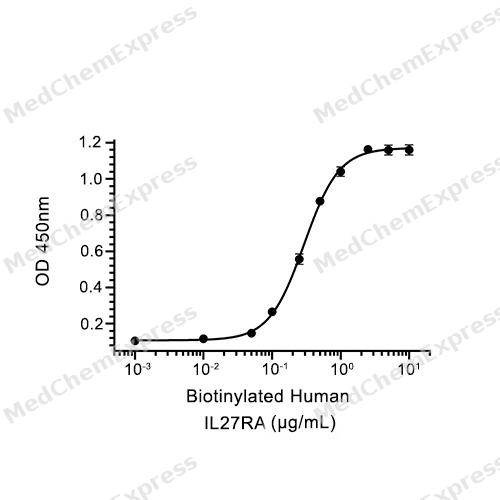
1. Measured by its binding ability in a functional ELISA. Immobilized human IL27-His at 10 μg/mL (100 μl/well) can bind human IL27RA-Fc, The EC50 of human IL27RA-Fc is 0.2-0.46 μg/mL.
2. Measured in antiviral assays using HepG2 cells infected with vesicular stomatitisvirus(VSV). The ED50 for this effect is typically ≤92 ng/mL.
3. Measured by its binding ability in a functional ELISA. Immobilized human IL27 at 10 μg/mL (100 μl/well) can bind human IL27RA-His. The ED50 of this effect is 0.2938 μg/mL.
MCE Validation Data
-
Purity - SDS-PAGE
Purity - SDS-PAGE
-
Bioactivity - ELISA
Bioactivity - ELISA


Technical Parameters
-
Species Human
-
Source CHO
-
Tag C-10*His
-
Synonyms
EBI3; IL-27 Subunit Beta; Epstein-Barr Virus Induced 3; IL27 Subunit; IL27B; IL35 Subunit; IL35B; IL-27B; Epstein-Barr Virus-Induced Gene 3 Protein; Epstein-Barr Virus Induced Gene 3; Interleukin-27 Subunit Beta; Cytokine Receptor; EBV-Induced Gene 3 Prot
-
AA Sequence
RKGPPAALTLPRVQCRASRYPIAVDCSWTLPPAPNSTSPVSFIATYRLGMAARGHSWPCLQQTPTSTSCTITDVQLFSMAPYVLNVTAVHPWGSSSSFVPFITEHIIKPDPPEGVRLSPLAERQLQVQWEPPGSWPFPEIFSLKYWIRYKRQGAARFHRVGPIEATSFILRAVRPRARYYVQVAAQDLTDYGELSDWSLPATATMSLGK
&:
FPRPPGRPQLSLQELRREFTVSLHLARKLLSEVRGQAHRFAESHLPGVNLYLLPLGEQLPDVSLTFQAWRRLSDPERLCFISTTLQPFHALLGGLGTQGRWTNMERMQLWAMRLDLRDLQRHLRFQVLAAGFNLPEEEEEEEEEEEEERKGLLPGALGSALQGPAQVSWPQLLSTYRLLHSLELVLSRAVRELLLLSKAGHSVWPLGFPTLSPQP -
Molecular Weight
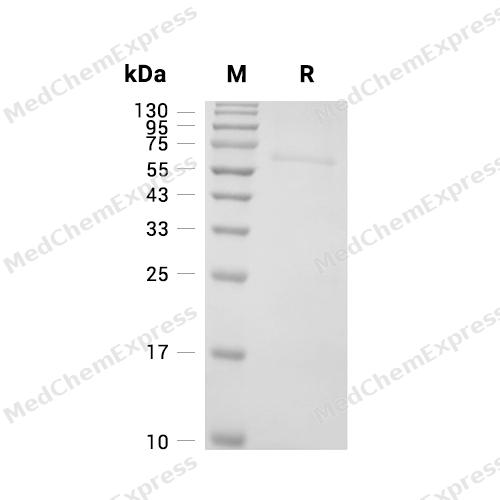
Approximately 56-58 kDa, based on SDS-PAGE under reducing conditions, due to the glycosylation.
-
Glycosylation
Yes
-
Purity
≥ 90%, as determined by reducing SDS-PAGE.


Product Properties
Lyophilized powder
Lyophilized from a 0.2 μm filtered solution of 20 mM MOPS,150 mM NaCl, 0.05% CHAPS, PH7.0. Normally 5 % - 8 % trehalose, mannitol and 0.01% Tween 80 are added as protectants before lyophilization.
<1 EU/μg, determined by LAL method.
It is not recommended to reconstitute to a concentration less than 100 μg/mL in ddH2O.
Stored at -20°C for 2 years from date of receipt. After reconstitution, it is stable at 4°C for 1 week or -20°C for longer (with carrier protein). It is recommended to freeze aliquots at -20°C or -80°C for extended storage.
Room temperature in continental US; may vary elsewhere.


Documentation
-
Data Sheet (267 KB)
-
SDS (252 KB)
- English - EN (252 KB)
- Français - FR (252 KB)
- Deutsch - DE (252 KB)
- Norwegian - NO (252 KB)
- Español - ES (252 KB)
- Swedish - SV (252 KB)
- Italian - IT (252 KB)
- Korean - KR (252 KB)
- Portuguese - PT (252 KB)
-
Handling Instructions (2659 KB)


References
[1]. [1]Liu S, et al. Soluble interleukin-27 receptor alpha is a valuable prognostic biomarker for acute graft-versus-host disease after allogeneic haematopoietic stem cell transplantation. Sci Rep. 2018 Jul 9;8(1):10328. [Content Brief]
[2]. [2]Kourko O, et al. IL-27, IL-30, and IL-35: A Cytokine Triumvirate in Cancer. Front Oncol. 2019 Oct 1;9:969. [Content Brief]
[3]. Fabbi M, et al. Dual Roles of IL-27 in Cancer Biology and Immunotherapy. Mediators Inflamm. 2017;2017:3958069. [Content Brief]
[4]. Pflanz S, et al. IL-27, a heterodimeric cytokine composed of EBI3 and p28 protein, induces proliferation of naive CD4+ T cells. Immunity. 2002 Jun;16(6):779-90. [Content Brief]
[5]. Petes C, et al. IL-27 amplifies cytokine responses to Gram-negative bacterial products and Salmonella typhimurium infection. Sci Rep. 2018 Sep 12;8(1):13704. [Content Brief]
[6]. Xu F, et al. IL-27 regulates the adherence, proliferation, and migration of MSCs and enhances their regulatory effects on Th1 and Th2 subset generations. Immunol Res. 2017 Aug;65(4):903-912. [Content Brief]
[7]. [7]Seita J, et al. Interleukin-27 directly induces differentiation in hematopoietic stem cells. Blood. 2008 Feb 15;111(4):1903-12. [Content Brief]
[8]. Hanson ML, et al. Oral delivery of IL-27 recombinant bacteria attenuates immune colitis in mice. Gastroenterology. 2014 Jan;146(1):210-221.e13. [Content Brief]
[9]. Qi J, et al. IL-27 Regulated CD4+IL-10+ T Cells in Experimental Sjögren Syndrome. Front Immunol. 2020 Aug 11;11:1699. [Content Brief]

Calculators
Concentration (start) × Volume (start) = Concentration (final) × Volume (final)


 Powered by Bioz

