



ITCH/AIP4 Protein, Human

Based on 1 Customer Validation
ITCH/AIP4 protein is an E3 ubiquitin protein ligase that catalyzes the conjugation of “Lys-29”, “Lys-48” and “Lys-63” linked ubiquitin, affecting inflammatory signaling pathways. It forms a ubiquitin editing complex that promotes RIPK1 degradation and terminates TNF- or LPS-mediated NFKB1 activation. ITCH/AIP4 Protein, Human is the recombinant human-derived ITCH/AIP4 protein, expressed by E. coli , with tag free.
- Species: Human
- Source: E. coli
-
Storage:Stored at -20°C for 2 years from date of receipt. After reconstitution, it is stable at 4°C for 1 week or -20°C for longer (with carrier protein). It is recommended to freeze aliquots at -20°C or -80°C for extended storage.


To place orders, for customer services and technical support, please contact: MedChemExpress USA
Tel: 609-228-6898 E-mail: [email protected] [email protected]


-
 Biological Activity
-
Technical Parameters
-
Product Properties
- Documentation
- Help & FAQs




Biological Activity
Description
ITCH/AIP4 protein is an E3 ubiquitin protein ligase that catalyzes the conjugation of “Lys-29”, “Lys-48” and “Lys-63” linked ubiquitin, affecting inflammatory signaling pathways. It forms a ubiquitin editing complex that promotes RIPK1 degradation and terminates TNF- or LPS-mediated NFKB1 activation. ITCH/AIP4 Protein, Human is the recombinant human-derived ITCH/AIP4 protein, expressed by E. coli , with tag free.
Background
ITCH/AIP4 functions as an E3 ubiquitin-protein ligase, orchestrating the transfer of ubiquitin from an E2 ubiquitin-conjugating enzyme to targeted substrates, catalyzing 'Lys-29,' 'Lys-48,' and 'Lys-63'-linked ubiquitin conjugation. It plays a crucial role in the regulation of inflammatory signaling pathways, forming an integral part of a ubiquitin-editing protein complex that modulates the transient nature of inflammatory responses. The complex, including TNFAIP3, TAX1BP1, and RNF11, ensures the termination of TNF- or LPS-mediated activation of NFKB1 by deubiquitinating 'Lys-63' polyubiquitin chains on RIPK1 and catalyzing the formation of 'Lys-48'-polyubiquitin chains. ITCH/AIP4 also ubiquitinates various proteins involved in immune response regulation, transcriptional activity modulation, and cellular antiviral responses. Notably, it participates in the degradation of proteins such as JUN, JUNB, and MAVS, highlighting its diverse roles in cellular processes, including apoptosis, reactive oxygen species regulation, and antiviral defense.
Verified Bioactivity
Measured by its binding ability in a functional ELISA. Immobilized Human ITCH at 2 μg/mL (100 μL/well) can bind Human LDLRAD3 (HY-P77057A). The ED50 for this effect is 1.13 μg/mL.
MCE Validation Data
-
Bioactivity - ELISA
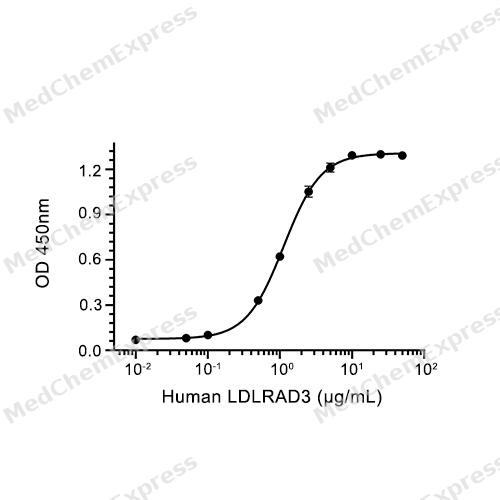
Bioactivity - ELISA


Technical Parameters
-
Species Human
-
Source E. coli
-
Tag Tag Free
-
Accession
Q96J02-2/NP_113671.3 (R485-E862)
-
Molecular Construction
-
N-term
-
ITCH (R485-E862)
Accession # Q96J02-2/NP_113671.3 -
C-term
-
-
Protein Length
Partial
-
Synonyms
ITCH; Itchy E3 Ubiquitin Protein Ligase Homolog; Itchy E3 Ubiquitin Protein Ligase; HECT-Type E3 Ubiquitin Transferase; AIP4; Atrophin-1 Interacting Protein 4; HECT-Type E3 Ubiquitin Transferase Itchy Homolog; Atrophin-1-Interacting Protein 4; E3 Ubiquiti
-
AA Sequence
RDFKAKVQYFRFWCQQLAMPQHIKITVTRKTLFEDSFQQIMSFSPQDLRRRLWVIFPGEEGLDYGGVAREWFFLLSHEVLNPMYCLFEYAGKDNYCLQINPASYINPDHLKYFRFIGRFIAMALFHGKFIDTGFSLPFYKRILNKPVGLKDLESIDPEFYNSLIWVKENNIEECDLEMYFSVDKEILGEIKSHDLKPNGGNILVTEENKEEYIRMVAEWRLSRGVEEQTQAFFEGFNEILPQQYLQYFDAKELEVLLCGMQEIDLNDWQRHAIYRHYARTSKQIMWFWQFVKEIDNEKRMRLLQFVTGTCRLPVGGFADLMGSNGPQKFCIEKVGKENWLPRSHTCFNRLDLPPYKSYEQLKEKLLFAIEETEGFGQE
-
Predicted Molecular Mass
45 kDa
-
Molecular Weight
Approximately 45 kDa, based on SDS-PAGE under reducing conditions.
-
Purity
≥ 95%, as determined by reducing SDS-PAGE.


Product Properties
Lyophilized powder.
Lyophilized from a 0.22 μm filtered solution of PBS, 200 mM L-Arginine, pH 7.4, 8% trehalose.
<1 EU/μg, determined by LAL method.
It is not recommended to reconstitute to a concentration less than 100 μg/mL in ddH2O.
Stored at -20°C for 2 years from date of receipt. After reconstitution, it is stable at 4°C for 1 week or -20°C for longer (with carrier protein). It is recommended to freeze aliquots at -20°C or -80°C for extended storage.
Room temperature in continental US; may vary elsewhere.


Documentation
-
Data Sheet (262 KB)
-
SDS (251 KB)
- English - EN (251 KB)
- Français - FR (251 KB)
- Deutsch - DE (251 KB)
- Norwegian - NO (251 KB)
- Español - ES (251 KB)
- Swedish - SV (251 KB)
- Italian - IT (251 KB)
- Korean - KR (251 KB)
- Portuguese - PT (251 KB)
-
Handling Instructions (2659 KB)

Calculators
Concentration (start) × Volume (start) = Concentration (final) × Volume (final)


 Powered by Bioz

