



LRPAP1 Protein, Mouse (HEK293, His)
Based on 2 publication(s) in Google Scholar
Low density lipoprotein receptor-related protein associated protein 1 interacts with the low density lipoprotein (LDL) receptor-related protein and facilitates its proper folding and localization by preventing the binding of ligands.LRPAP1 Protein, Mouse (HEK293, His) is the recombinant mouse-derived LRPAP1 protein, expressed by HEK293 , with C-6*His labeled tag.
- Species: Mouse
- Source: HEK293
-
Storage:Stored at -20°C for 2 years from date of receipt. After reconstitution, it is stable at 4°C for 1 week or -20°C for longer (with carrier protein). It is recommended to freeze aliquots at -20°C or -80°C for extended storage.


To place orders, for customer services and technical support, please contact: MedChemExpress USA
Tel: 609-228-6898 E-mail: [email protected] [email protected]


-
 Biological Activity
-
Technical Parameters
-
Product Properties
- Documentation
- References
- Help & FAQs




Biological Activity
Description
Low density lipoprotein receptor-related protein associated protein 1 interacts with the low density lipoprotein (LDL) receptor-related protein and facilitates its proper folding and localization by preventing the binding of ligands.LRPAP1 Protein, Mouse (HEK293, His) is the recombinant mouse-derived LRPAP1 protein, expressed by HEK293 , with C-6*His labeled tag.
Background
Low density lipoprotein receptor-related protein associated protein 1 ( LRPAP1) interacts with the low density lipoprotein (LDL) receptor-related protein and facilitates its proper folding and localization by preventing the binding of ligands. LRPAP1 is a widely expressed gene that encodes low density lipoprotein receptor-related protein-associated protein 1, a 357 amino acid protein that is thought to act as a chaperone that binds and protects the lipoprotein receptor-related proteins LRP1 and LRP2[1][2][3][4].
Verified Bioactivity
Immobilized Mouse LRPAP1 at 2 μg/mL (100 μL/well) can bind Biotinylated Mouse VLDLR protein (HY-P78049). The ED50 for this effect is < 0.6 nM.
MCE Validation Data
-
Purity - SDS-PAGE
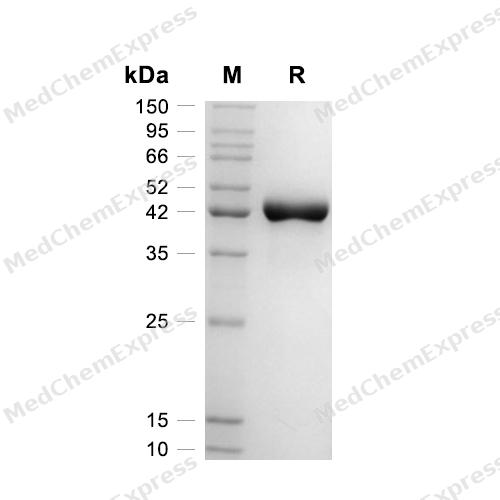
Purity - SDS-PAGE
-
Bioactivity - ELISA
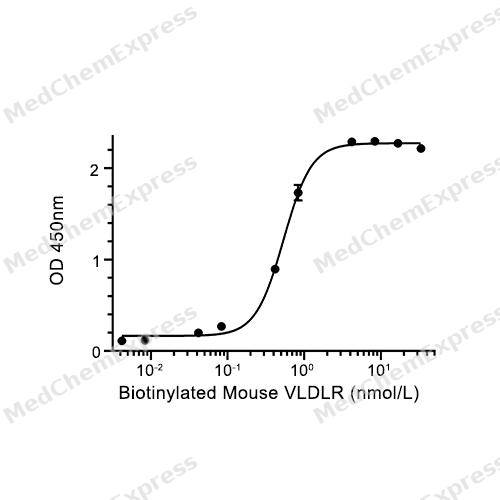
Bioactivity - ELISA


Publications (2)
-
Journal Impact Factor
-
Most Recent
-
Cell
2026 Apr 2;189(7):1923-1941.e26. PMID: 41785850 -
Kidney Dis (Basel)
The Effect of Low-Density Lipoprotein Receptor-Related Protein-1 on Acute Kidney Injury and Renal Tubular Epithelial Triglyceride Accumulation. [Abstract]2025 Apr 14;11(1):320-331. PMID: 40432903


Technical Parameters
-
Species Mouse
-
Source HEK293
-
Tag C-6*His
-
Accession
Q52KI7 (Q29-L360)
-
Gene ID16976
-
Molecular Construction
-
N-term
-
LRPAP1 (Q29-L360)
Accession # Q52KI7 -
6*His
-
C-term
-
-
Protein Length
Full Length of Alpha-2-macroglobulin receptor-associated protein Chain
-
Synonyms
LRPAP1; Low Density Lipoprotein-Related Protein-Associated Protein 1 (Alpha-2-Macroglobulin Receptor-Associated Protein 1); Prev. A2MRAP; Low Density Lipoprotein Receptor-Related Protein-Associated Protein 1; Prev. RAP; 39 KDa Receptor-Associated Protein;
-
AA Sequence
QPIAGHGGKYSREKNEPEMAAKRESGEEFRMEKLNQLWEKAKRLHLSPVRLAELHSDLKIQERDELNWKKLKVEGLDKDGEKEAKLIHNLNVILARYGLDGRKDAQMVHSNALNEDTQDELGDPRLEKLWHKAKTSGKFSSEELDKLWREFLHYKEKIQEYNVLLDTLSRAEEGYENLLSPSDMAHIKSDTLISKHSELKDRLRSINQGLDRLRKVSHQGYGSTTEFEEPRVIDLWDLAQSANFTEKELESFREELKHFEAKIEKHNHYQKQLEISHQKLKHVESIGDPEHISRNKEKYVLLEEKTKELGYKVKKHLQDLSSRVSRARHNEL
-
Predicted Molecular Mass
39.8 kDa
-
Molecular Weight
Approximately 42-45 kDa, based on SDS-PAGE under reducing conditions.
-
Purity
≥ 95%, as determined by reducing SDS-PAGE.


Product Properties
Lyophilized powder
1.Lyophilized from a 0.22 μm filtered solution of 20 mM PB, 150 mM NaCl, pH 7.4.
2.Lyophilized from a 0.22 μm filtered solution of PBS, pH 7.4, 8% trehalose.
Please refer to the lot-specific COA for specific buffer information.
<1 EU/μg, determined by LAL method.
It is not recommended to reconstitute to a concentration less than 100 μg/mL in ddH2O. For long term storage it is recommended to add a carrier protein (0.1% BSA, 5% HSA, 10% FBS or 5% Trehalose).
Stored at -20°C for 2 years from date of receipt. After reconstitution, it is stable at 4°C for 1 week or -20°C for longer (with carrier protein). It is recommended to freeze aliquots at -20°C or -80°C for extended storage.
Room temperature in continental US; may vary elsewhere.


Documentation
-
Data Sheet (264 KB)
-
SDS (252 KB)
- English - EN (252 KB)
- Français - FR (252 KB)
- Deutsch - DE (252 KB)
- Norwegian - NO (252 KB)
- Español - ES (252 KB)
- Swedish - SV (252 KB)
- Italian - IT (252 KB)
- Korean - KR (252 KB)
- Portuguese - PT (252 KB)
-
Handling Instructions (2659 KB)


References
[1]. Aldahmesh MA, et al. Mutations in LRPAP1 are associated with severe myopia in humans. Am J Hum Genet. 2013 Aug 8;93(2):313-20. [Content Brief]
[2]. Wagner MC, et al. Lrpap1 (RAP) Inhibits Proximal Tubule Clathrin Mediated and Clathrin Independent Endocytosis, Ameliorating Renal Aminoglycoside Nephrotoxicity. Kidney360. 2023 May 1;4(5):591-605. [Content Brief]
[3]. Magliyah MS, et al. Rhegmatogenous Retinal Detachment in Nonsyndromic High Myopia Associated with Recessive Mutations in LRPAP1. Ophthalmol Retina. 2020 Jan;4(1):77-83. [Content Brief]
[4]. Thurner L, et al. LRPAP1 is a frequent proliferation-inducing antigen of BCRs of mantle cell lymphomas and can be used for specific therapeutic targeting. Leukemia. 2019 Jan;33(1):148-158. [Content Brief]

Calculators
Concentration (start) × Volume (start) = Concentration (final) × Volume (final)


 Powered by Bioz

