



LRPAP1 Protein, Human (HEK293, C-His)
Based on 2 publication(s) in Google Scholar
The LRPAP1 protein serves as a molecular chaperone for LDL receptor-related proteins and regulates ligand binding throughout the secretory pathway. It transiently interacts with the LRP1/α-2-macroglobulin receptor chain, reducing ligand binding. LRPAP1 Protein, Human (HEK293, C-His) is the recombinant human-derived LRPAP1 protein, expressed by HEK293 , with C-6*His labeled tag.
- Species: Human
- Source: HEK293
-
Storage:Stored at -20°C for 2 years from date of receipt. After reconstitution, it is stable at 4°C for 1 week or -20°C for longer (with carrier protein). It is recommended to freeze aliquots at -20°C or -80°C for extended storage.


To place orders, for customer services and technical support, please contact: MedChemExpress USA
Tel: 609-228-6898 E-mail: [email protected] [email protected]


-
 Biological Activity
-
Technical Parameters
-
Product Properties
- Documentation
- Help & FAQs




Biological Activity
Description
The LRPAP1 protein serves as a molecular chaperone for LDL receptor-related proteins and regulates ligand binding throughout the secretory pathway. It transiently interacts with the LRP1/α-2-macroglobulin receptor chain, reducing ligand binding. LRPAP1 Protein, Human (HEK293, C-His) is the recombinant human-derived LRPAP1 protein, expressed by HEK293 , with C-6*His labeled tag.
Background
LRPAP1 protein serves as a molecular chaperone for LDL receptor-related proteins, contributing to the regulation of their ligand binding activity throughout the secretory pathway. Notably, LRPAP1 engages in transient interactions with the LRP1/alpha-2-macroglobulin receptor heavy and light chains, coinciding with a reduction in ligand binding by the receptor. Additionally, LRPAP1 forms interactions with LRP2/glycoprotein 330, LDLR, and SORL1, with diverse outcomes ranging from internalization and degradation to modulating ligand binding. The intricate network of interactions underscores the multifaceted role of LRPAP1 in orchestrating the function and trafficking of LDL receptor-related proteins.
Verified Bioactivity
Immobilized LRPAP1 at 0.5 μg/mL (100 μL/well) can bind Biotinylated VLDLR protein (HY-P78049). The KD for this effect is < 0.6 nM.
MCE Validation Data
-
Purity - SDS-PAGE
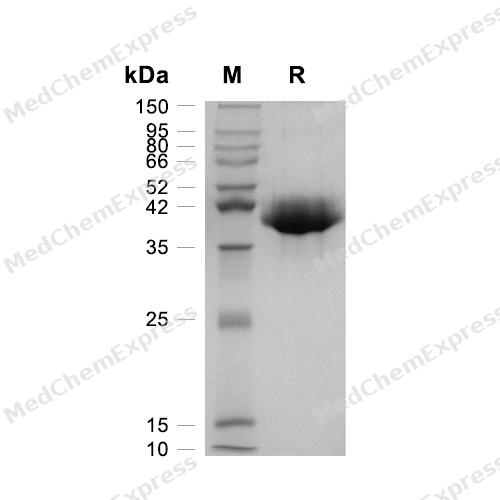
Purity - SDS-PAGE
-
Bioactivity - ELISA
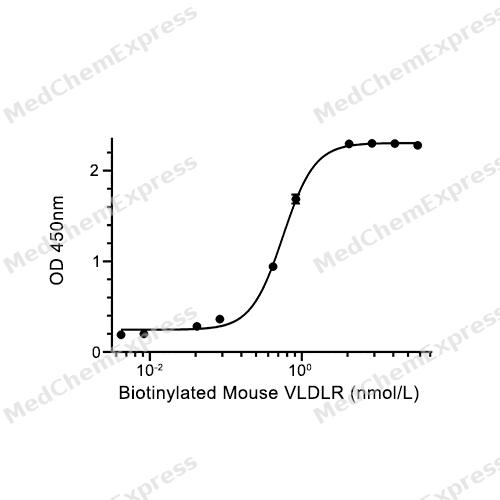
Bioactivity - ELISA


Publications (2)
-
Journal Impact Factor
-
Most Recent
-
Cell
2026 Apr 2;189(7):1923-1941.e26. PMID: 41785850 -


Technical Parameters
-
Species Human
-
Source HEK293
-
Tag C-6*His
-
Accession
P30533 (Y35-L357)
-
Gene ID4043
-
Molecular Construction
-
N-term
-
LRPAP1 (Y35-L357)
Accession # P30533 -
6*His
-
C-term
-
-
Protein Length
Full Length of Mature Protein
-
Synonyms
LRPAP1; Low Density Lipoprotein-Related Protein-Associated Protein 1 (Alpha-2-Macroglobulin Receptor-Associated Protein 1); Prev. A2MRAP; Low Density Lipoprotein Receptor-Related Protein-Associated Protein 1; Prev. RAP; 39 KDa Receptor-Associated Protein;
-
AA Sequence
YSREKNQPKPSPKRESGEEFRMEKLNQLWEKAQRLHLPPVRLAELHADLKIQERDELAWKKLKLDGLDEDGEKEARLIRNLNVILAKYGLDGKKDARQVTSNSLSGTQEDGLDDPRLEKLWHKAKTSGKFSGEELDKLWREFLHHKEKVHEYNVLLETLSRTEEIHENVISPSDLSDIKGSVLHSRHTELKEKLRSINQGLDRLRRVSHQGYSTEAEFEEPRVIDLWDLAQSANLTDKELEAFREELKHFEAKIEKHNHYQKQLEIAHEKLRHAESVGDGERVSRSREKHALLEGRTKELGYTVKKHLQDLSGRISRARHNEL
-
Predicted Molecular Mass
38.6 kDa
-
Molecular Weight
Approximately 37-42 kDa, based on SDS-PAGE under reducing conditions.
-
Glycosylation
Yes
-
Purity
≥ 95%, as determined by reducing SDS-PAGE.


Product Properties
Lyophilized powder
Lyophilized from a 0.22 μm filtered solution of 20 mM PB, 150 mM NaCl, pH 7.4.
<1 EU/μg, determined by LAL method.
It is not recommended to reconstitute to a concentration less than 100 μg/mL in ddH2O. For long term storage it is recommended to add a carrier protein (0.1% BSA, 5% HSA, 10% FBS or 5% Trehalose).
Stored at -20°C for 2 years from date of receipt. After reconstitution, it is stable at 4°C for 1 week or -20°C for longer (with carrier protein). It is recommended to freeze aliquots at -20°C or -80°C for extended storage.
Room temperature in continental US; may vary elsewhere.


Documentation
-
Data Sheet (261 KB)
-
SDS (252 KB)
- English - EN (252 KB)
- Français - FR (252 KB)
- Deutsch - DE (252 KB)
- Norwegian - NO (252 KB)
- Español - ES (252 KB)
- Swedish - SV (252 KB)
- Italian - IT (252 KB)
- Korean - KR (252 KB)
- Portuguese - PT (252 KB)
-
Handling Instructions (2659 KB)

Calculators
Concentration (start) × Volume (start) = Concentration (final) × Volume (final)


 Powered by Bioz

